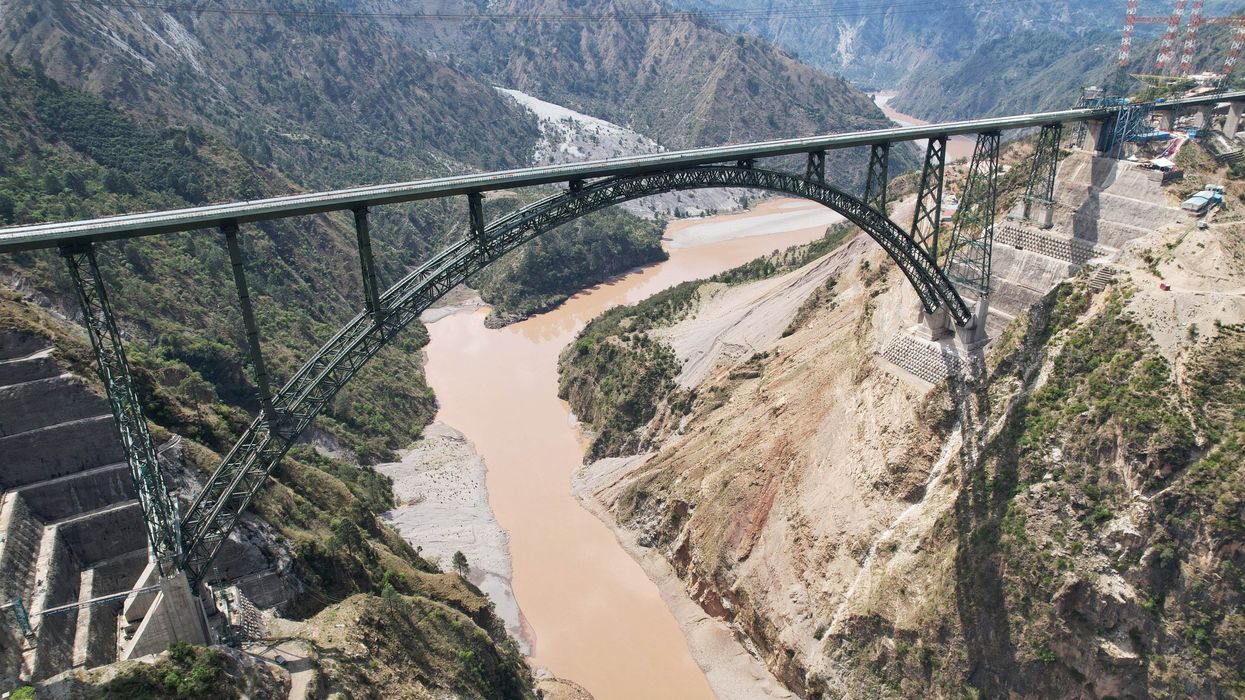

The world's tallest railway bridge is now in India, standing at 359 metres (around 1,180 feet) above the Chenab River in the Jammu and Kashmir region.
At 29 metres (over 95 feet) taller than the Eiffel Tower, the Chenab Bridge is a remarkable feat of engineering.
The construction of the bridge took several decades, but it will finally be open to visitors by the end of December 2023 or January 2024, a press release by the Ministry of Railways in March informed.
According to media reports the Chenab Bridge, stretching 1,315 metres (4,314 feet), is a crucial piece of the Indian government's ambitious plan to connect the Kashmir Valley with the Indian Railway network.
This project, known as the Udhampur-Srinagar-Baramulla Rail Link (USBRL), also includes the construction of the country's longest transportation tunnel and Indian Railways' first-ever cable bridge.
Prime Minister Narendra Modi, who campaigned on a platform of nationalism and a vision of a prosperous India, sees these infrastructure investments as a means to foster social cohesion and exert political influence by linking remote areas with important urban centres.
The Chenab Bridge and the USBRL project, therefore, hold significant strategic value for the Indian government.
Experts believe, the newly established railway link between Kashmir and the rest of India will play a crucial role in boosting the region's industrial and agricultural sectors, as it will offer all-weather rail connectivity between the valley and the rest of the country.
Previously, the only way to connect the Indian-controlled parts of Kashmir with the rest of India was through the Srinagar-Jammu national highway, a winding 300-kilometer (185-mile) road that frequently closes during the winter and is prone to vehicle accidents.
Sushant Singh, a senior fellow at the Centre for Policy Research in India, told CNN that the bridge holds political implications since it is perceived as a way of "integrating Kashmir into India."
Singh believes that historically, the railway link, including the Chenab Bridge, was intended to make Kashmir "feel more as a part of India."
However, despite being established before Prime Minister Narendra Modi came into power, the USBRL project, including the Chenab Bridge, is being presented as a significant achievement of Modi's push for development in India.
India has made substantial investments in upgrading its infrastructure, with a particular focus on transportation. In February, the country's Prime Minister Narendra Modi inaugurated the first phase of a 1,386-kilometre (861-mile) expressway connecting New Delhi with Mumbai, the country's financial capital.
The 246-kilometer (153-mile) section of the expressway alone cost $1.4 billion, according to a government press release.
Additionally, India is working on the Western Dedicated Freight Corridor to ease congestion on the railway network.