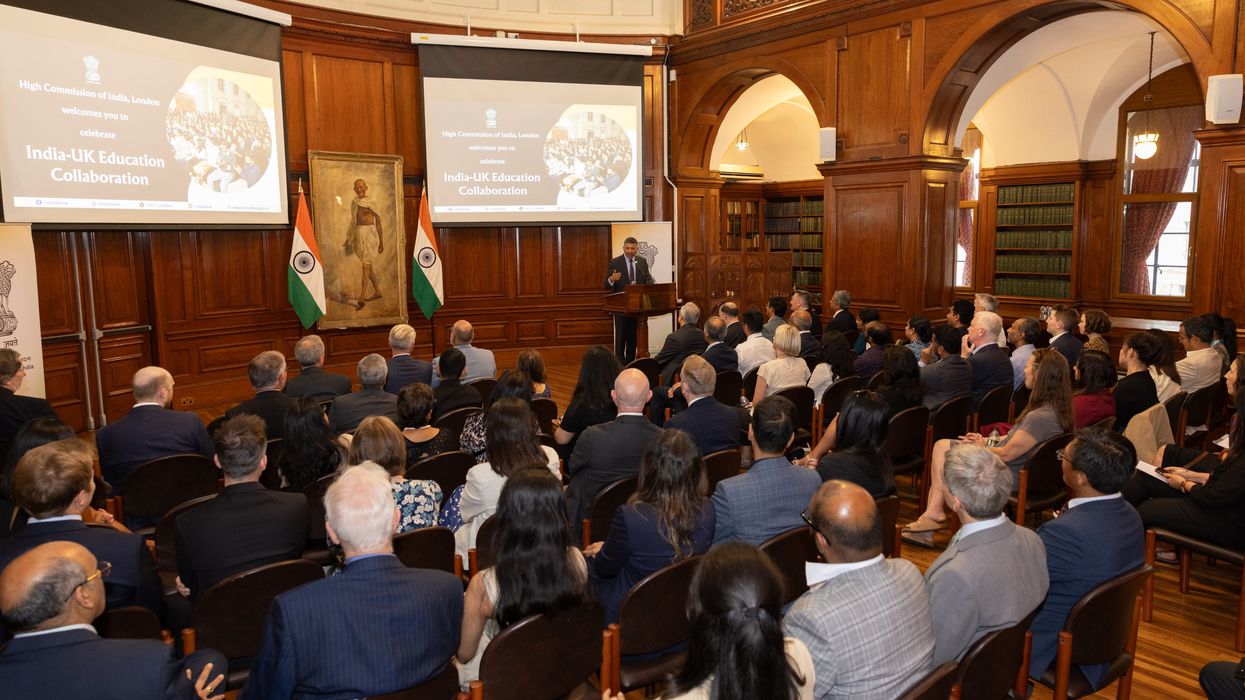

INDIA’S high commissioner to the UK has urged British universities to set up campuses for higher education in the south Asian country.
Vikram Doraiswami also called for further opportunities to expand bilateral exchanges – bringing more UK students to India for short stays, internship, and collaborative learning experiences.
The Indian high commission hosted six UK universities in London to celebrate the expansion of higher education ties under the National Education Policy (NEP) 2020.
The institutions that have signed Letters of Intent (LoI) to establish campuses in India include the University of Southampton; University of Liverpool; University of York; Newcastle University; Coventry University and Queen’s University Belfast.
This week, the University of Southampton will become the first foreign university to officially open its doors in India.
In his remarks at the India-UK education collaboration event at India House in London last Thursday (10), Doraiswami congratulated the six partner universities and invited additional institutions to explore collaboration opportunities; from joint research programmes and dual or joint degree offerings to the creation of innovation campuses, faculty and student exchanges, and the development of completely new campuses.
He said, “There is a long-standing cultural emphasis in India on education as the most valuable investment. Many Indian students already come to the UK, and India now forms the largest cohort of international students here. However, that alone is not enough. We have quality private institutions, and new provisions allow foreign universities to establish campuses, both greenfield and brownfield. I’m proud to say the UK is the first country to seize this opportunity.
“Southampton, York, Queen’s Belfast and others have already registered their intent. This progress has exceeded expectations. The UK’s engagement in India will benefit both countries – not just in terms of education, but also by deepening understanding, research collaboration, and industry links.”
Doraiswami pointed out that these efforts will not only enrich young people’s careers, but also strengthen links between India and the UK.
“Universities in India have reached impossible levels – cut-off marks requiring over 99 per cent averages. We need major investment coming into the university sector. India now has significant private capital ready to build facilities at scale, but what we can’t do is build capacity at scale,” the high commissioner said.
He added, “We think the UK is the obvious partner to help build out at scale - not just new university campuses, but partnerships across the board: department-based partnerships, research partnerships, joint degree partnerships, faculty exchanges.”
Professor Mark E Smith, president and vice-chancellor, University of Southampton, said, “Two years ago, this idea (setting up an Indian campus) was just a conversation. Now, we are preparing to inaugurate our new campus in the Delhi Capital Region. I want to thank the high commissioner and his team for their exceptional support.
“Southampton’s engagement with India predates this campus. Our India Centre, for instance, has already marked its fifth anniversary. We also recently welcomed Professor Prakash, who holds the ICCR chair of Indian Studies at Southampton, supported by the ministry of external affairs and the high commission.”
He added, “The new Gurugram campus aims to deliver world-class education in one of India’s most dynamic business hubs. Our presence there supports India’s aspirations to become a global education hub, and our programmes are aligned with industry needs to equip students with practical skills and opportunities.”
Professor Andrew Atherton, vice-president (International Engagement) at the University of Southampton, said India’s scale, ambition, entrepreneurial energy and supportive regulations made it the clear choice for expansion. He cited high demand, with India needing a new university every three months until 2030 to meet projected needs.
Southampton’s Gurugram campus will launch with four undergraduate and two postgraduate programmes. Even before school results, it received 800 applications, issued 400 offers, and secured 200 acceptances. Atherton described how Southampton has partnered with industry leaders Deloitte and Investec to ensure students receive real-world training. The 80,000 sqft facility mirrors the standards of their UK campus to provide an identical academic environment.
The university targets to expand from 140 students in year one to over 5,500 by 2035 – and likely beyond that. The event was attended by representatives from other universities, the British School, the UK Department for Education, and the NHS.