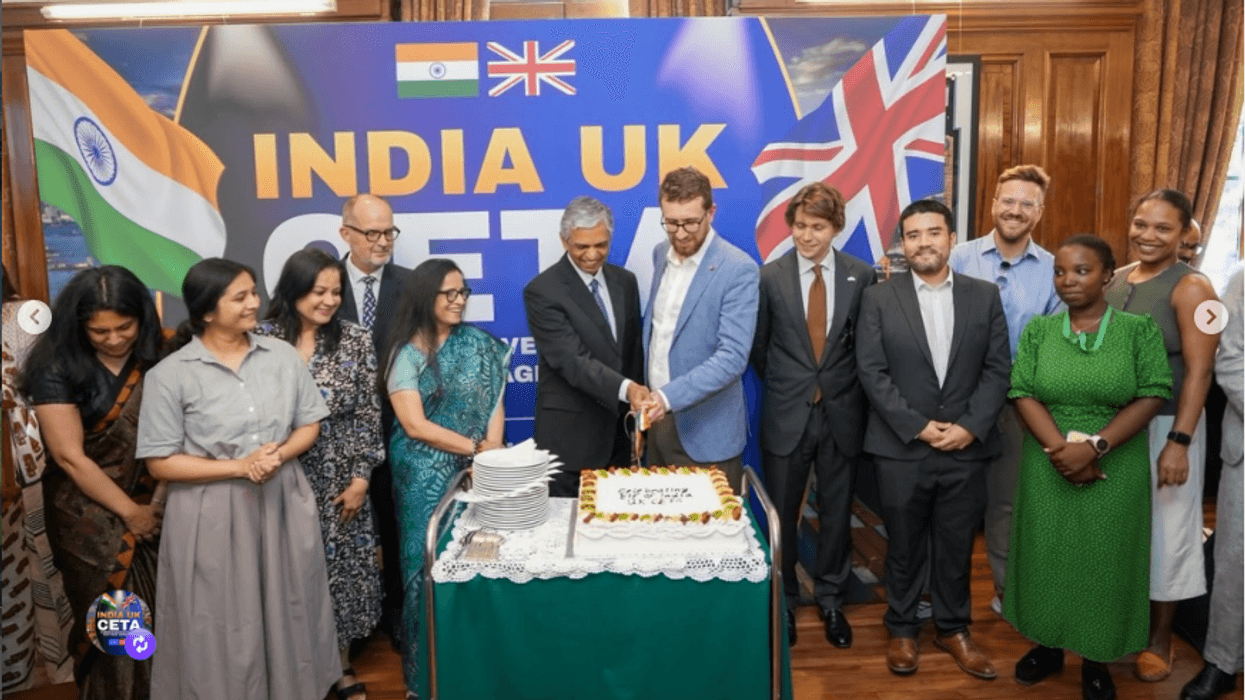

INDIA’S high commissioner to Britain, Periasamy Kumaran, cut a cake at India House last Wednesday (15) to celebrate the India-UK Free Trade Agreement finally coming into force after more than a decade of negotiations.
A portrait of Jawaharlal Nehru, independent India’s first prime minister, surveyed an array of Indian goods that can now be exported to the UK either tax free or at greatly reduced rates of taxation.
The high commissioner also opened a small box containing jewellery that had arrived overnight from India free of tax.
Gems and jewellery make up one sector where Indian traders expect to do well in the UK market in the years to come. But the jewellery looked very traditional and will probably appeal only to British Asians, particularly for weddings.
People will not have to go to India to do their shopping.
Other items will have wider appeal – textiles, for example. On display were a packet of classic Darjeeling black tea, a bottle of Jaisalmer Indian Craft Gin, another of Samsara Contemporary Indian Gin, and coffee from India.
The governments officially refer to the FTA as the Comprehensive Economic and Trade Agreement (CETA).
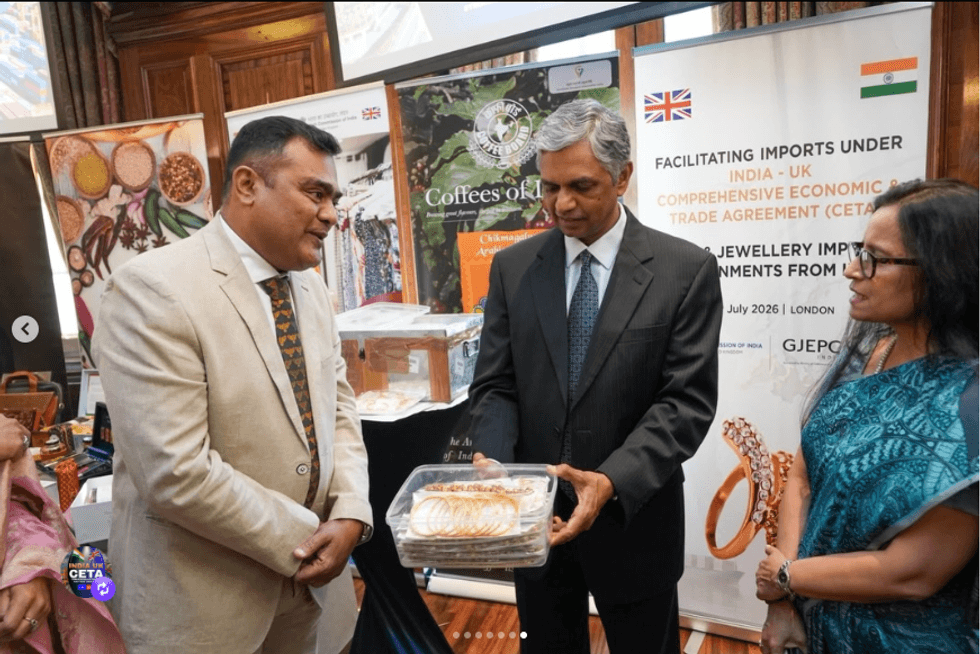 Tax-free jewellery shipped to BritainIndian High Commission
The high commissioner addressed a gathering of British and Indian businessmen: “This is a major economic milestone for both India and the UK, and a powerful statement of intent about the future of one of the world’s most important economic partnerships.
“This agreement is firmly focused on the future. It is defined by confidence, mutual respect and shared ambition, and, above all, it is focused on growth, on enabling the free flow of goods and services in both directions, strengthening investment links, making it easier for companies to create jobs in each other’s economies, and demonstrating that our greatest successes will be those that we build together.”
He added: “The evidence is already compelling. Bilateral trade in goods and services now stands at nearly £48 billion. The long-held aspiration of doubling UK India trade by 2030 once appeared rather ambitious, but today, with CETA in force, it is a goal that appears firmly within reach.
“The investment relationship is equally distinctive. Investments flow strongly in both directions. India is investing in the UK, while British companies continue to expand their presence in India. Few major bilateral relationships can demonstrate such balanced two-way confidence.”
Data from the UK’s Department for Business and Trade shows that, for inward investment in 2025-26, India emerged as the second-largest source of FDI into the UK after the United States, with 93 investment projects creating nearly 12,700 new jobs, the high commissioner said.
Kumaran added: “These companies are not simply investing in Britain; they are creating employment, paying taxes, strengthening supply chains, and contributing to Britain’s future. That is what a modern partnership looks like – the world’s fifth and sixth largest economies working together towards shared goals.”
 Assam teaIndian High Commission
It is fair to say most people in Britain are unaware that India is now the world’s fifth largest economy, having overtaken the UK. Of course, when it comes to per capita income, India has a long way to go before it catches up with the West.
The frustration for successive high commissioners has been that most people in Britain appear unaware of the extent to which the UK economy is being propped up by investment from India. This is the problem that Kumaran, like his predecessor Vikram Doraiswami, will have to counter.
Kumaran described the tangible importance of trade, saying: “We have with us today importers from India’s gems and jewellery sector, whose first consignment, benefiting from zero duty under CETA, arrived today by air cargo.
“Multiple consignments worth millions of dollars have sailed from the ports of India to leverage the benefits of CETA, including labour-intensive goods such as textiles, leather, electronic goods, and chemicals. Similarly, I can also sense the excitement among British automobile, food and drink, and Scotch whisky exporters. This is more than just one shipment or a set of shipments. It represents the beginning of a new era of opportunity for businesses on both sides.
“It shows how an agreement negotiated between governments can translate into real opportunities for companies, consumers, and communities. This morning, I also had the privilege of visiting DP World’s London Gateway Port, where a vessel from India had just arrived. It was a fitting symbol for today’s occasion.”
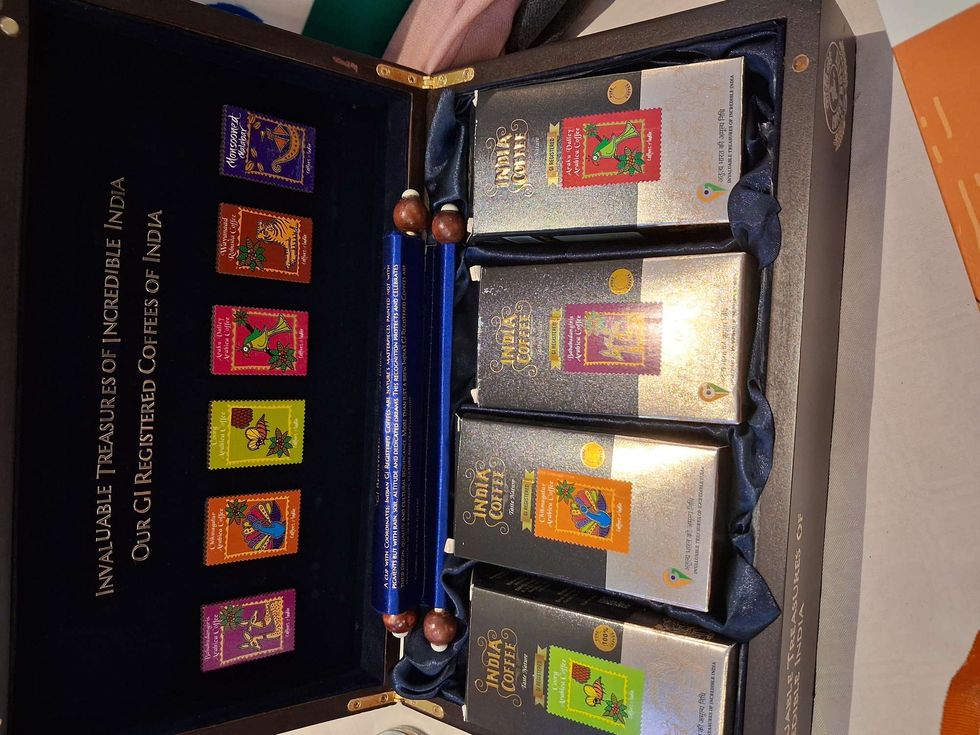 Indian coffeeIndian High Commission
He added: “Trade is about movement, not only of ships and goods, but also of ideas, investment, and people. But the significance of this agreement cannot be measured by trade and investment outcomes alone. Its real promise lies in co-development, co-innovation, and a deeper, long-term strategic partnership.
“India and the UK share a natural partnership in financial services. The UK remains one of the world’s foremost global financial centres, while India is among the fastest-growing major economies, with deepening capital markets, a rapidly expanding digital economy, and an ambitious programme of financial sector reform. The opportunities for collaboration have now been created.
“Mechanisms, including the India-UK economic and financial dialogue, are deepening cooperation in financial services, fintech, and the digital economy. The numbers speak for themselves. India today records around 660 million digital transactions every day, more than the combined populations of the United Kingdom, France, Germany, and Australia. It has laid more than 4.2 million kilometres of optical fibre, enough to circle the Earth 105 times, and completed more than 177 billion biometric authentications.
“India has also committed to achieving 500 gigawatts of non-fossil fuel energy capacity by 2030, creating immense opportunities in renewable energy, green hydrogen, battery storage, and climate finance. The opportunity before us is not simply to sell into each other’s markets, but to build together cleaner energy systems, better infrastructure, stronger digital networks, and the industries of the future.”
 Samsara gin showcased at the event Indian High Commission
He said: “Talent has always been one of the strongest bridges between India and the UK. Our diaspora, our students, our entrepreneurs, our scientists, and our professionals have connected our societies in ways that no treaty alone could achieve. CETA now provides that human connection with a stronger economic foundation. But it must be understood that economic agreements are not destinations; they are foundations for the future. Their true value lies not only in the text that is signed, but in the opportunities they unlock, the confidence they inspire, and the prosperity they create.
“The India-UK Comprehensive Economic and Trade Agreement marks the beginning of a new phase in our partnership. Rabindranath Tagore wrote, ‘Faith is the bird that feels the light and sings when the dawn is still dark.’ Today, that light is clearly on the horizon as the India-UK CETA enters into force. Both our countries have every reason to look ahead with confidence.”
On pressing a button, he appeared in a video where his message was: “Today marks a historic milestone in the India-UK partnership as the Comprehensive Economic and Trade Agreement enters into force to help businesses and stakeholders make the most of the opportunities it creates. I’m delighted to launch today the India-UK CETA Facilitation Forum on the LinkedIn platform.”