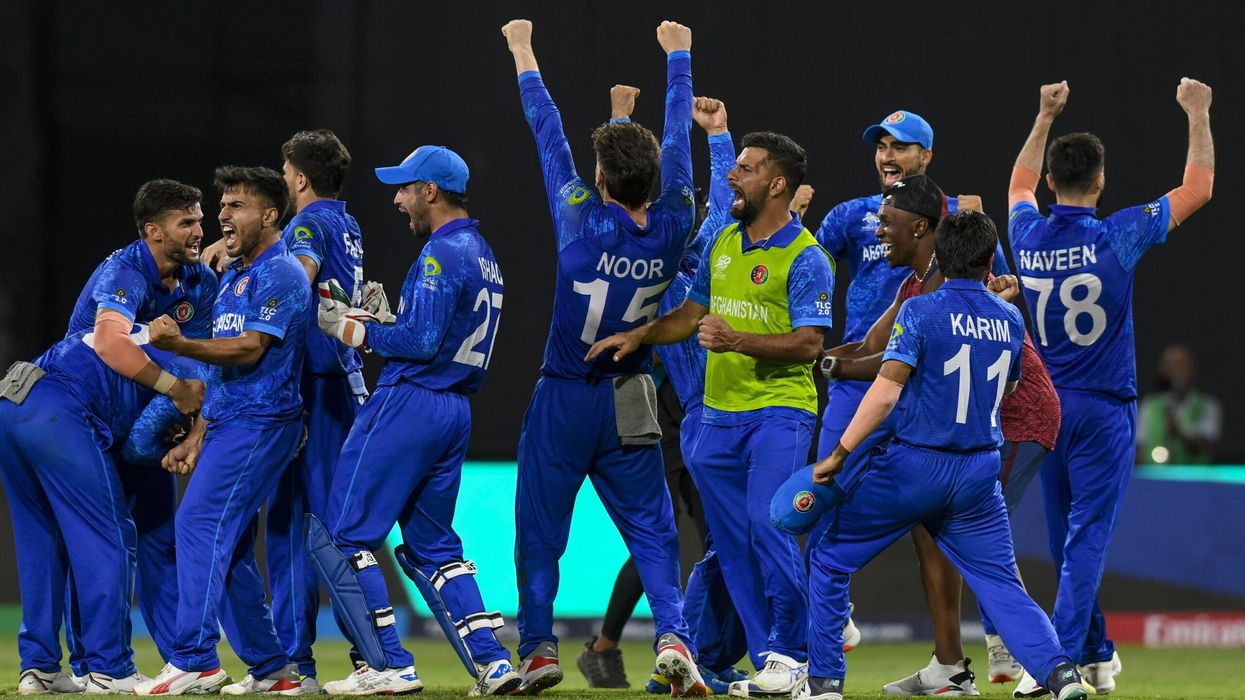

Afghanistan advanced to the semi-finals of the T20 World Cup with an eight-run victory over Bangladesh under the Duckworth Lewis System in St Vincent on Monday.
This win secured their place in the semi-finals alongside India from Group 1, and eliminated Australia from the tournament.
Bangladesh had the opportunity to progress or help Australia advance with a victory, but Afghanistan dismissed them for 105, securing the win needed to set up a semi-final match against South Africa in Trinidad on Wednesday.
India, who defeated Australia by 24 runs earlier in St Lucia, will face title holders England in the second semi-final in Guyana on Thursday.
Afghanistan's hopes seemed slim when they were restricted to 115-5, but skipper Rashid Khan took 4-23 and Naveen-ul-Haq 4-26 in a strong bowling performance that secured the win.
The last few overs were intense, with Bangladesh needing roughly a run per ball and the DLS calculations changing with every wicket and boundary. Naveen sealed the victory in the penultimate over by bowling Taskin Ahmed and trapping Mustafizur Rahman in front with consecutive balls, leading to emotional celebrations from his teammates.
"It's unbelievable, I don't have any words to describe my feelings," said Rashid. "Definitely back home. Everyone is so, so happy for this big achievement for us being in the semi-final. We have to push ourselves for the people back home, for their happiness, to make the country proud. So that was the discussion we had and everyone did a wonderful job."
In the 12th over, Gulbadin Naib collapsed just after his coach Jonathan Trott had indicated to his players to slow down and wait for a rain shower to intensify and stop play. Rashid later explained that Gulbadin had been suffering from cramp. Gulbadin returned to claim the eighth Bangladesh wicket, dismissing Tanzim Hasan Sakib with a top edge to cover.
Despite their hopes diminishing after the rain interruption in the 12th over, which reduced the match by one over and their target to 114, Bangladesh remained in contention while Litton Das was at the crease. Das scored 54 not out off 49 balls with five fours and a six but ultimately ran out of partners.
"I think we bowled really well as a bowling unit, we did a lot of good things," said Bangladesh captain Najmul Hossain Shanto. "But as a batting group, we made a lot of poor decisions, especially in the middle overs, so that cost us today."
Rashid revived Afghan hopes by dismantling the middle order after Bangladesh reached the end of the powerplay at 46-3. He also boosted Afghanistan's batting, hitting three sixes in a 10-ball 19. Rashid showed his frustration when he hurled his bat down the wicket at Karim Janat for refusing a second run in the final over.
Rashid had won the toss and elected to bat first. Openers Rahmanullah Gurbaz (43) and Ibrahim Zadran (18) laid a strong foundation with a fourth half-century partnership of the tournament. However, the innings collapsed from 84-1 to 93-5 in 11 balls before Rashid's late boost.
Leg spinner Rishad Hossain (3-26) did the most damage, with Bangladeshi bowlers delivering 66 dot balls over the innings.
(With inputs from Reuters)