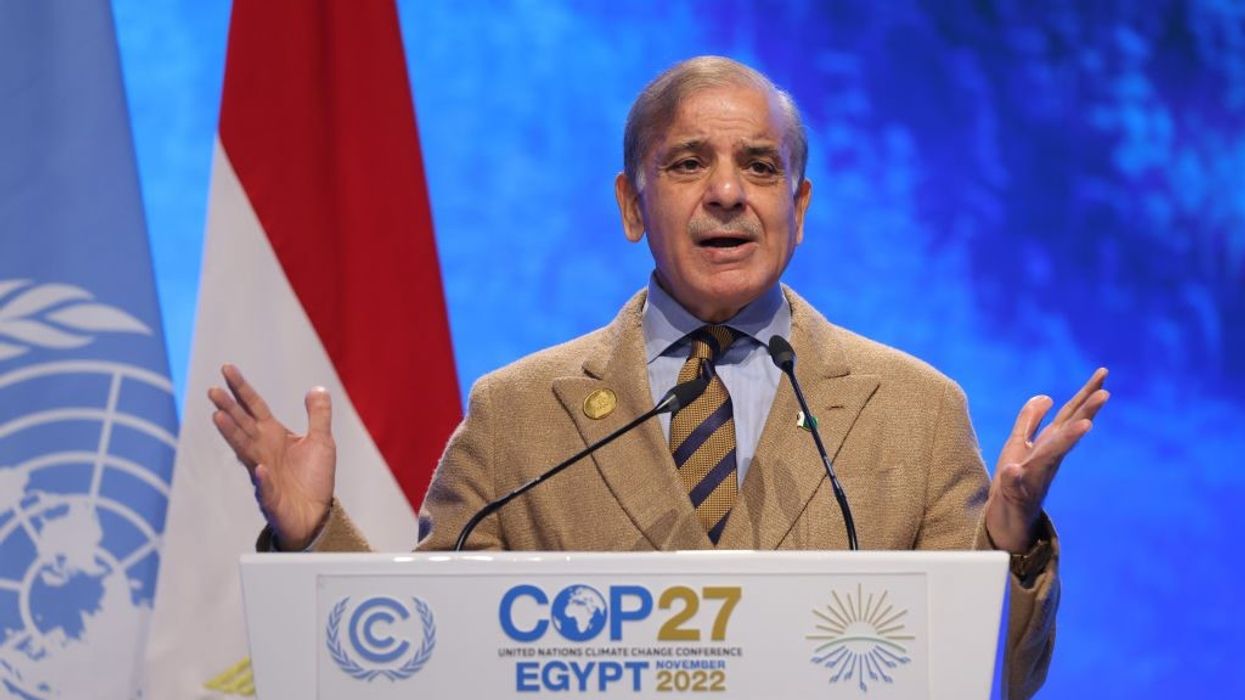

PAKISTAN prime minister Shehbaz Sharif offered talks with India to address all serious and outstanding issues as he said 'war is not an option' for both countries as they fight poverty and unemployment.
Sharif made the remarks while addressing the inaugural session of the Pakistan minerals summit. The meeting, organised under the slogan of ‘Dust to Development’, aimed at bringing foreign investment to the cash-strapped country.
“We are prepared to talk with everyone, even with our neighbour, provided that the neighbour is serious to talk serious matters on the table because war is no more an option,” the prime minister said, in an apparent reference to India.
Sharif’s comments came amid continued strain in ties between India and Pakistan on a number of issues including Islamabad’s continued support to cross-border terrorism and the Kashmir issue.
India has also asserted that Jammu and Kashmir “was, is and will” always be part of the country.
Sharif’s coalition government is getting ready to face an election at the completion of the five-year term of Parliament on August 12.
It is expected that the National Assembly, the lower house, will be dissolved a few days before the end of the term to provide more time for the next elections.
The prime minister talked about the history of wars between Pakistan and India.
The wars in his opinion resulted in an increase in poverty, unemployment, and lack of resources to finance education, health, and well-being of the people.
He said Pakistan’s nuclear capability was for defensive purposes and not for aggression.
“Because if there is any nuclear flashpoint, who will live to tell what happened? So (war) is not an option,” he said.
Sharif emphasised that Pakistan was well aware of the dark side of a nuclear conflict but India should also realise it.
He also said that relations would not become normal until the “abnormalities” were removed by addressing the unresolved issues.
“It is equally important that our neighbour has to understand that we cannot become normal neighbours unless abnormalities are removed and unless our serious issues are understood and addressed through peaceful and meaningful discussions,” he said.
Recently, India's external affairs minister S Jaishankar said that it is not possible for India to have normal relations with the neighbouring country until the policy of cross-border terrorism is abrogated.
“We can’t allow terrorism to be normalised; we can not allow that to become the basis for getting us into discussions with Pakistan. To me it is a fairly common sense proposition,” he said in June.
Chief of army staff General Asim Munir also attended the summit along with several national and foreign dignitaries.
(PTI)