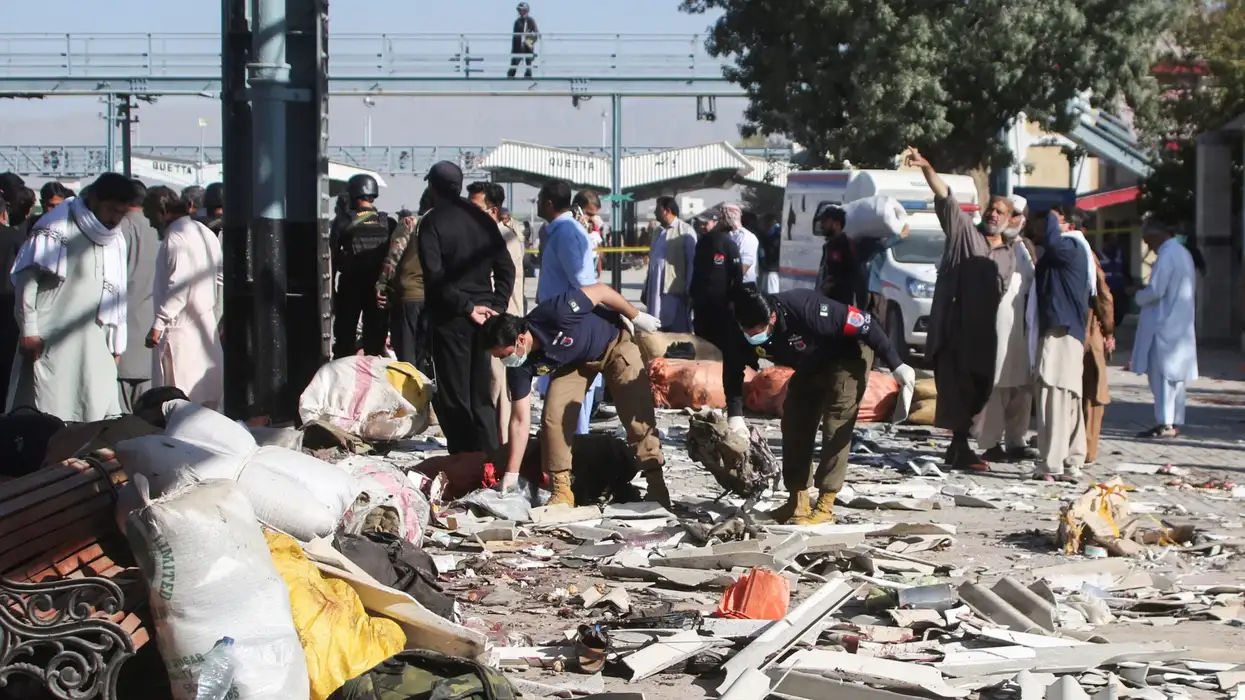

A BOMBING claimed by Pakistani separatists killed 26 people including 14 soldiers at a railway station in the southwestern Balochistan province, a hospital spokesman said Saturday (9).
The blast hit as passengers waited on a platform at the main railway station in the provincial capital Quetta.
"Fourteen members of the army and 12 civilians were killed," said Wasim Baig, spokesman for Quetta's Sandeman Provincial Hospital, raising an earlier toll of 25 provided by police.
Forty-six members of the security forces and 14 civilians were wounded, the spokesman added.
An AFP journalist saw pools of blood and ripped backpacks at the scene, where a large metal sheet protecting passengers from the elements had been blown off.
Mohammed Oumer, one of the casualties, said he went to the station to get a train home to his village.
"But just as we arrived, there was the explosion and I found myself wounded and in hospital," he said.
Rescue workers stand amid the bodies at a hospital morgue after a bomb blast at a railway station in Quetta, Pakistan November 9, 2024. REUTERS/Naseer AhmedDespite frequent attacks in Balochistan the toll of Saturday's blast was particularly high for the southwestern province, which borders Afghanistan and Iran.
The train station explosion hit at around 8:45 am (0345 GMT) and was claimed by the Baloch Liberation Army (BLA), one of the area's main separatist groups.
The attack "was carried out on a Pakistani army unit at Quetta railway station... after completing a course at the Infantry School," the BLA said in a statement.
The Associated Press of Pakistan, the official news agency, cited railway officials as saying the blast happened near the ticket booth when two trains were scheduled to depart.
Prime minister Shehbaz Sharif said the attackers "will pay a heavy price", according to a statement from his office.
The BLA frequently claims deadly attacks against security forces or Pakistanis from other provinces, notably Punjabis.
At Quetta station, police said they were working to determine the cause of the blast.
"When we reached here, initially it appeared that some explosive had perhaps been hidden or left in the luggage. But now we think it may be a suicide bomber," Muhammad Baloch, a senior local police official, told journalists.
Firefighters, rescuers and passengers were working through abandoned luggage on the platform, guarded by heavily armed members of the security forces.
At the hospital, Mohammed Irfan had to identify two of his relatives killed in the bombing.
"As we woke up we found out there was an explosion," he said.
"Then we discovered that my uncle and another relative had gone to have tea at the station."
Militants have in the past targeted energy projects with foreign financing -- most notably from China -- accusing outsiders of exploiting the resource-rich region while excluding residents in the poorest part of Pakistan.
In August, the BLA claimed responsibility for coordinated attacks by dozens of assailants who killed at least 39 people, one of the highest tolls to hit the region.
(Agencies)





Netanyahu faces backlash for calling Britain ‘Islamic Republic’