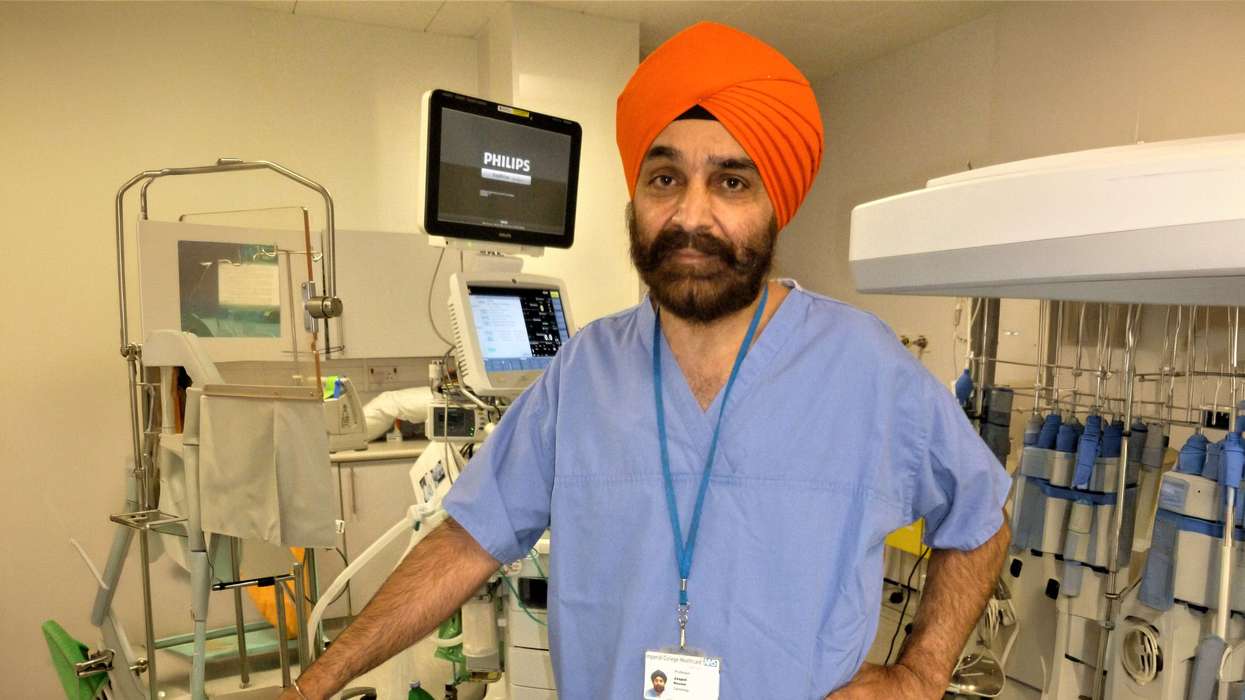

From one year to the next, the health message to British Asians from Prof Jaspal Kooner, one of the most experienced cardiologists in the UK, remains the same – “the odd jalebi at Diwali is ok but go easy on the mithai”.
Kooner is the founder director of the South Asia Biobank which is trying to discover the holy grail of medical science – even if Asians lead an exemplary healthy life with gym sessions and marathon runs – they are still susceptible to cardiovascular disease and diabetes.
If he can get the answer, it would affect the lives of a quarter of the world’s population.
Kooner said: “The facts are that people of South Asian descent, whether they come from India or Pakistan or Bangladesh or Sri Lanka, have almost a two-fold higher risk of heart disease than Europeans. And the same population has a three-fold higher risk of diabetes than Europeans.”
“So the obvious question is, why?” he went on. “We’ve put together a project study called a South Asia biobank, which now has nearly 100,000 South Asians in this country of Indian, Pakistani, Bangladeshi and Sri Lankan descent. And we assembled baseline data when we enrolled them into the study.”
He continued: “We follow their health over a period of years to see which of the people develop heart disease and diabetes and who don’t. Of course, there are multiple risk factors which are causing these diseases. And because you are looking at the events as they are rising, and you’re able to compare that with what the risk factors were at baseline and how they’re evolving, you can get much closer to establishing a cause and effect relationship.”
He explained: “When the missing link is discovered, there will be hopefully new treatments. So lifestyle changes are important, but the key thing is to maintain what we call optimal control of these risk factors. What we need to do, as a matter of principle, is to say, ‘We are Asian, and we are twice or three times the risk as Europeans.’
“That means that we can’t get away with just normal blood pressure, normal sugar, normal cholesterol, normal this, normal that. We need to drive these risk factors into a much, much lower range so their effects are minimised.”
Details of the Biobank are now on a website, with Asians, who want to help with the research, invited to join the mega project.
It is stated that “much progress in medical science has been made in the past five decades but this has not provided answers to why people of South Asian origin remain at such high risk of cardiovascular disease, diabetes, and other critical illnesses compared to other populations.
“To date, most large-scale studies have largely recruited people of European ancestry. This lack of diversity in research hinders our understanding of reasons why South Asian populations are more susceptible to certain illnesses.
“South Asia Biobank is a major world-wide resource for medical researchers to help understand and prevent major diseases amongst people of South Asian ancestry. The more information we can arm ourselves with about serious conditions like heart disease, diabetes and obesity, the more chance we have of preventing disease, finding new treatments and even cures.
“Our research vision is to understand why people of South Asian origin are at high risk of coronary heart disease (CHD), type 2 diabetes, and related illnesses.
“South Asians number 1.8 billion individuals and are a quarter of the global population. In the UK, South Asians comprise the largest minority population. The approximate 2-fold higher risk of CHD, and 3-fold higher risk of diabetes, among South Asians compared to Europeans cannot be fully explained by lifestyle, environmental, biological or known genetic factors. This knowledge gap is the single most important obstacle in reversing the epidemic of these major diseases among South Asians and constitutes a major health inequality.
“Our research is designed to address this knowledge gap by exploring novel biological pathways underlying incident CHD, diabetes, and related disorders in South Asians which will be identified by integrating multiple sources of data (genome sequencing, proteome and metabolome) and will capture the interplay of genetic predisposition and the biological imprints of environmental and lifestyle exposures (i.e. the internal exposome). If you are interested in joining our team, have any questions, or would like to find out more about the South Asia Biobank, we encourage you to reach out to us.”
Kooner was born in Kenya, came to Britain aged 12 in 1968, went into medicine, and was named “Doctor of the Year” across the NHS in 2004. He is professor of clinical cardiology at Imperial College London. He practises at a number of venues, including Hammersmith Hospital. His expertise is “coronary angioplasty and stenting, ischaemic heart disease, general adult cardiology, and hypertension”.
He strongly advocates Asians confront the nine basic factors underlying 90 per cent of heart attacks.
He spelt them out: “If you control them or eliminate their contribution then you can potentially stop the epidemic of coronary heart disease. These risk factors are cholesterol, blood pressure, diabetes, smoking, physical inactivity, weight; the fruit and vegetable intake is important; reducing alcohol intake is important; stress is important.
“Salt is very closely linked with blood pressure and a normal healthy intake of salt should only be about three to four grams. A majority of people eating bread and cereals will not know the high salt content of these foods.
“The healthy diet should probably consist of good protein, like fish or chicken – sometimes a small amount of meat is also fine. It should contain large amounts of vegetables and green salads. And if you need to use sugars you are better off using the naturally occurring sugars in fruits.”
On physical exercise, “ideally the recommended guidelines are that you should exercise for forty minutes to an hour a day, and that it should be done at a moderate pace and the exercise should be enough to make you breathless. These exercises can include walking, jogging, cycling, swimming, gym based exercises. Asian women are the most sedentary, followed by Asian men, then European women and European men. Physical exercise carried out consistently can lower your risk by 30 to 40 per cent.”
Mithai contains large amounts of fat and the sugar, too, gets stored as fat. “It’s a combination of bread, roti, rice, pasta, potatoes, chocolates, biscuits, cakes, pastries and the like. They will essentially get converted into glucose and then be stored as fat.”
For many years, he has restricted himself to one roti for dinner. And, no, he doesn’t put ghee on it.