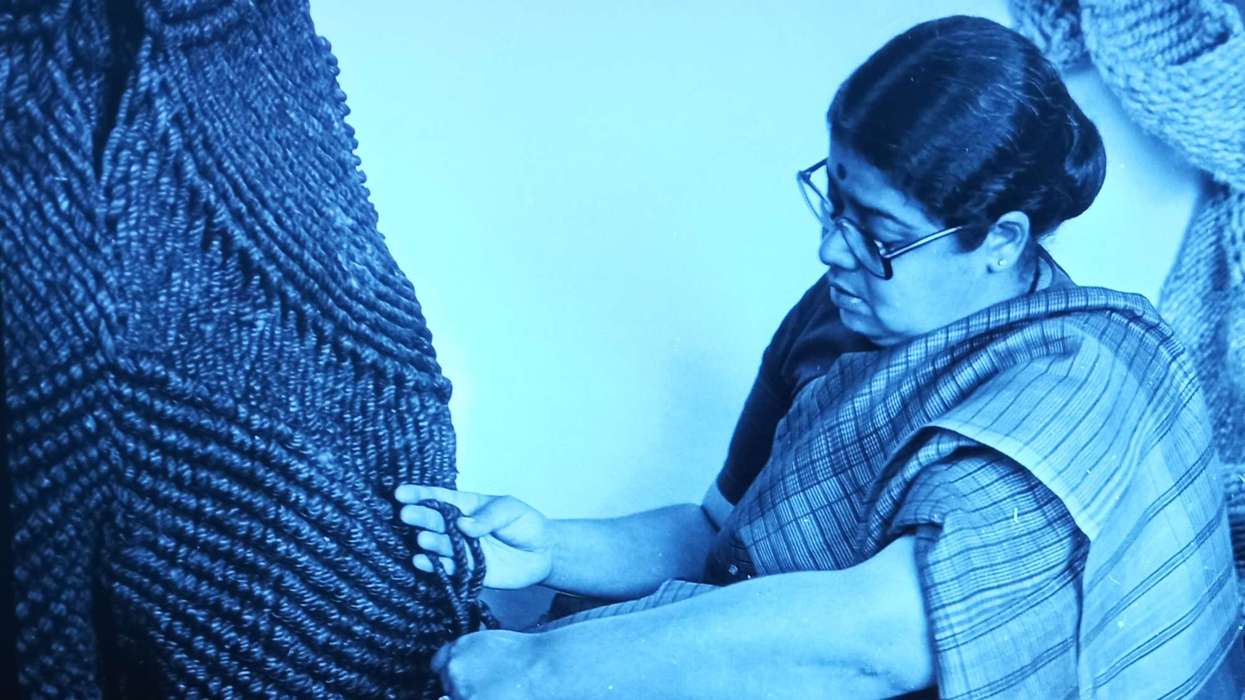

MRINALINI MUKHERJEE, one of India’s best known modern sculptors, was born in 1949 and died in 2015. But she has left behind unique sculptures made from hemp.
When she became an artist, her parents, Benod Behari Mukherjee and Leela Mukherjee, didn’t tell their daughter to get a proper job because they were distinguished artists themselves, having studied at Santiniketan in West Bengal. Here, they absorbed Rabindranath Tagore’s love of the arts and passed it on to their daughter. The exhibitions that the Royal Academy in London and the Hepworth Wakefield have collaborated on reflect the rich artistic traditions of Bengal.
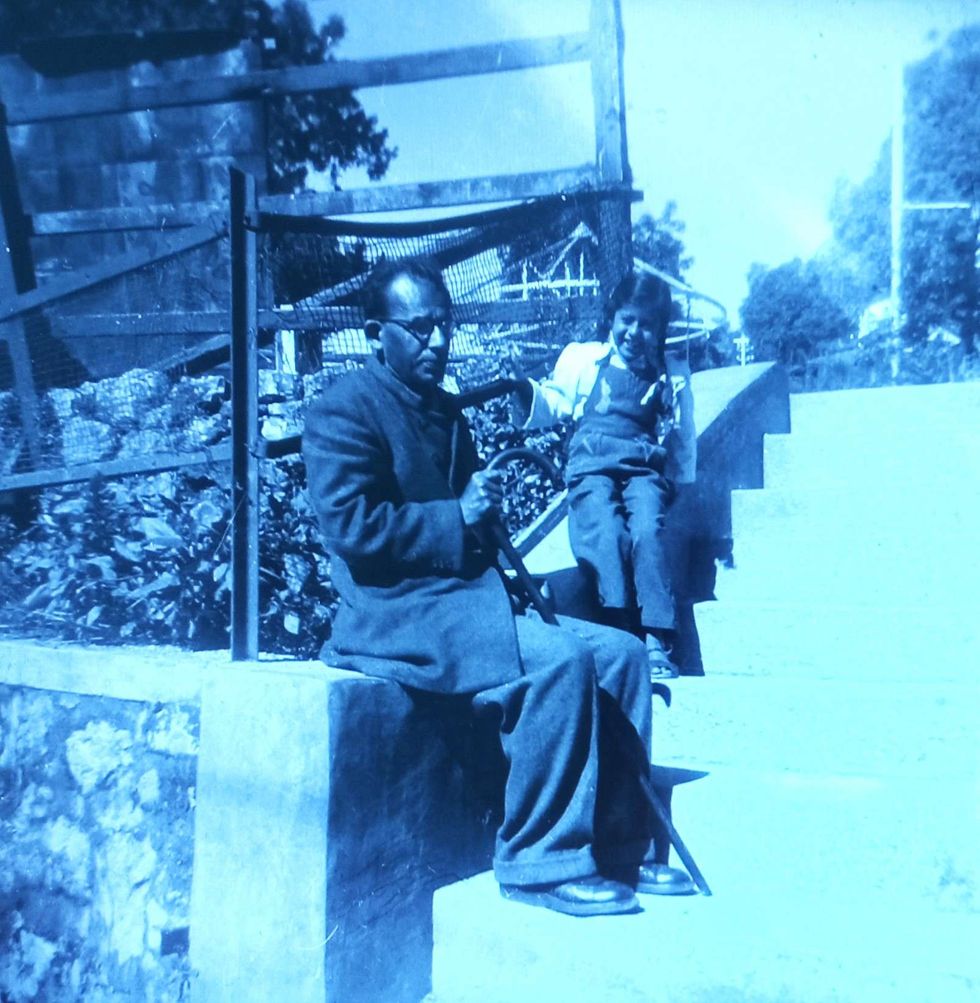 With her father Benod Behari in Dehradun in 1954.
Those who missed Mrinalini’s work at the Royal Academy, where the exhibition ran from October 31, 2025 to February 24, 2026, can see her sculptures at Hepworth Wakefield, though that will involve a two-and-a-half-hour journey from London. An added incentive is that West Yorkshire is stunningly beautiful.
There has always been a rich arts tradition in Bengal which cuts across religious lines. Of course, East Bengal became East Pakistan in 1947 and Bangladesh in 1972.
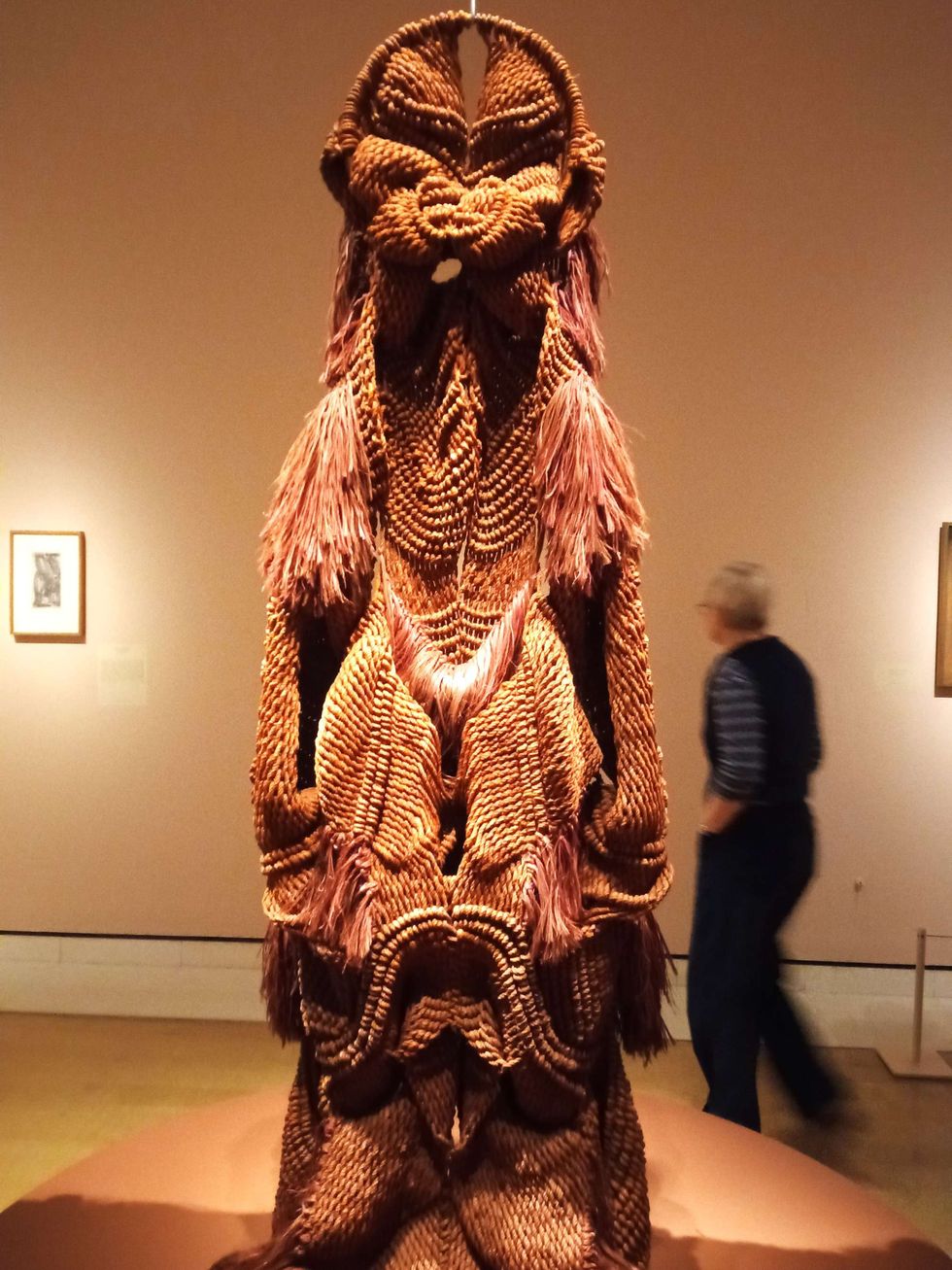 Ritu Raja (1977) from hemp and steel.
The exhibition at the Royal Academy, one of the most spectacular from the British Asian point of view, was called A Story of South Asian Art: Mrinalini Mukherjee and Her Circle. The 100 works also included art by her parents and also those of her mentors and close friends, including KG Subramanyan, Nilima Sheikh and Gulammohammed Sheikh.
There were three galleries which centred on a location pivotal to Mrinalini’s development – Santiniketan, Baroda (Vadodara), and New Delhi – and to the broader cultural avant-garde.
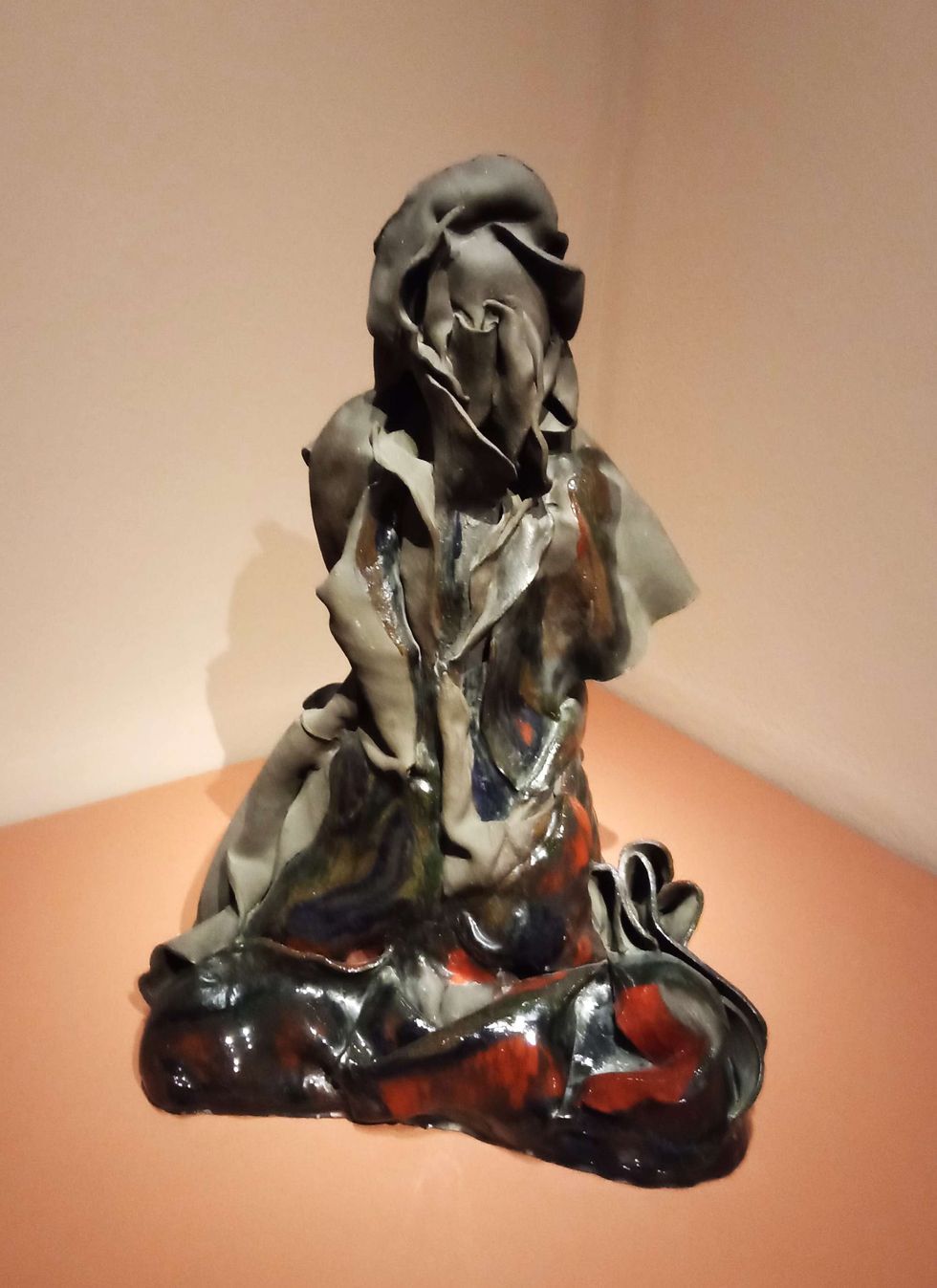 Night Bloom II, partly glazed ceramic work.
Santiniketan is world renowned. Founded in 1901 by the poet and polymath Tagore, Santiniketan is home to the university Visva-Bharati, meaning “communion of the world with India” in Sanskrit. The Institute of Fine Arts, Kala Bhavana (est. 1919), was a crucible for Indian modernism and challenged the colonial education of the British Raj with a holistic and cross-cultural approach.
Students worked in close communion with the surrounding landscape of rural Bengal, drawing on local craft traditions and international art.
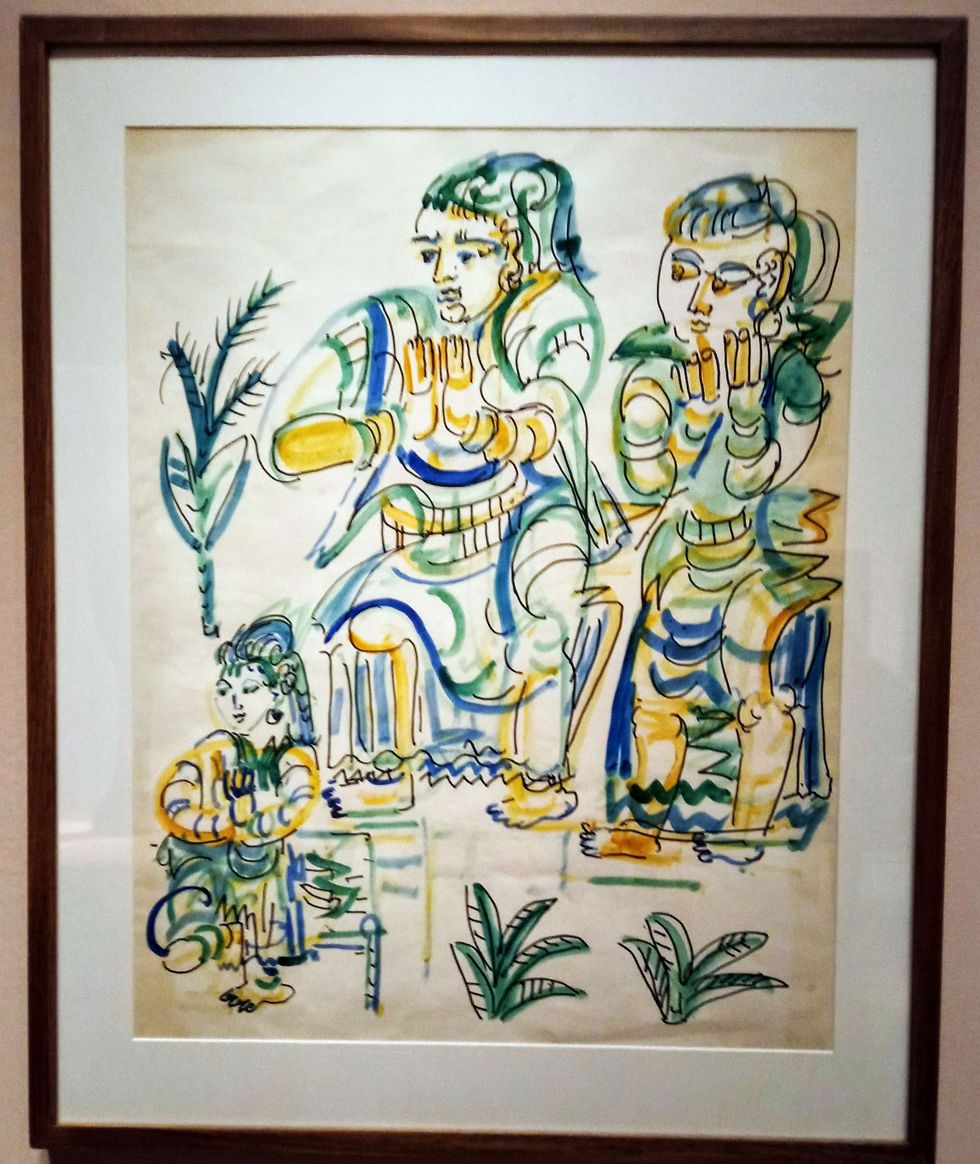 Leela Mukherjee’s watercolour, sketch pen and pastel on paper.
Among its most influential teachers was Benode Behari Mukherjee, whose paintings and collages embodied contextual modernism: a movement grounding artistic practice in humanism and the lived environment.
At Santiniketan, Leela Mukherjee, considered one of India’s first modern female sculptors, developed her own distinctive sculptural and graphic language, blending influences from as wide as west Africa and Mexico with Indian and Nepalese folk art.
The Faculty of Fine Arts at Maharaja Sayajirao University, Baroda, was established in 1949, two years after Indian independence. It became one of the most influential schools for postcolonial artistic experimentation. While conceived in dialogue with Santiniketan, it was distinct in its cosmopolitan outlook.
In 1965, Mrinalini enrolled under Subramanyan. A prolific painter, muralist, printmaker, and designer, Subramanyan urged his students to collapse hierarchies between fine art and craft, traditionally insisted upon by the West, and to look to the pluralisms within Indian cultural histories. “Our art tradition has few parallels in the world for its depth, breadth, antiquity, diversity and unbroken hierarchy,” he wrote in 1971.
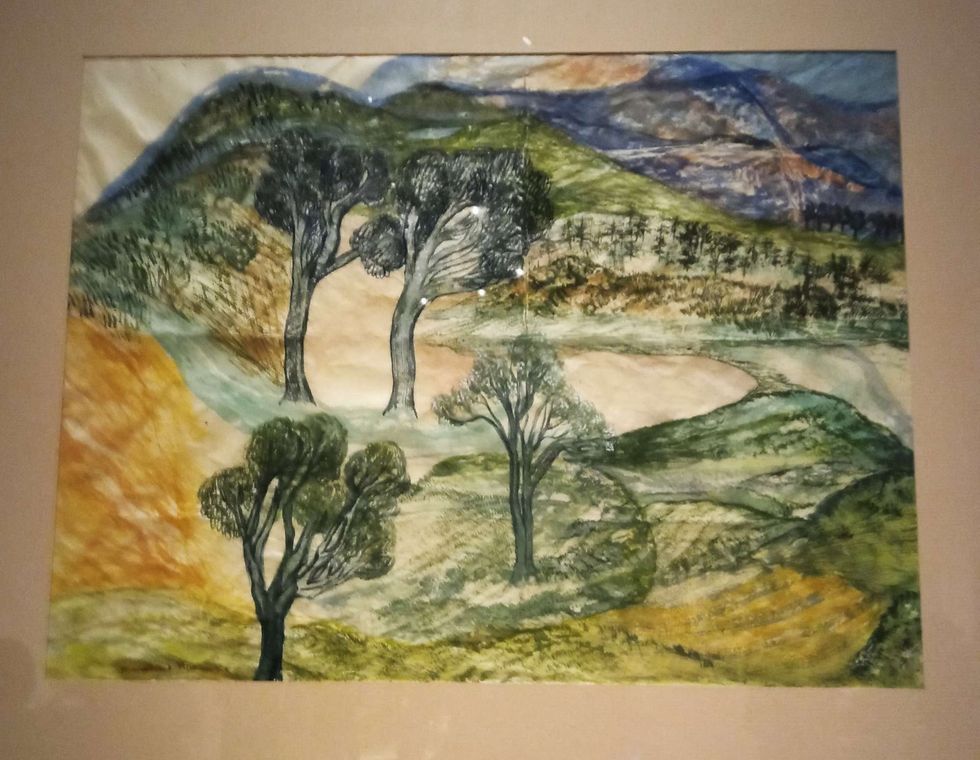 Watercolour on paper.
With his encouragement, Mrinalini became interested in the latent potential of various local materials such as jute and hemp, otherwise judged as poor and non-conventional. She adapted the ancient Arabic knotting technique of macramé into monumental sculptures that fused figuration with abstraction.
At the Hepworth Wakefield, the exhibition, called Mrinalini Mukherjee: Unbound Forms Women sculptors of India and Bangladesh, will run from May 23 until November 1, 2026.
On display “will be the wide range of media explored by Mrinalini Mukherjee across a remarkable 40-year career, including her monumental fibre works – such as Nag Devta (1979) and Aspara (1985), one of her mid-career masterpieces – ceramic and bronze sculptures, drawings, etchings and watercolours”.
Her mother’s work will also be included. Groupings of Leela Mukherjee’s bronzes, carved wooden sculptures and watercolours, will reveal the diversity of her influences across traditional folklore and indigenous Indian and Nepalese woodworking.
Her mother was as talented an artist.
“Born Leela Mansukhani, she trained in art at Kala Bhavan, Santiniketan, under masters, including Nandalal Bose and Ramkinkar Baij, and married fellow artist Benode Behari Mukherjee. Her work spanned sculpture (especially wood and later bronze), murals, painting, drawing and printmaking. She taught art and led departments at schools such as Welham in Dehradun, and later worked at Lalit Kala Akademi studios in Delhi, where she explored etching and bronze casting.”
The Hepworth Gallery says: “The exhibition will situate Mrinalini Mukherjee’s work within a broader lineage of radical women artists who worked in the decades following independence across India and Bangladesh and who reshaped modern sculpture in south Asia. It will chart the story of their artistic development and evolution and highlight the impact of these eminent south Asian women sculptors and their vital contributions to the development of international sculpture. Although only Leela Mukherjee and Mrinalini Mukherjee shared a lived, intergenerational dialogue, the exhibition will trace affinities that extend beyond biography – connections forged through parallel acts of reinvention during a period of profound artistic change across the subcontinent.”
The gallery adds that Mrinalini “will be presented in the context of key works by pioneering women artists from the early generation of modern Indian and Bangladeshi sculpture – Meera Mukherjee (1923–1998), Novera Ahmed (1939–2015) and Pilloo Pochkhanawala (1923–1986). Bringing these artists in dialogue for the first time in the UK, the exhibition will foreground an interwoven history of south Asian art that has long been underrepresented within western accounts of global modernisms.”
It adds: “A selection of bronze sculptures by Meera Mukherjee draws on the Dhokra craft techniques of indigenous craftspeople in central and eastern India, and explore themes of labour, spirituality, community, kinship and ordinary daily life. Meera Mukherjee’s textile works will demonstrate how weaving informed her sculptural language, translating the logic of thread and binding into metal. Bangladeshi artist Novera Ahmed’s works will demonstrate her extraordinary abilities in sculpting with concrete, cement, bronze and steel to create works that play with the geometries of human and animal forms.”
The exhibitions at the Royal Academy and at the Hepworth Wakefield have both been curated by Tarini Malik. She was formerly curator of modern and contemporary art at the Royal Academy. She is now an independent curator and writer. She was the Shane Ackroyd associate curator of the British Pavilion at the 2024 edition of Venice Biennale.
Previously, she was a curator at the Whitechapel Gallery, the Hayward Gallery and Serpentine Galleries.
She said: “Mrinalini Mukherjee’s extraordinary artistic practice is the organising principle of the show, but its deeper ambition is to illuminate the matrilineages that have long underpinned modern sculpture in south Asia. These artists are bound by intellectual kinship, shared pedagogies, and a commitment to material experimentation. Seen together, their work reveals a sculptural history built through dialogue, inheritance and reinvention – one that demands a rethinking of how modernism itself is understood.”