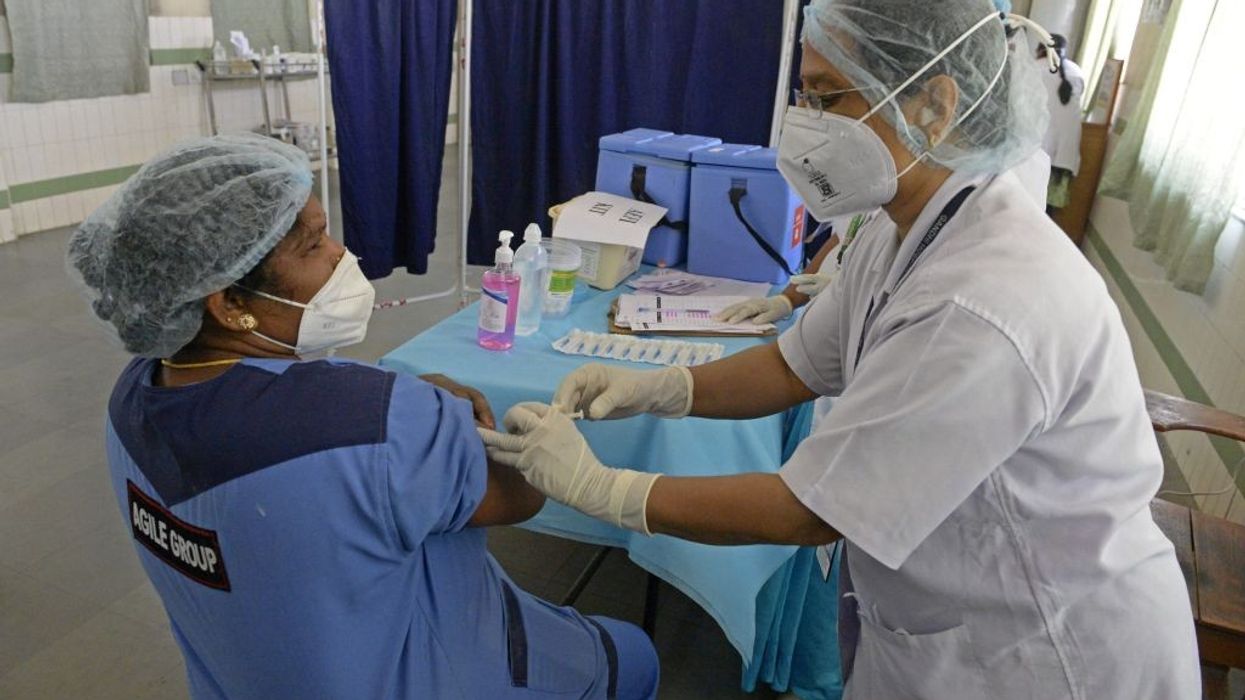

INDIA's drugs regulator approved for emergency use two coronavirus vaccines, one developed by AstraZeneca and Oxford University and the other by local company Bharat Biotech and a state-run institute.
The decisions on Sunday(3) mark the first vaccine approvals in India, which after the US has recorded the most infections of the novel coronavirus, and could enable the country to source vaccines locally.
India is expected to start a massive immunisation programme within about a week, and hopes to inoculate 300 million of its 1.35 billion people free of charge in the first six to eight months of this year.
Prime Minister Narendra Modi welcomed the approvals.
"It would make every Indian proud that the two vaccines that have been given emergency use approval are made in India!" he said on Twitter, calling it a sign of a "self-reliant" country.
India has reported more than 10.3 million Covid-19 cases and around 150,000 deaths, though its infection rate has come down significantly from a mid-September peak.
The AstraZeneca shot, already approved in Britain, Argentina and El Salvador, will take the lead in India and Bharat Biotech's COVAXIN will be administered under stricter conditions given no efficacy data has been released for it.
The Indian government has yet to sign a formal deal for the AstraZeneca vaccine with its local maker, Serum Institute of India (SII), although this is expected within days. SII has stockpiled 50 million doses.
Health minister Harsh Vardhan said on Twitter India was ready for a "quick and equitable" distribution of vaccines.
SII expects the government to buy 100 million doses from it in the next two months and restrict exports until then, said chief executive Adar Poonawalla.
By August, it aims to provide 300 million doses and has also seen interest from African and Asian countries including Bangladesh.
Efficacy data
Drugs Controller General of India V G Somani said the overall efficacy of the AstraZeneca vaccine, locally branded COVISHIELD, was 70.42 per cent based on trials done overseas. No efficacy study has been done in India.
Bharat Biotech's COVAXIN, developed with the government-run Indian Council of Medical Research, was found "safe and provides a robust immune response", Somani said.
Both vaccines will be administered in two doses and stored at 2-8° degrees Celsius (36 to 48°F), he said.
Poonawalla said they recommended that the AstraZeneca vaccine be administered eight to 10 weeks apart.
The efficacy of the Indian vaccine COVAXIN could "go up much more" than 60 per cent after two doses are given, a source with knowledge of the matter told Reuters. Bharat Biotech earlier said they could produce up to 300 million doses a year.
"While this vaccine addresses an unmet medical need during this pandemic, our goal is to provide global access to populations that need it the most," the company's chairman, Krishna Ella, said. "COVAXIN has generated excellent safety data with robust immune responses."
An opposition lawmaker and former minister, however, questioned the approval process for COVAXIN.
"Bharat Biotech is a first-rate enterprise, but it is puzzling that internationally accepted protocols relating to phase 3 trials are being modified for Covaxin," Jairam Ramesh wrote on Twitter.
India's regulator has also received an emergency-use application for the Covid-19 vaccine made by Pfizer and Germany's BioNTech - the first shot to secure regulatory approval in the West.
SII plans to sell the AstraZeneca vaccine to the Indian government at about Rs 250 ($3.42) per dose and Rs 1,000 on the private market.
The regulator on Sunday also allowed Cadila Healthcare to conduct Phase-III trials on 26,000 participants for its DNA-platform vaccine candidate, saying the interim trial data had shown it was "safe" and prompted an immune response under a three-dose regimen.




 Sant Sansad Master Jasraj sharing his views Mahesh Liloriya
  Sant Sansad- Deep PrajjawalanMahesh Liloriya