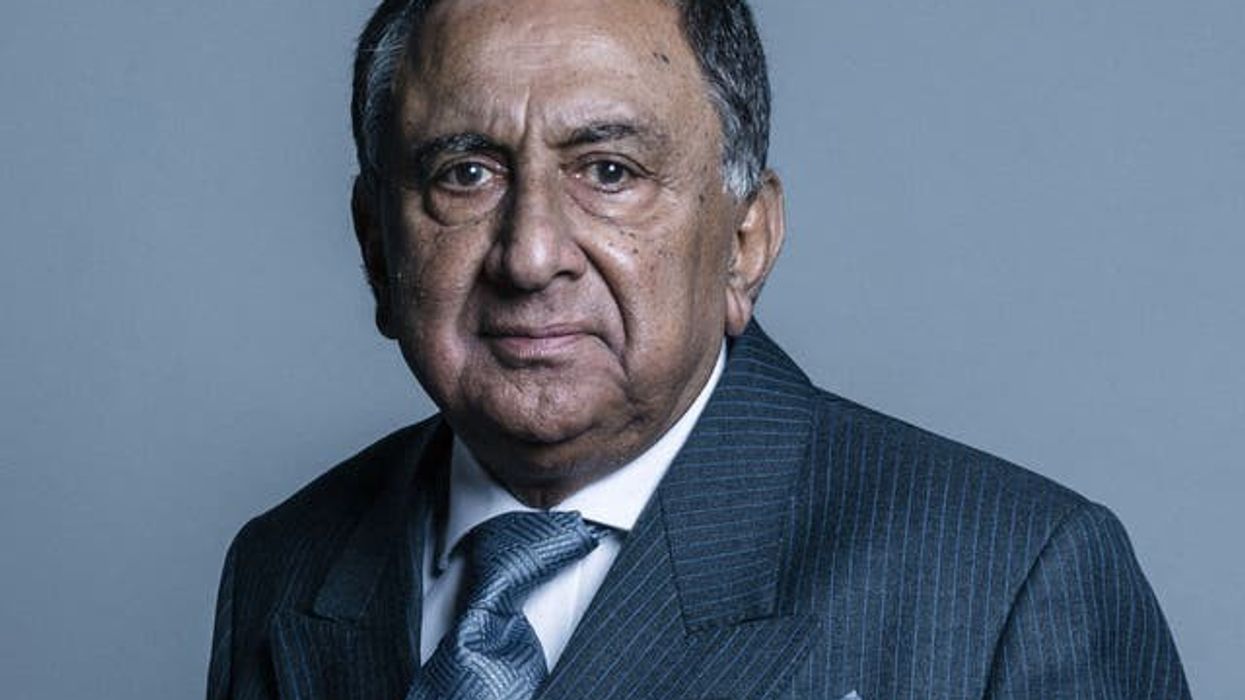

British politician and first Conservative Muslim peer Lord Mohamed Sheikh passed away on Thursday (22) aged 81.
A successful businessman and a writer, Lord Sheikh achieved many things during his lifetime. He founded the Conservative Muslim Forum and chaired it for several years.Currently, he is the president of the Forum.
The peer has been a visiting lecturer at Universities and also acts as an advisor. He promoted educational and cultural ties between the UK and other countries.
Originally from Punjab, Lord Sheikh was born in Kenya and brought up in Uganda.
His family arrived 'penniless' in the UK in 1972 after being expelled from Uganda by General Idi Amin. His father was a wealthy businessman, who made his money from dealing with items like coffee and cotton. He was also the owner of several properties in Uganda.
“We arrived here penniless. General Idi Amin took everything from us, except what we had in our minds. Because we were doing very well in Uganda, we came here and we were prepared to work hard," Lord Sheikh said about early days in UK.
“What we did in this country, was perhaps what we had learned in Uganda and that is to use our brains, to use our initiative, work hard, and we have done very well.”
Lord Sheikh started working for an insurance broking organisation called Camberford Law. He ended up owning it and transformed it into a public company, which provided risk facilities for 1,800 brokers. It went on to win 12 major awards over the course of three years.
Lord Sheikh was elevated to the House of Lords in 2006. He has travelled extensively overseas and visited a number of countries to expand trade between them and the UK.
He is a Patron of several Muslim and non-Muslim organisations and is actively involved in strengthening relationships between various racial and religious groups.
Lord Sheikh has founded and co-chairs the All Party Parliamentary Group (APPG) for Islamic and Ethical Finance in British Parliament.
He is co-chair of the APPG on Turkey and the Prevention of Genocide and Crimes Against Humanity. He is also a vice-chair of the APPGs on Bangladesh, Sri Lanka, Nepal, Kazakhstan and Tajikistan.
His first book on the Maharaja Ranjit Singh was very well received, and his second, An Indian in the House, is on the first four Indians who were members of British Parliament. He has nearly completed his third, a historical novel.
He founded the charity the Sheikh Abdullah Foundation, which is named after his father, and was patron of the charity, Orphans in Need.
Lord Sheikh has been added to the 2021 Indiaspora Government Leaders List which recognises 200 government leaders of Indian heritage in 15 countries around the world.
His funeral took place on Friday (23) at Croydon Mosque and Islamic Centre, with a burial at Greenlawn Memorial Park.






 Curator Emma Slocombe with ikat robes and arabachi coats in the Peter the Great Room in Blickling Hall Amit Roy
 View of the entrance to Blickling Hall on a rainy autumn dayAmit Roy
 Kente cloth from Ghana in the Long Gallery in Blickling Hall
 Decoration in the Great Hall at Blickling Hall Amit Roy
 Palampore fragment made in coastal south-east India in the Brown Room in Blickling Hall Amit Roy
 Bed valance dating from early 1700s in the Italian Print Room at Blickling Hall Amit Roy
 Indian inspired fabric draped on sofas in the South Drawing Room in Blickling Hall Amit Roy
 Indian inspired fabric draped on sofas in the South Drawing Room with Indian carpet in Blickling Hall Amit Roy
 Karun Thakar has picked out the geometric patterns in the bookcase and the Kente cloth in the Long Gallery in Blickling Hall Amit Roy
 Large tapestry depicting Peter the Great defeating the Swedish army at the Battle of Poltava in 1709 Amit Roy
 ikat robes and arabachi coats in the Peter the Great Room in Blickling Hall Amit Roy
 Baghs and kanthas made by women provide contrast to the men only portraits in the Great Hall at Blickling Hall Amit Roy
 Baghs and kanthas in the entrance Great Hall at Blickling Hall Amit Roy
 Baghs and Kanthas in the Great Hall in harmony with stained glass window at Blickling Hall Amit Roy
 Kimonos reflect Japanese influence in Upper Ante Room in Blickling Hall Amit Roy
 Kimono in Upper Ante Room in Blickling Hall
 A view of the Palace and fort at Agra shows romantic side of India Amit Roy
 Blickling Hall Amit Roy
 Table carpet, European 1670-1680 Amit Roy
 Unfinished 17th century Italian embroidery in the Print Room at Blickling Hall Amit Roy
 Picture of Kashmir shows a romantic view of India Amit Roy
 A panel of Ashburnham bed hangings made in Gujarat for sale in Europe in the Brown Room in Blickling Hall Amit Roy
 Colcha made in the 1600s by women in Bengal for the Portuguese market in the Long Gallery at Blickling Hall Amit Roy




