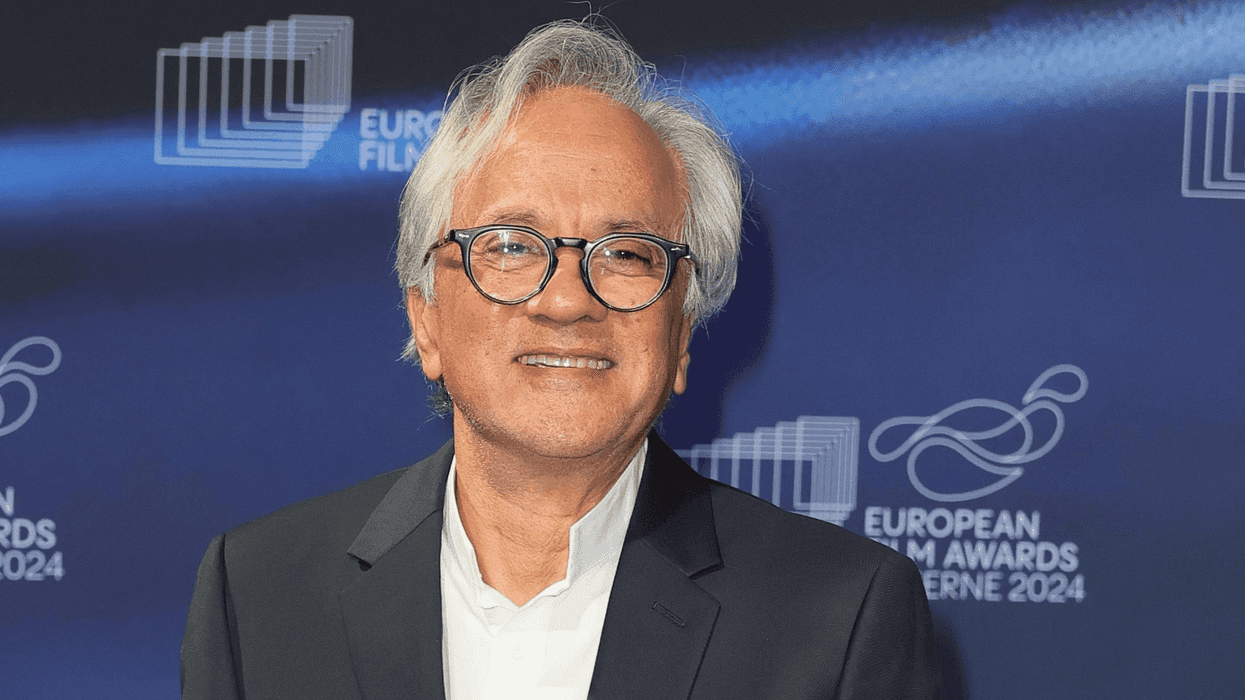

A PLAN to send a house-sized sculpture into orbit made headlines in January, signalling that one of Britain’s most influential contemporary artists still relishes grand gestures. Sir Anish Kapoor said the work would be visible from Earth and conceived as a protest against the commercialisation of space.
“It is hard not to sound pompous, but what we are trying to do is bring back the early sense of adventure in space,” Anish Kapoor told The Times. He declined to name the investors backing the project, expected to cost hundreds of millions, saying only that they were “not necessarily American”.
The announcement followed an unusually busy 2025. In August, Kapoor collaborated with Greenpeace on what was described as the world’s first artwork created at an active offshore gas site. Activists scaled Shell’s Skiff gas platform off the Norfolk coast and produced a vast crimson stain on a giant canvas using 1,000 litres of a blood-red, non-toxic solution made from seawater, beetroot powder and food-based pond dye.
Kapoor titled the piece Butchered, explaining: “I wanted to make something visual, physical, visceral to reflect the butchery they are inflicting on our planet.”
Earlier, Liverpool Cathedral hosted Monadic Singularity, his first solo exhibition inside a UK cathedral, marking the building’s centenary. Spanning 25 years of his career, the exhibition included works never before shown in Britain, among them a monumental sculpture and a kinetic wax piece installed in the cathedral’s main space.
In late 2023, a series of Vantablack paintings were showcased at Lisson Gallery in New York. The works employ nano-technology capable of absorbing 99.965 per cent of visible light, creating surfaces so dark that objects appear almost to vanish. Kapoor described it as “the blackest in the universe”, adding: “It’s not just a thing you paint on. It’s a highly technical, complicated physical process.”
He is set to return to London with a major solo exhibition at the Hayward Gallery in June, bringing together recent works with early pieces to trace his five-decade career. The exhibition will explore what Kapoor has described as “the space of the object”, shifting viewers’ attention from material surfaces to the unseen or imagined beyond.
Born in Mumbai in 1954 to Punjabi and Iraqi-Jewish parents, Kapoor moved to London in the early 1970s to study at Hornsey College of Art before completing an MA at Chelsea School of Art and Design. By the 1980s his installations using intensely coloured powdered pigments had begun attracting international attention.
He represented Great Britain at the Venice Biennale in 1990 with Void Field and won the Turner Prize the following year. His best-known public works include Cloud Gate in Chicago, widely known as ‘The Bean’, Sky Mirror in Nottingham, Temenos in Middlesbrough and the 376-foot ArcelorMittal Orbit created for the 2012 London Olympics, Britain’s tallest sculpture.
Kapoor was elected a Royal Academician in 1999, appointed CBE in 2003 and knighted in 2013. His work is held in major collections including the Museum of Modern Art in New York, Tate in London and the Guggenheim museums in Venice, Bilbao and Abu Dhabi.
ENDS


