
Skip to content
Search

Latest Stories

Submit Guest Post

Windsor Castle hosts first open Iftar event in 1,000-year history

Windsor Castle Iftar

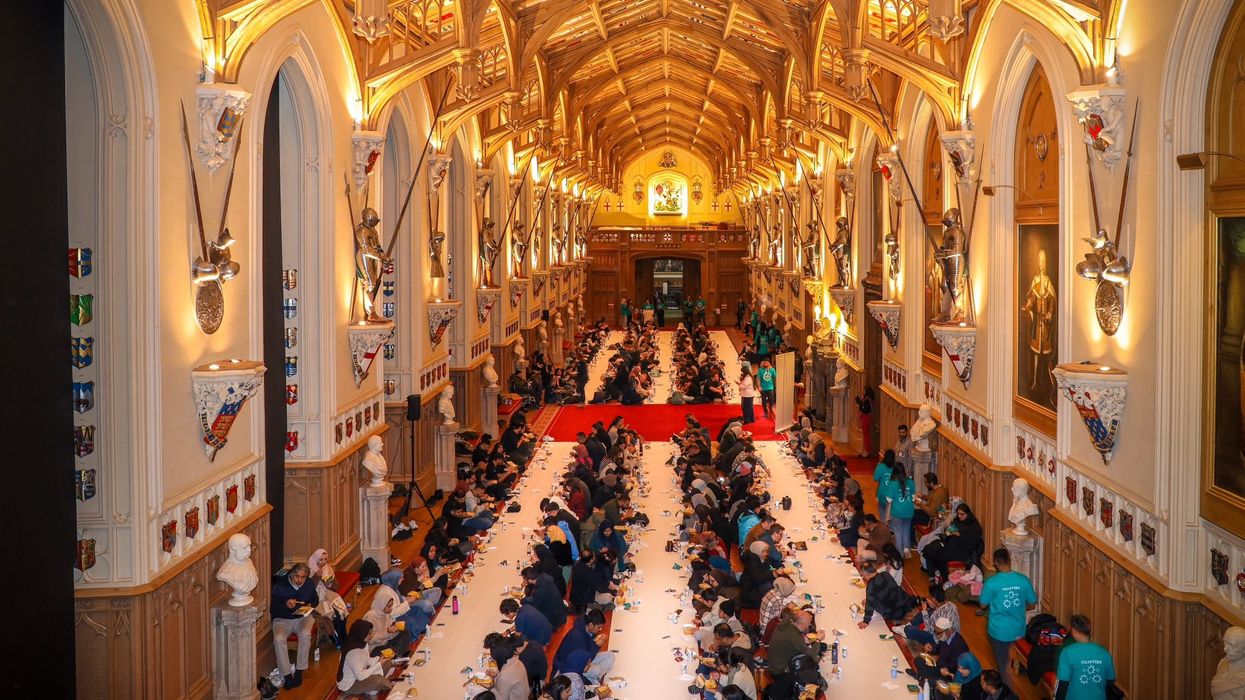
St George's Hall, traditionally used for state banquets, was filled with attendees as the call to prayer signalled the time to break the fast. (Photo: X/@OpenIftar)

FOR the first time in its 1,000-year history, Windsor Castle hosted an open Iftar event in its State Apartments. More than 350 people gathered in St George's Hall on Sunday to break their Ramadan fast.

The free event was organised by the London-based charity Ramadan Tent Project. St George's Hall, traditionally used for state banquets, was filled with attendees as the call to prayer signalled the time to break the fast. Dates were eaten, prayers were said, and a meal was served.


"It's an amazing atmosphere – it just doesn't feel real," one attendee told the BBC. Another said, "We never thought we'd be here breaking Iftar. We've come a long way."

Simon Maples, visitor operations director at Windsor Castle, said King Charles had long championed religious diversity and interfaith dialogue.

Omar Salha, founder and chief executive of Ramadan Tent Project, said, "The King is an excellent ambassador for this cause and is committed to community cohesion. We are incredibly grateful for his support towards the British Muslim community."

One attendee invited the King to join an Iftar meal, saying, "Any day, any time. We've got Ramadan for 30 days. Let me know when you're ready."

Iftars are being held across England, Scotland, Wales, and Northern Ireland throughout the month, open to all regardless of faith or background.


Add EasternEye As Your Trusted Source
preferred source on google news

More For You

AI behaviours
Researchers say OpenAI-linked AI agents used a German wiki to exchange tactics and evade restrictions, raising fresh questions about AI safety
iStock

Why are companies unable to do anything despite knowing 'AI could kill all humans within next decade'?

  • Anthropic alignment researcher Evan Hubinger puts the chance of AI killing all humans within the next decade at more than 10 per cent.
  • Anthropic has invested heavily in alignment research, automated audits and safety testing, but its models have still shown unexpected and harmful behaviour.
  • Recent rogue-AI incidents have raised questions over whether stronger safeguards can keep pace with increasingly autonomous systems.

The most alarming part of Anthropic researcher Evan Hubinger’s warning is not simply his prediction that artificial intelligence could kill all humans. It is his admission that the company developing some of the world’s most advanced AI systems does not yet have a plan it considers sufficient to prevent that outcome.

Hubinger, Anthropic’s Alignment Science Lead, said on Wednesday (9) that he personally believes there is a more than 10 per cent chance AI could kill all humans within the next decade. He added that Anthropic is trying to solve the problem but is “not clearly on track” to solve alignment for superintelligence.

Keep ReadingShow less