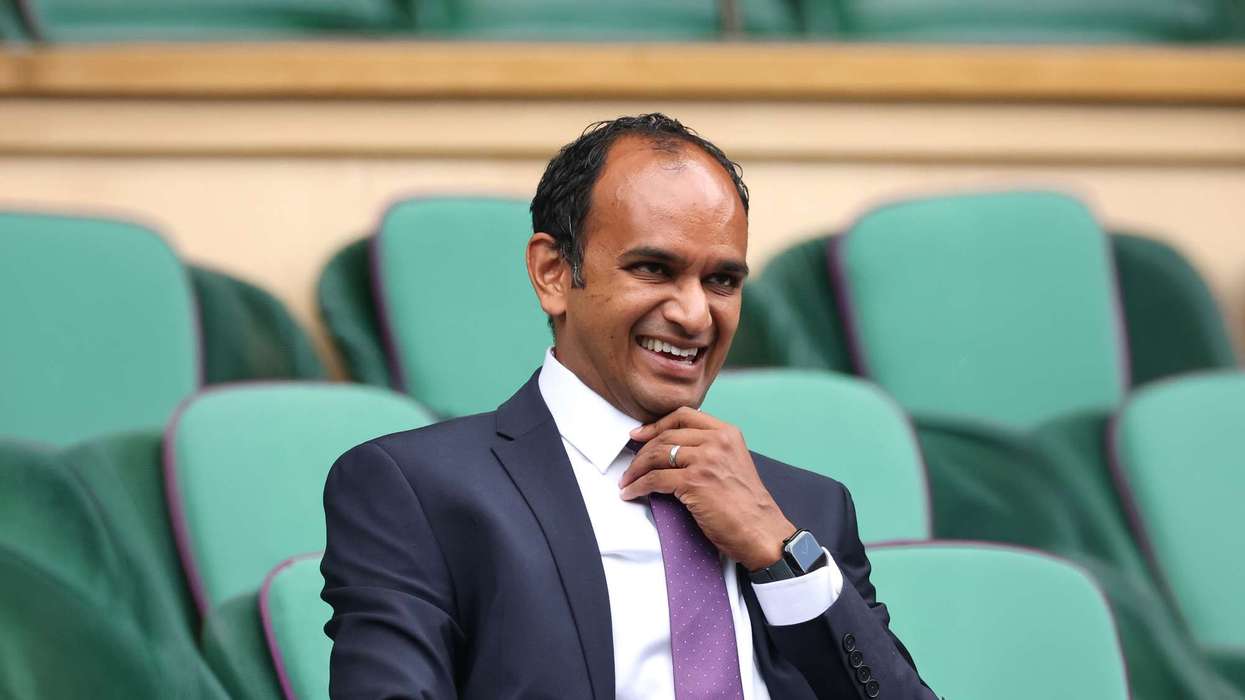

IN THE UNFORGIVING world of English football, where reputations rise and fall with the rhythm of the league table, Vinai Venkatesham has built a reputation as something unusual: a quietly effective operator whose calm demeanour conceals sharp strategic instincts.
Last April he created a stir across the Premier League when Tottenham Hotspur appointed him chief executive, filling the considerable void left by Daniel Levy, who had led the club for nearly a quarter of a century.
The appointment signalled both continuity and change. Levy had transformed Tottenham commercially and overseen the construction of its state-of-the-art stadium, but the club’s on-pitch fortunes had stagnated. Venkatesham arrived with a clear brief: restore competitiveness and reconnect the club with supporters frustrated by years of underachievement.
Those frustrations had boiled over the previous season. Tottenham finished 17th in the Premier League, just one place above the relegation zone, prompting protests against Levy from sections of the fanbase. It was a dramatic fall for a club that had once aspired to challenge the league’s elite. For Venkatesham, the challenge was not merely operational but emotional – to rebuild trust as much as results.
Before stepping into the high-pressure theatre of sports administration, Venkatesham had navigated a variety of industries. He began his career in 2002 as an oil trader with Mitsui Bussan Commodities. A year later he joined Deloitte as a strategy consultant, specialising in financial services and the technology, media and telecommunications sectors.
His first real encounter with global sport came with the London 2012 Olympic Games. As commercial manager for the organising committee, Venkatesham helped negotiate a range of sponsorship, hospitality, merchandising and broadcast deals.
But it was during his 14-year tenure at Arsenal that Venkatesham truly established himself as a major figure in English football administration. He joined the club in 2010 as head of global partnerships, a role focused on expanding Arsenal’s commercial reach. Over the years he moved steadily through the organisation, serving as sales and marketing director and later chief commercial officer.
In 2018 he was appointed managing director after Ivan Gazidis departed for AC Milan. Two years later, Venkatesham stepped into the role of chief executive. The timing was delicate. Arsenal were navigating one of the most uncertain periods in their modern history. In 2017 the club had failed to qualify for the UEFA Champions League for the first time in two decades. Soon afterwards the club’s long-serving manager Arsène Wenger stepped down, closing a chapter that had defined Arsenal for a generation.
Venkatesham helped oversee a restructuring that gradually restored Arsenal’s competitiveness. Among his most consequential moves was the appointment of Mikel Arteta as manager, a choice that initially raised eyebrows but ultimately reshaped the club’s trajectory.
Beyond the men’s team, Venkatesham was instrumental in expanding investment in Arsenal’s women’s side, reflecting the club’s commitment to developing the women’s game. His leadership coincided with a period of commercial growth as well.
Colleagues often describe him as a rare figure in football’s executive ranks: personable, approachable and largely free of ego. During the Covid-19 pandemic he was forced to make difficult decisions affecting staff and operations, yet many within the club recall the compassion with which he handled those pressures. “As a person, you couldn't say a bad word about him. Really nice guy,” a former colleague told the BBC.
Venkatesham left Arsenal at the end of the 2023–24 season, explaining that it was “time to pursue another challenge”. The timing was notable. Arsenal finished as Premier League runners-up that year and recorded record revenues of £616.6 million, underlining the club’s commercial resurgence during his tenure.
For nearly 17 months afterwards he maintained a notably low profile. Media reports linked him with potential moves to Newcastle United, while other opportunities reportedly emerged from the US and Saudi Arabia. At one point there was even speculation that he might step away from football altogether.
Against that backdrop, his eventual appointment at Tottenham came as a surprise to many observers – particularly among Arsenal supporters. Crossing the North London divide is rarely straightforward, and the move immediately attracted scrutiny.
Now, midway through the current Premier League season, Venkatesham has begun to outline his vision for Tottenham’s revival. In an open letter released on 17 January he addressed supporters directly, acknowledging the team’s struggles while promising a more proactive approach in the transfer market.
“Our supporters want wins and performances to be proud of,” he wrote, “and we know the men’s team has fallen short of where we want to be so far this season.”
While reaffirming his confidence in the existing squad, he signalled that reinforcement would be necessary. “We believe in our current squad, but must add more quality, experience, and leadership to compete consistently at the highest level. Doing so requires a more proactive approach to recruitment.”
As part of that strategy he announced that Rafi Moersen would join later in the year as director of football operations, a role that “will play a central role in shaping and executing our player transactions and supporting the wider football operation.”
Venkatesham has also emphasised Tottenham’s commitment to raising the competitive level of the women’s team, noting that the club invested significantly during the January transfer window.
Whether he can replicate at Tottenham the transformation he helped engineer at Arsenal remains an open question. Football has a way of humbling even the most capable executives. Yet Venkatesham’s career suggests a steady pattern: a willingness to combine commercial acumen with patient rebuilding.
Born in 1981 to parents of Indian origin, Venkatesham grew up in London. He was educated at Latymer Upper School before going on to study at Oxford, where he earned a Master of Arts in Economics and Management. He is also a qualified chartered management accountant.
He was appointed Officer of the Order of the British Empire in the 2024 New Year Honours for services to sport.

