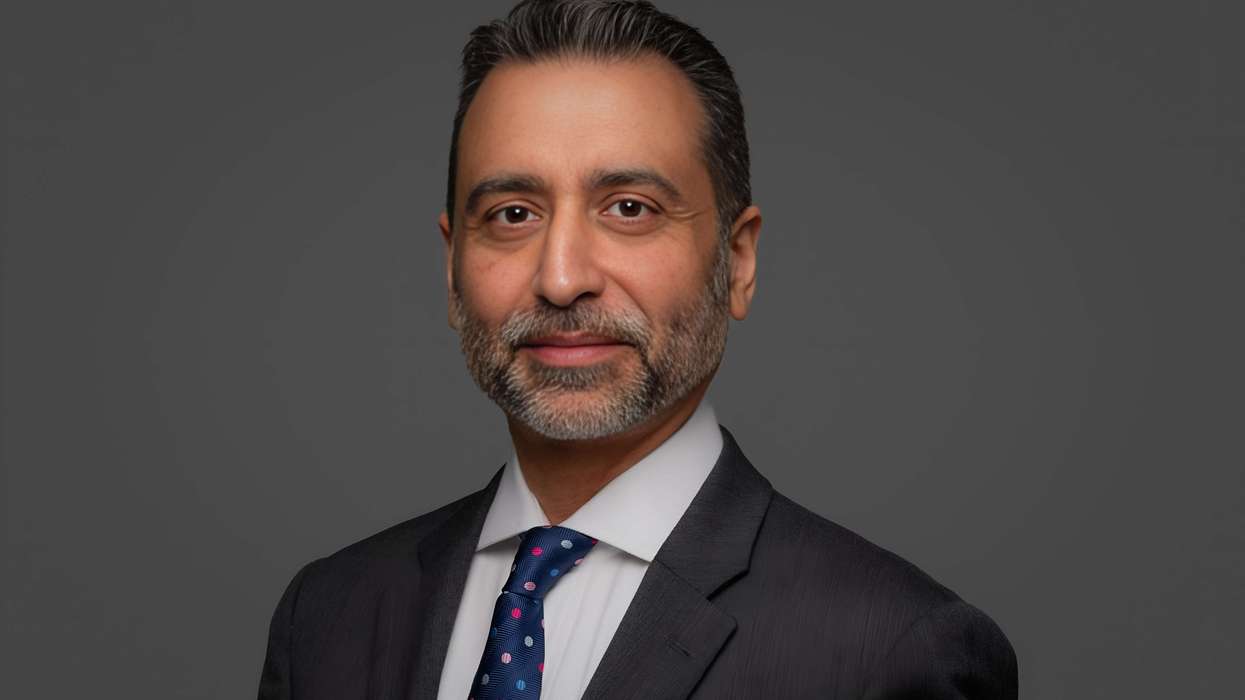

FOR Suresh Kanwar, leadership is not the comfort of a defined path but the responsibility to chart one – defining direction while others are still searching for stability.
On March 1, 2025, Kanwar stepped into that responsibility when he took charge of Deloitte UK’s £1.6 billion financial services practice, assuming one of the 13 most senior leadership roles within the firm’s 26,000-strong British operation.
The moment was anything but tranquil. Deloitte had recently shed over 700 jobs as it grappled with pandemic-era overheads and flatlining revenues in parts of its financial services division. Within the cautious language of consulting, this was widely understood to be a turbulent period.
Kanwar, however, appeared energised rather than unsettled.
Speaking to the GG2 Power List, he said: “I am somebody who likes challenges. I like to do difficult things. That doesn't mean that I'm going to get it right all the time. But one needs to be more right than wrong.
“I don't have any qualms or nerves about leading through an ambiguous time. This is a really important time for us in the UK and even more crucial for UK plc. The next 10 to 20 years is going to be a really critical period for us.”
The scale of the challenge is considerable. Deloitte’s financial services practice sits at the intersection of banking, capital markets, insurance, investment management and emerging financial technologies. Each of those sectors is navigating profound change: the acceleration of artificial intelligence, regulatory recalibration following a decade of reforms, and shifting global capital flows.
In that environment, leadership becomes less about incremental improvement and more about steering institutions through structural transformation.
Kanwar’s own journey reflects the kind of discipline and determination often associated with Britain’s post-war immigrant story.
Of Punjabi origin, he is a third-generation British Asian. Education, he says, was non-negotiable within the household.
“Everybody in our family and community strongly believed that education was the only route to a better life,” he recalled. “I think through a combination of that upbringing from my parents and through my own drive, I am where I am.”
That drive led him to Oxford, where he studied chemistry before beginning his professional career in 1998 at Andersen Consulting, now Accenture.
What followed was a steady ascent through the upper tiers of global consulting. Over nearly two decades at Accenture, Kanwar built a reputation in capital markets advisory, ultimately rising to managing director in the firm’s capital markets business.
By 2016 he was ready for a new challenge.
“Moving to Deloitte from Accenture was about personal growth. I wanted to explore different ways to serve clients in a more holistic and better way,” he said.
At Deloitte, his rise was swift but methodical. He first led the capital markets consulting practice before being entrusted with the broader banking and capital markets team. From there, his remit expanded further, culminating in his appointment as managing partner for financial services.
He is a strategist who balances commercial clarity with collaborative leadership.
“I don't think leadership is learnt from one person. There are some aspects that you admire in a group of leaders that you have the privilege of working with.
“Leadership, for me, is more about how does everybody benefit from guidance and vision. It is also about how can I make sure that everybody has a voice.”
His decision-making framework, whether in advising global banks or shaping organisational strategy, rests on two deceptively simple questions: “are we taking accountability appropriately and are we adding value appropriately.”
“The answer to these two questions guides my decision making,” he said.
That clarity is particularly useful in an industry now confronting multiple technological tipping points. Among them, Kanwar sees blockchain and digital assets approaching a long-anticipated moment of maturity.
“If we look back on the blockchain and digital asset journey over the last 15 years or so, it's never quite reached fruition… But now it does feel like we're at a tipping point,” he said. “It feels like 2026-27 are going to be the years where there is going to be digitisation of tokenised currency platforms.”
Recent developments suggest that assessment may be well founded. Major financial institutions have begun experimenting with tokenised deposits and blockchain-enabled settlement systems, signalling a gradual convergence between traditional finance and decentralised technologies.
Artificial intelligence represents another frontier. Deloitte has invested heavily in AI capabilities, including the launch of a dedicated AI studio within its offices. Yet Kanwar remains cautious about the pace and scope of automation.
“We all still want a human touch. I think we need to be really thoughtful about how much gets automated… Trustworthiness of AI and agentic AI is also an issue that we are very cautious about,” he said.
“Naturally AI has led to the skills that our people require needing to evolve. What we've all got to ensure is that we collectively are taking advantage of this technology.”
Alongside technological shifts, Kanwar also keeps a close eye on geopolitical dynamics shaping global business. The relationship between India and the UK, he believes, holds particular promise.
“India and the UK share probably the closest relationship in the world. The two countries understand each other so well. On top of that, there is a large and influential Indian diaspora in this country,” he said.
Terming the recently concluded UK-India Free Trade Agreement as “game changing,” he said there is much more that “could, should and will happen between the two countries.”
A father to three sons aged 21, 17 and 14, Kanwar’s life remains anchored by family.
Relaxation, he says, is usually found in simple routines: time with friends, music, the gym, swimming and films – although the demands of client work occasionally intrude into weekends.
In a sector often defined by caution and risk mitigation, Kanwar’s distinguishing trait may be his ease with ambiguity – and his willingness to move forward while others hesitate.
As he puts it: “Leadership is leading through ambiguity. Not everything is going to be clear. The path is not going to be set; it is my job to set the path through ambiguity.”