
Highlights
- A 17th-century brass astrolabe once owned by Indian royalty sold for more than £2m at Sotheby's in London
- The instrument, made in Lahore for a Mughal nobleman, is described as possibly the largest of its kind in existence
- The sale set a world record for an astronomical instrument from the Islamic world, beating a 2014 record of just under £1m
A RARE 17th-century brass astrolabe once owned by Indian royalty has sold for more than £2 million ($2.75m) at Sotheby's in London, setting a world record for an astronomical instrument from the Islamic world.
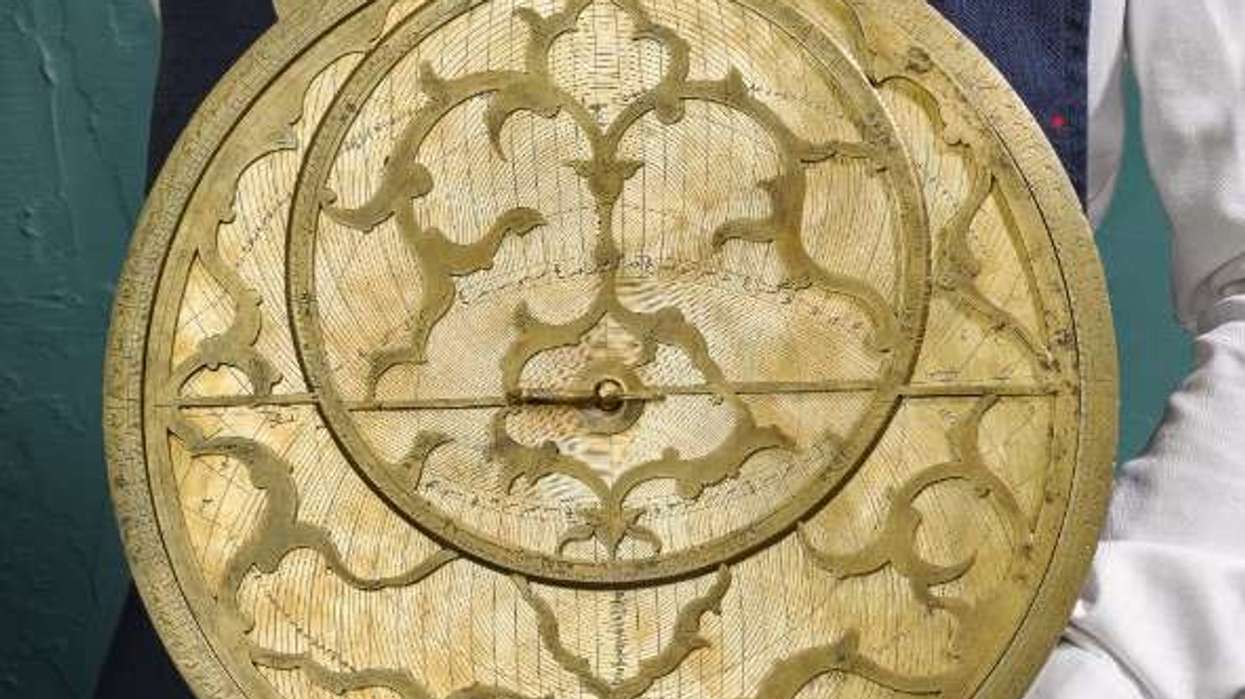
The object, described as "perhaps the largest in existence" by Sotheby's head of Islamic and Indian Art Benedict Carter, was made in Lahore in the early 17th century for Aqa Afzal, a Mughal nobleman who administered the city. It had never been publicly exhibited before the auction, the BBC reported.
The instrument was crafted by two brothers, Qa'im Muhammad and Muhammad Muqim, who belonged to the celebrated Lahore School of astrolabe-making, one of the most renowned centres of its kind. It weighs 8.2kg, measures nearly 30cm in diameter and stands about 46cm tall - almost four times the size of a typical astrolabe from that period.
It was known to have been part of the royal collection of Maharaja Sawai Man Singh II of Jaipur, and passed to his wife, Maharani Gayatri Devi, after his death, before moving into a private collection.
Astrolabes are metallic disks with interlocking components historically used to tell the time, map the stars and determine the direction of Mecca.
Dr Federica Gigante of the Oxford Centre for History of Science, Medicine and Technology told the BBC they were comparable to modern smartphones in their versatility.
"You can calculate the time of sunset, sunrise, the height of a building, the depth of a well, distance and even use them to predict the future," she was quoted as saying.
Carter noted the piece carried a cross-cultural quality, with star pointers named in Persian alongside Sanskrit equivalents etched in Devanagari script. It contains 94 cities marked with their longitudes and latitudes, and 38 star pointers linked by intricate floral tracery.
The sale broke the previous record held by an Ottoman astrolabe made for Sultan Bayezid II, which sold in 2014 for just under £1m.