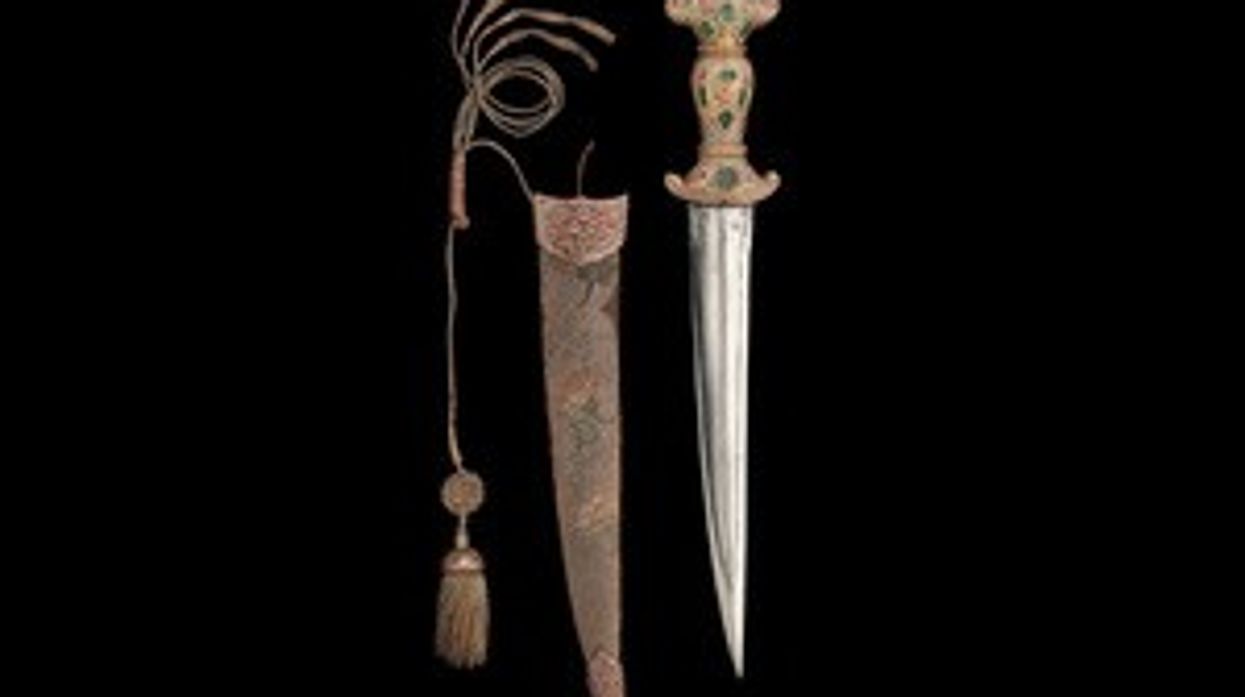

A mughal dagger and scabbard is at risk of leaving the country unless a UK buyer can be found as a temporary export bar has been placed to save the work.
Owned by Robert Clive, an important figure in British India, and collected during his time in India, the dagger is likely to have been acquired by him in 1757 following his victory at the Battle of Plassey.
Valued at £1,120,000, the dagger has an unusually formed jade hilt with an unparalleled arrangement of precious stones, some of considerable size, whilst the blade is a fine example of Indian watered steel.
Dating back to 1650, the silk brocade cover on the wooden scabbard is Iranian, demonstrating the influence of Iran on India during the mughal period.
Culture minister Caroline Dinenage said: "This beautiful example of a mughal dagger and scabbard has a lot to teach us about both the British in India and the nature of diplomatic gifts at that time.
"I hope a UK-based buyer is found so this magnificent item can be studied and enjoyed for years to come."
The Reviewing Committee on the Export of Works of Art and Objects of Cultural Interest (RCEWA) has said that its departure from the UK would be a misfortune because it was of outstanding significance for the study of 18th century Mughal weapons.
The decision on the export licence application for the piece will be deferred until 8th October 2021, which could be extended until 8th February 2022 if a serious intention to raise funds to purchase it is made at the recommended price of £1,120,000.