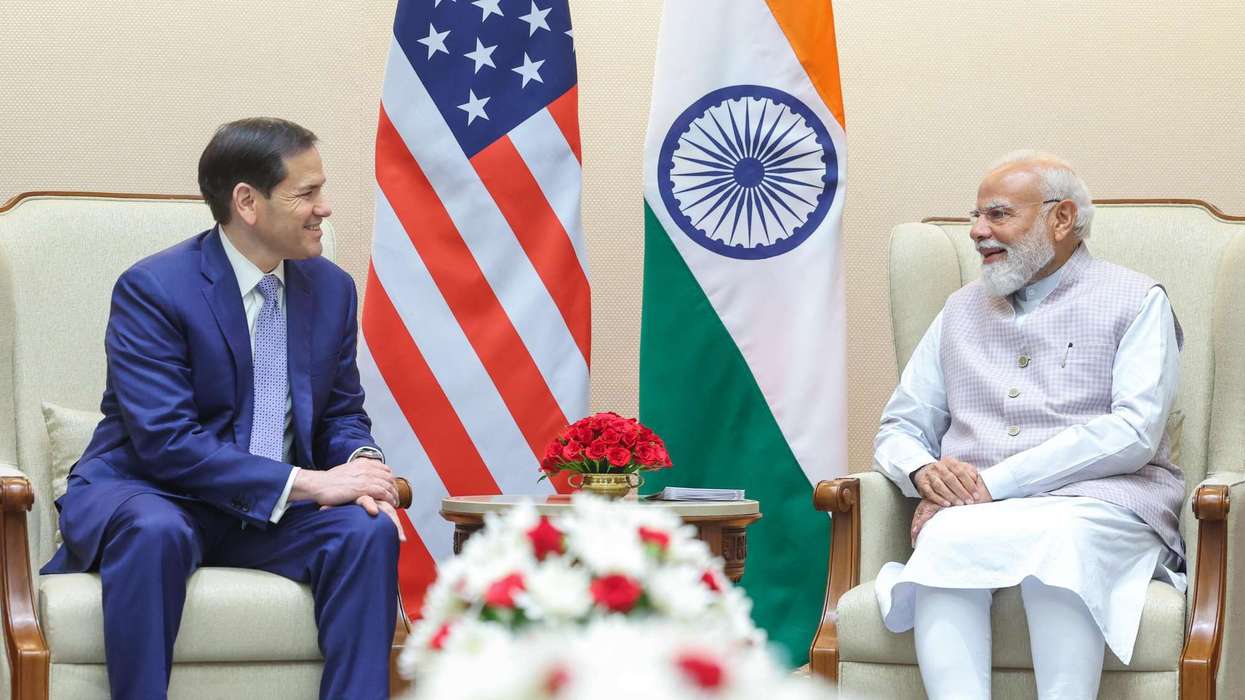

US SECRETARY of state Marco Rubio said on Sunday that India and the US are close to finalising a trade agreement that would be “beneficial” and “sustainable” for both countries, as he held wide-ranging talks with India's external affairs minister S Jaishankar aimed at improving ties after months of strain.
Rubio, on a four-day visit to India, said both sides had made “tremendous progress” on the proposed deal and expressed hope that the US Trade Representative would visit India soon to take discussions forward.
“We've made tremendous progress, and I think we're going to wind up with a trade agreement between the US and India that is going to be enduring and beneficial to both sides and sustainable in a way that addresses national interests that we have,” Rubio said at a joint media briefing with Jaishankar.
Jaishankar said both sides discussed the need to conclude the interim trade agreement soon.
“On the economic front, we spoke about the value of concluding, at an early date, the final text of the interim agreement regarding reciprocal and mutually beneficial trade,” he said.
He added that the agreement would be an important step towards a broader bilateral trade pact envisioned during prime minister Narendra Modi’s talks with US president Donald Trump in Washington in February 2025.
The discussions covered trade, visas, defence, energy security, critical minerals, high technology, terrorism and the West Asia conflict. The talks came after bilateral ties were hit by Washington’s tariff policies and disagreements over trade.
Rubio rejected suggestions that the US-India relationship had lost momentum and said the current trade tensions were part of a broader effort by the Trump administration to rebalance America’s trade relations globally.
“This is not about India. This is about the United States in terms of trade,” Rubio said.
“The President did not say: ‘Let's figure out a way to create friction with India over trade.’ The President came in and said: ‘We have a trade situation involving the US economy that doesn't work moving forward’.”
“There’s a huge imbalance that’s built up, and it needs to be addressed. He pursued it from a global perspective,” he said.
Rubio added that trade concerns had come up in discussions with countries around the world, including US allies.
“The good news is that through this rebalancing, we are ultimately seeking and believe we will arrive at trade arrangements around the world that are good for the United States, but also good for our trade partners,” he said.
“And one of those we hope will be India. In fact, we are on the verge of making that happen.”
The US Secretary of State described India as one of Washington’s most important strategic partners and said bilateral ties would become stronger by the end of the current US administration.
“India is an important strategic partner of the United States, one of our most important strategic partners in the world,” he said.
“The US-India relationship has not lost any momentum.”
Rubio also said Washington’s engagement with countries such as China and Pakistan was not at the expense of its relationship with India.
“As far as our relations with other countries are concerned, we have relations and work at the tactical level in many ways with countries all over the world, so does India, like every other responsible nation,” he said.
“But I don't view our ties with any country in the world as coming at the expense of our strategic alliance with India.”
In his remarks, Jaishankar outlined India’s broader foreign policy position and said New Delhi supported dialogue and diplomacy to resolve conflicts.
“Let me state India's broad position... And I would make five points here. One, that we advocate dialogue and diplomacy to address conflicts. Two, we support safe and unimpeded maritime commerce,” he said.
“Three, we demand scrupulous respect for international law. Four, we are against the weaponisation of market shares and resources. And five, we believe in the value of trusted partnerships and resilient supply chains to de-risk the global economy.”
Jaishankar also raised concerns over the impact of the West Asia crisis on India’s energy security and stressed the importance of diversified energy supplies.
“The way we will deal with the current situation in Hormuz and frankly going forward as well, is to diversify our energy sources, because that is at the heart of our energy security,” he said.
“It is important to keep energy prices down for global growth.”
He said India maintained strong relations with the US, Israel, Iran and Gulf nations and did not view diplomacy in the region as a “zero-sum game”.
“Obviously, we want peace and stability in the region,” he said.
Jaishankar also raised India’s concerns regarding recent US visa and immigration policy changes and said legal mobility should not be adversely affected.
Rubio acknowledged there could be “some bumps” and “friction points” during the transition period as Washington reforms its immigration system.
“It is not a system that is targeted at India; it is one that's being applied globally,” Rubio said.
“But we're in a period of transition, and like any period of transition, there's going to be some bumps on that road.”
On security cooperation, Jaishankar said India and the US shared concerns over terrorism.
“Prominent among them is terrorism. Our position in that regard is very clear. It is one of zero tolerance,” he said.
“I particularly recognised the extradition from the United States to India last year of a key planner of the 26/11 Mumbai attacks.”
“Our two countries will intensify cooperation bilaterally, as well as in relevant international forums. We will continue to collaborate closely on countering illegal trade.”
Rubio also referred to India joining the US-backed Pax Silica initiative on critical minerals and artificial intelligence supply chains.
Later, Jaishankar described the meeting as “good discussions” in a post on X.
“Reviewed the entire spectrum of our Comprehensive Global Strategic Partnership, including trade and energy, defence and security, critical minerals and AI, nuclear and people-to-people, counter-terror and counter-narcotics cooperation,” he said.
Rubio also met India's national security advisor Ajit Doval during the visit. India's External Affairs Ministry spokesperson Randhir Jaiswal said the discussions focused on defence, security and strategic technology cooperation, including the TRUST initiative.