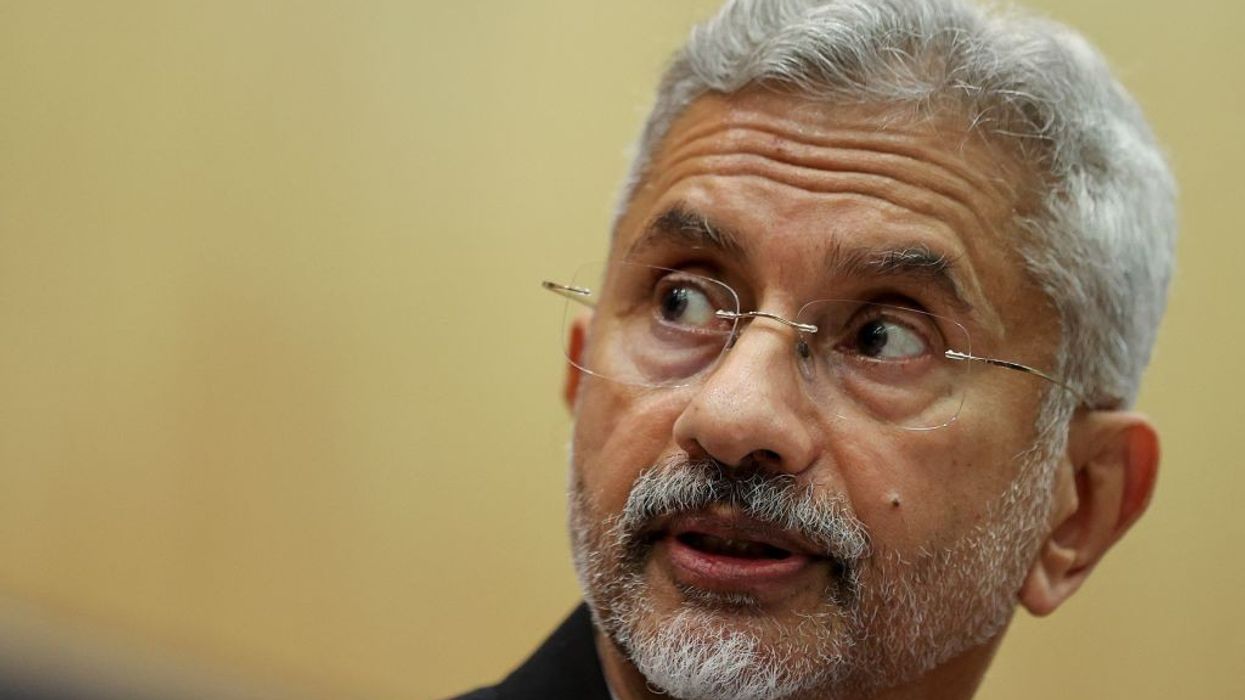

INDIA’S foreign minister on Tuesday (21) urged Britain to remove a rule requiring Indians visiting there to quarantine even if they are fully vaccinated.
India's Covishield vaccine, developed by AstraZeneca and manufactured in India by Pune-based Serum Institute, is not recognised by Britain under new rules despite being identical to the doses given to millions of Britons.
The rules, that come into effect next month, have caused anger, with many Indians branding the decision as discriminatory. Britons vaccinated in the UK with the same Indian-made doses are not required to quarantine.
They could also lead to a retaliation from New Delhi, with Indian government sources saying it was likely to take reciprocal steps if the issue is not quickly resolved.
"Urged early resolution of quarantine issue in mutual interest," foreign minister Subrahmanyam Jaishankar said on Twitter after a meeting with the UK’s new foreign secretary, Liz Truss, in New York, where both are attending the United Nations General Assembly.
The British High Commission in New Delhi said the United Kingdom was working with India to resolve the issue.
"We are engaging with the Government of India to explore how we could expand UK recognition of vaccine certification to people vaccinated by a relevant public health body in India," a spokesperson said.
The rules, that mandate 10 days of self-isolation for travellers arriving from India, also apply to many other countries using Covishield, including most African ones.
From October 4, the UK’s current “traffic light system” of red, amber, green countries based on levels of Covid-19 risk will be replaced by one red list of countries.
The scrapping of the amber list, which includes India, means a reduced PCR test cost burden for some travellers.
Shashi Tharoor, an Indian opposition MP and author, said on Monday (20) he had cancelled a planned book tour of Britain in protest against the rules. "It is offensive to ask fully vaccinated Indians to quarantine," he said.
Tharoor said he pulled out of a debate at The Cambridge Union debating society and from the launch events for the UK edition of his book, The Battle Of Belonging, because of the restrictions.
A second Congress MP, Jairam Ramesh, said the decision "smacks of racism".
AstraZeneca is one of the key providers to Britain's vaccination program, along with US peers Moderna and Pfizer. The AstraZeneca vaccine makes up most of the doses given to Indians to date.
A smaller number have taken an indigenous vaccine developed by Bharat Biotech, which is not in use in Britain.






 Curator Emma Slocombe with ikat robes and arabachi coats in the Peter the Great Room in Blickling Hall Amit Roy
 View of the entrance to Blickling Hall on a rainy autumn dayAmit Roy
 Kente cloth from Ghana in the Long Gallery in Blickling Hall
 Decoration in the Great Hall at Blickling Hall Amit Roy
 Palampore fragment made in coastal south-east India in the Brown Room in Blickling Hall Amit Roy
 Bed valance dating from early 1700s in the Italian Print Room at Blickling Hall Amit Roy
 Indian inspired fabric draped on sofas in the South Drawing Room in Blickling Hall Amit Roy
 Indian inspired fabric draped on sofas in the South Drawing Room with Indian carpet in Blickling Hall Amit Roy
 Karun Thakar has picked out the geometric patterns in the bookcase and the Kente cloth in the Long Gallery in Blickling Hall Amit Roy
 Large tapestry depicting Peter the Great defeating the Swedish army at the Battle of Poltava in 1709 Amit Roy
 ikat robes and arabachi coats in the Peter the Great Room in Blickling Hall Amit Roy
 Baghs and kanthas made by women provide contrast to the men only portraits in the Great Hall at Blickling Hall Amit Roy
 Baghs and kanthas in the entrance Great Hall at Blickling Hall Amit Roy
 Baghs and Kanthas in the Great Hall in harmony with stained glass window at Blickling Hall Amit Roy
 Kimonos reflect Japanese influence in Upper Ante Room in Blickling Hall Amit Roy
 Kimono in Upper Ante Room in Blickling Hall
 A view of the Palace and fort at Agra shows romantic side of India Amit Roy
 Blickling Hall Amit Roy
 Table carpet, European 1670-1680 Amit Roy
 Unfinished 17th century Italian embroidery in the Print Room at Blickling Hall Amit Roy
 Picture of Kashmir shows a romantic view of India Amit Roy
 A panel of Ashburnham bed hangings made in Gujarat for sale in Europe in the Brown Room in Blickling Hall Amit Roy
 Colcha made in the 1600s by women in Bengal for the Portuguese market in the Long Gallery at Blickling Hall Amit Roy




