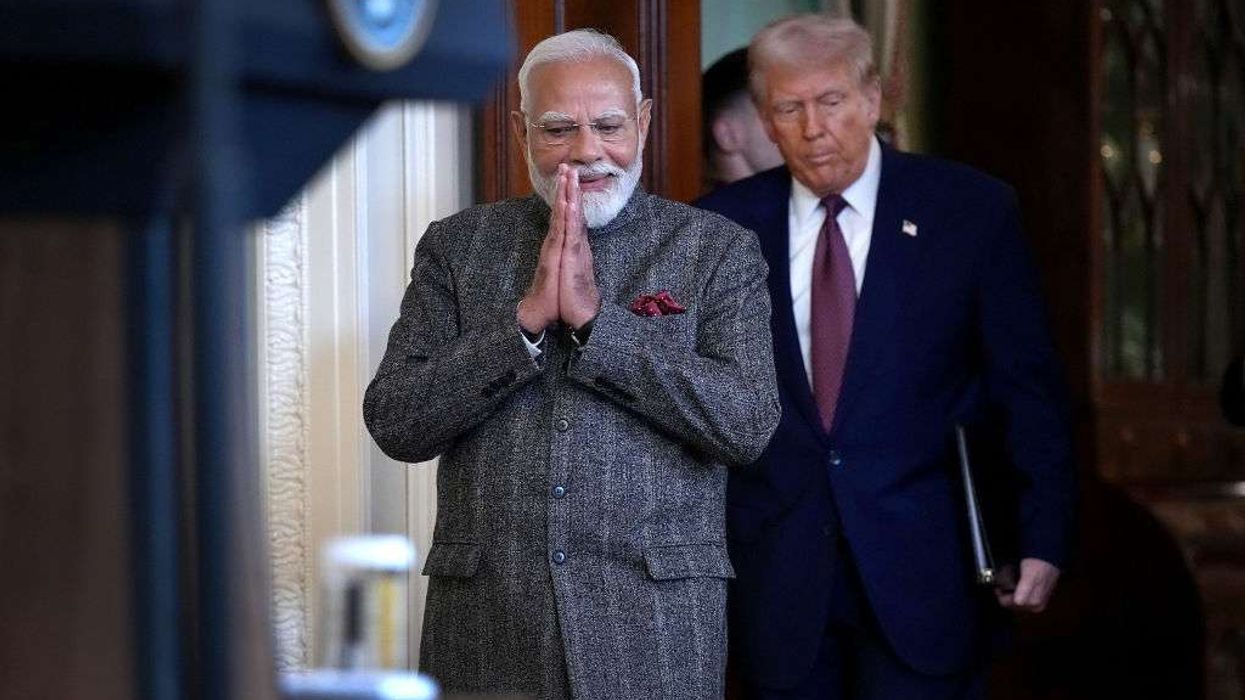

INDIA said on Thursday (16) that its energy policies will continue to prioritise the interests of its citizens, following US president Donald Trump’s claim that prime minister Narendra Modi had assured him India would stop buying Russian oil.
Foreign ministry spokesperson Randhir Jaiswal said in a statement that India’s approach was based on ensuring stable prices and secure supplies rather than responding to external political pressure.
“It has been our consistent priority to safeguard the interests of the Indian consumer in a volatile energy scenario. Our import policies are guided entirely by this objective,” he said.
The comments came hours after Trump told reporters in Washington that Modi had promised to end Russian oil imports as part of US efforts to cut off Moscow’s energy revenues.
“I was not happy that India was buying oil, and he assured me today that they will not be buying oil from Russia,” Trump said at a White House event, adding that the next step would be to convince China to follow suit.
New Delhi has neither confirmed nor denied Trump’s remarks. In fact, the Indian foreign ministry later said it was “not aware of any telephone conversation” between the two leaders on Wednesday (15).
India, one of the world’s biggest importers of crude oil, depends on overseas suppliers for more than 85 per cent of its energy needs. While it traditionally relied on Middle Eastern producers, the country shifted towards Russian crude in 2022 after Western sanctions on Moscow created a market for discounted oil. Russia has since become India’s largest oil supplier, accounting for about one-third of total imports.
According to trade data, India imported 1.62 million barrels of oil per day from Russia in September. Imports are expected to rise further in October as Russia increases exports following damage to some of its refineries by Ukrainian drone attacks.
Despite US concerns, India has long defended its purchase of Russian oil, describing it as vital to maintaining affordable energy prices for its population.
“Ensuring stable energy prices and secured supplies have been the twin goals of our energy policy,” Jaiswal said. “This includes broad-basing our energy sourcing and diversifying as appropriate to meet market conditions.”
However, three sources familiar with refinery operations told Reuters that some Indian refiners are preparing to gradually reduce Russian oil imports from December, as existing orders for November have already been placed. The refiners have not been formally instructed by the government to do so, but they are reportedly exploring alternative crude sources.
Mangalore Refinery and Petrochemicals Limited (MRPL) confirmed it was looking for discounted alternatives while hoping to maintain access to Russian supplies. “We are exploring all options to ensure cost-effective sourcing,” an MRPL official said.
Trump has in recent months intensified pressure on India over its ties with Moscow. In August, he raised tariffs on Indian exports to 50 per cent, accusing New Delhi of indirectly funding Russia’s war in Ukraine. US negotiators have linked a possible reduction in tariffs to India’s willingness to curb its Russian oil purchases.
At the same time, both sides have discussed expanding energy cooperation. “The current US administration has shown interest in deepening energy cooperation with India. Discussions are ongoing,” Jaiswal said.
Russia, meanwhile, remains confident that its partnership with India will continue. Deputy prime minister Alexander Novak said on Thursday that Russian energy remained “in demand, economically advantageous, and practical.”
Kremlin spokesman Dmitry Peskov added that depriving countries of the right to choose their suppliers would violate the principles of free trade.
Analysts say India is likely to proceed cautiously, balancing Washington’s pressure with its own energy security and economic interests. With global oil prices recently hitting a five-month low, the immediate financial impact of any shift could be limited.
However, a full halt to Russian oil purchases, if it happens, would mark one of the biggest shifts in global energy flows since the start of the Ukraine war.
(Agencies)