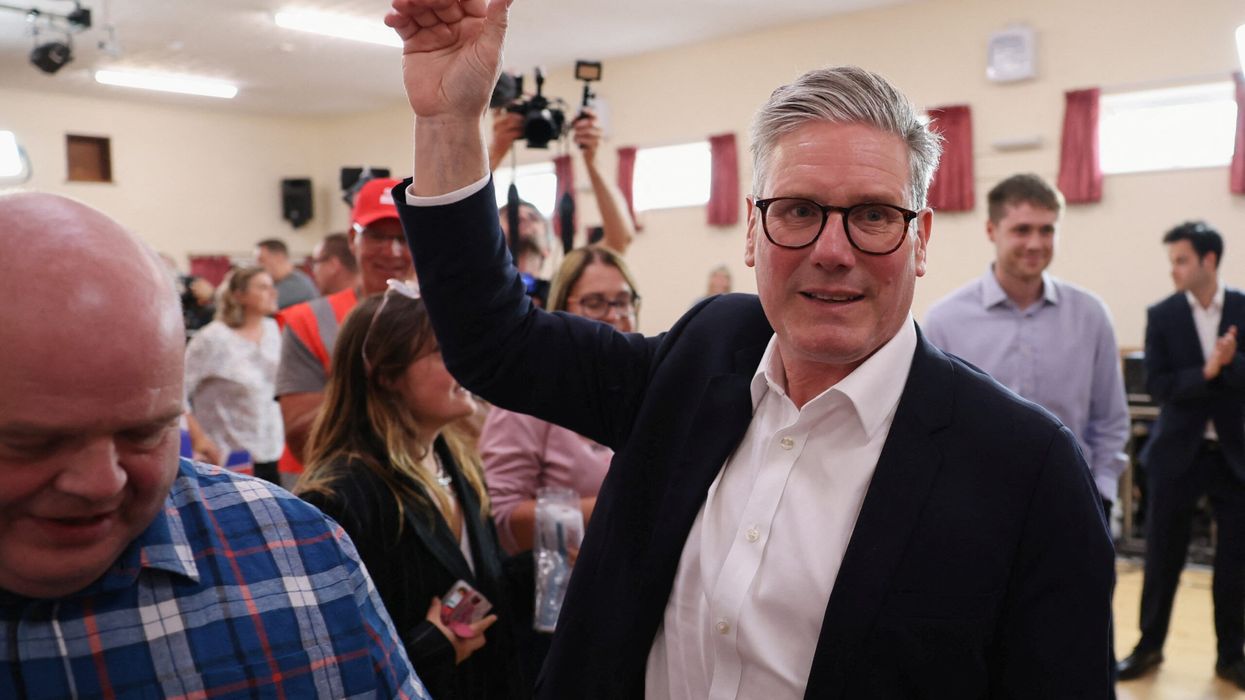

LABOUR leader Sir Keir Starmer and prime minister Rishi Sunak on Wednesday kicked off the last day of campaigning before polls open in a national election, each warning voters of dire economic consequences if the other man wins.
Opinion polls show Starmer's Labour Party is set for a big win that would end 14 years of Conservative government and hand the centre-left leader the keys to the prime minister's Number 10 Downing Street office on Friday morning.
Fearful that voters could see the result as a foregone conclusion and stay at home when polling opens at 6.00 GMT on Thursday or register protest votes with smaller parties, Labour issued a fresh rallying cry:
"Don’t forget the economic chaos for which the British people are still paying the price," Labour's campaign coordinator Pat McFadden said in a statement.
"If you vote Conservative, nothing will change. If you don’t vote at all or vote for another party, you run the risk of waking up on Friday to Rishi Sunak walking through the door to No. 10 once again."
Starmer's campaign has been built around a one-word promise of 'Change', tapping into discontent at the state of Britain's stretched public services and falling living standards - symptoms of a sluggish economy and political instability.
Sunak has sought to persuade voters that his 20 months in charge have set the economy on an upward path after the external shocks of COVID-19 and the war in Ukraine, and drawn a line under years of turmoil overseen by his Conservative predecessors.
He argues that Starmer would have to put up taxes to implement his agenda for change
Having failed to close Labour's roughly 20-point opinion poll lead the Conservatives have pivoted from seeking victory to trying to minimise the scale of defeat.
Their final hours campaign warned that the bigger Labour's win, the more emboldened Starmer would be to raise taxes beyond those he has already outlined.
"The larger the scale of the supermajority, the easier it will be to ram through extreme policies – and the more tax rises will be inflicted on the British people," the Conservatives said in a statement.
Starmer has accused Conservatives of running "an increasingly desperate, negative campaign".
Advantage Labour
Labour Party is set to sweep to power with a record number of seats at Thursday's national election, a forecast by polling company Survation showed on Tuesday.
Survation's central scenario showed Keir Starmer's Labour winning 484 of the 650 seats in parliament, far more than the 418 won by the party's former leader Tony Blair in his famous 1997 landslide win and the most in its history.
The Conservatives, who have been in power for the last 14 years, were predicted to win just 64 seats, which would be the fewest since the party was founded in 1834.
The right-wing Reform UK party was projected to win seven seats.
The Survation analysis used the Multilevel Regression and Post-stratification (MRP) technique that estimates public opinion at a local level from large national samples. Pollsters describe it as a model that uses polling data, rather than a poll itself.
Other MRP analyses have shown smaller margins of victory for Labour, but none have shown a different overall outcome.
Earlier, a regular poll by Redfield and Wilton Strategies which measured vote share nationwide showed a slight narrowing in Labour's lead, but still put the party on course for a comfortable victory.