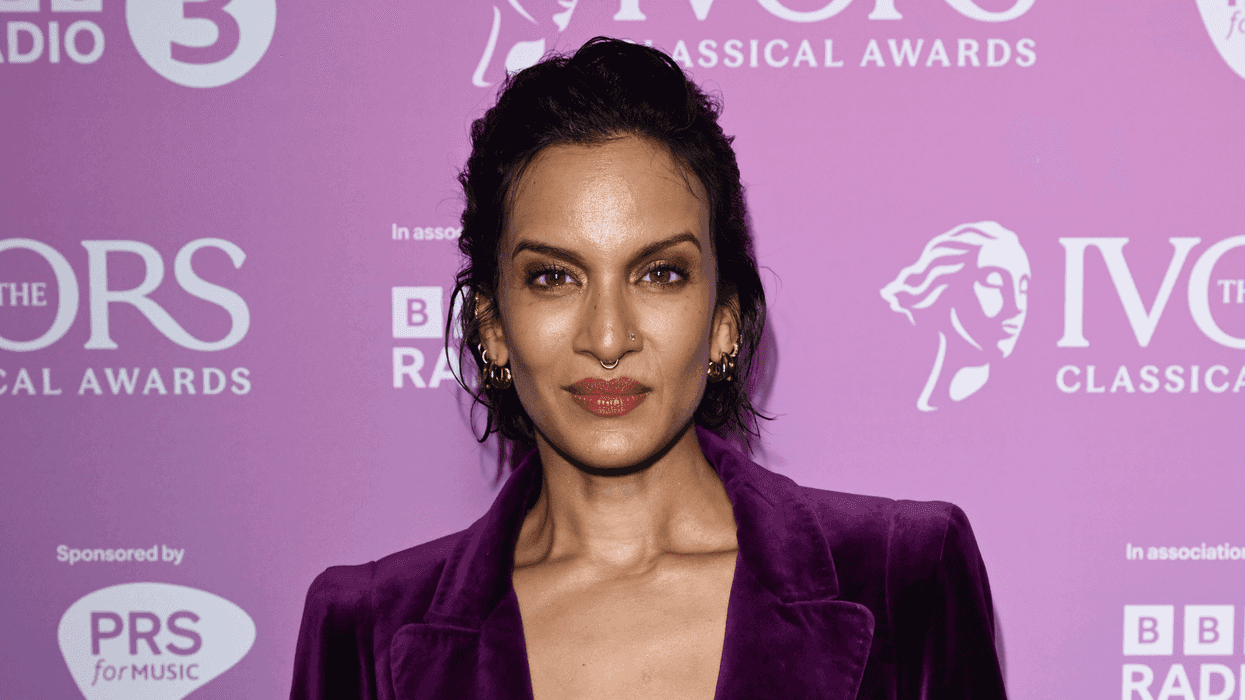

A SITAR can do many things in the right hands: shimmer, mourn, erupt into rhythm. When Damon Albarn began gathering collaborators for Gorillaz’s latest album The Mountain, he invited Anoushka Shankar into the studio for what was meant to be a short session. Instead, the instrument – and the artist behind it – became a quiet thread running through the record.
Albarn had asked Shankar to join a two-day recording session, giving her remarkable freedom. What followed became one of the album’s most discussed creative pairings. Rather than a single cameo, Shankar’s sitar appears across six tracks, woven into the record’s dense sonic architecture.
“They were very open about which songs to put sitar on,” Shankar, 44, told the Hollywood Reporter India, “and after one or two, they must have liked my style, so we kept doing more.”
For Shankar, however, the significance of the Gorillaz collaboration runs deeper than a high-profile credit. For three decades she has been building precisely this kind of musical bridge – between traditions, cultures and genres – and she understands the power of a platform as vast as Gorillaz’s to carry that work to new audiences.
The collaboration arrives during a period of extraordinary momentum. In January, Shankar announced that the three instalments of her Chapters trilogy will receive a full orchestral performance at Amsterdam’s storied Concertgebouw in May.
Conducted by Robert Ames and performed by the London Contemporary Orchestra, the programme will bring together Forever, For Now; How Dark It Is Before Dawn; and We Return to Light, performed in sequence and reimagined for symphonic forces. It is the kind of ambitious undertaking that only an artist entirely at ease with both classical tradition and contemporary experimentation could attempt.
The concept had already proved its power at the BBC Proms last August, when orchestral versions of the Chapters albums received their world premiere at the Royal Albert Hall.
Last November she received the Ivor Novello Innovation Award at the Ivors Classical Awards – an honour reserved for composers whose work expands the boundaries of music itself. The accolade felt entirely consistent with a career that has resisted neat categorisation.
“I think everything I do in music is about working between genres and borders in a way that isn’t really easy to classify or categorise,” Shankar said when accepting the award.
Within 24 hours came further news: her album Chapter III: We Return to Light and its single Daybreak had both received Grammy nominations, adding to a formidable tally that now stands at 14 nominations across her career.
At the centre of this creative surge is the Chapters trilogy itself – three mini-albums released between 2023 and 2025, each created with a different collaborator and each exploring a distinct emotional terrain.
When she presented the trilogy’s concluding performance at the Brighton Festival last May – where she served as guest director – the moment carried a particular emotional weight. Suffering from vocal strain, Shankar was unable to address the audience herself. Instead, she asked her bandmates to read her reflections aloud: meditations on love, loss, motherhood and resilience. In the packed Brighton Dome, the effect was quietly powerful.
The trilogy’s release also coincided with a personal milestone: 2025 marked 30 years since Shankar first stepped onto a concert stage. In that time she has collaborated with an almost implausibly diverse group of artists – from Herbie Hancock, Patti Smith and Sting to Jacob Collier, Nils Frahm, Arooj Aftab and Rodrigo y Gabriela. Her work has ranged across jazz clubs, symphony halls and outdoor festivals drawing 40,000 people.
Running parallel to her musical career is a deep commitment to humanitarian work. Shankar has been a vocal advocate for social justice, working with organisations including UNHCR and Choose Love, for whom she serves as an official ambassador. She has spoken candidly about her own experience as a survivor of childhood sexual abuse and has supported global campaigns such as One Billion Rising. In the music industry she serves as the inaugural president of the F-List, a UK database designed to address the gender imbalance in the sector.
Beyond Amsterdam, the first half of 2026 promises little respite. A Latin American tour announced in December will bring the Chapters project to new audiences, while a long-awaited return to India – her first tour there in several years – has generated particular excitement. Shankar has described the tour as a celebration of “three decades of growth, risk, and reinvention.”
Born in London in June 1981 to Bengali sitar maestro Ravi Shankar and his Tamil wife Sukanya Rajan, she spent her childhood moving between London and Delhi. Under her father’s rigorous tutelage she began studying the sitar and the intricacies of Indian classical music, absorbing not only a tradition passed down through generations but also the spirit of improvisation that had made Ravi Shankar famous worldwide.
Her public debut came in February 1995 at Siri Fort in New Delhi, aged just 13, performing at her father’s 75th birthday concert alongside tabla maestro Zakir Hussain. By 14 she was touring internationally with him. By 15 she was assisting on his landmark album Chants of India, produced by George Harrison, who later helped bring her to the attention of Angel Records.
Ravi Shankar died in December 2012, leaving behind one of the most influential legacies in modern music. For his daughter, the loss sharpened a sense of responsibility: to honour that inheritance while shaping something entirely her own.
Today, living in London with her sons Zubin and Mohan, Shankar continues to do precisely that. Across orchestras, electronic experiments, global collaborations and intimate solo performances, she has transformed the sitar into a passport between musical worlds – and, in the process, carved out one of the most distinctive and influential careers in contemporary music.
ENDS