
THE fatal stabbing of British lawmaker David Amess was a terrorist incident, police said Saturday (16), as MPs pressed for tougher security in the wake of the second killing of a UK politician while meeting constituents in just over five years.
Veteran Conservative MP David Amess, 69, was talking with voters at a church in the small town of Leigh-on-Sea east of London when he was stabbed to death on Friday (15).
Police said they arrested a 25-year-old suspect and were investigating "a potential motivation linked to Islamist extremism".
Police have said the investigation is in the "very early stages", though multiple UK media outlets, citing sources, reported that the suspect was believed to be a British national with Somali heritage.
 David Amess MP
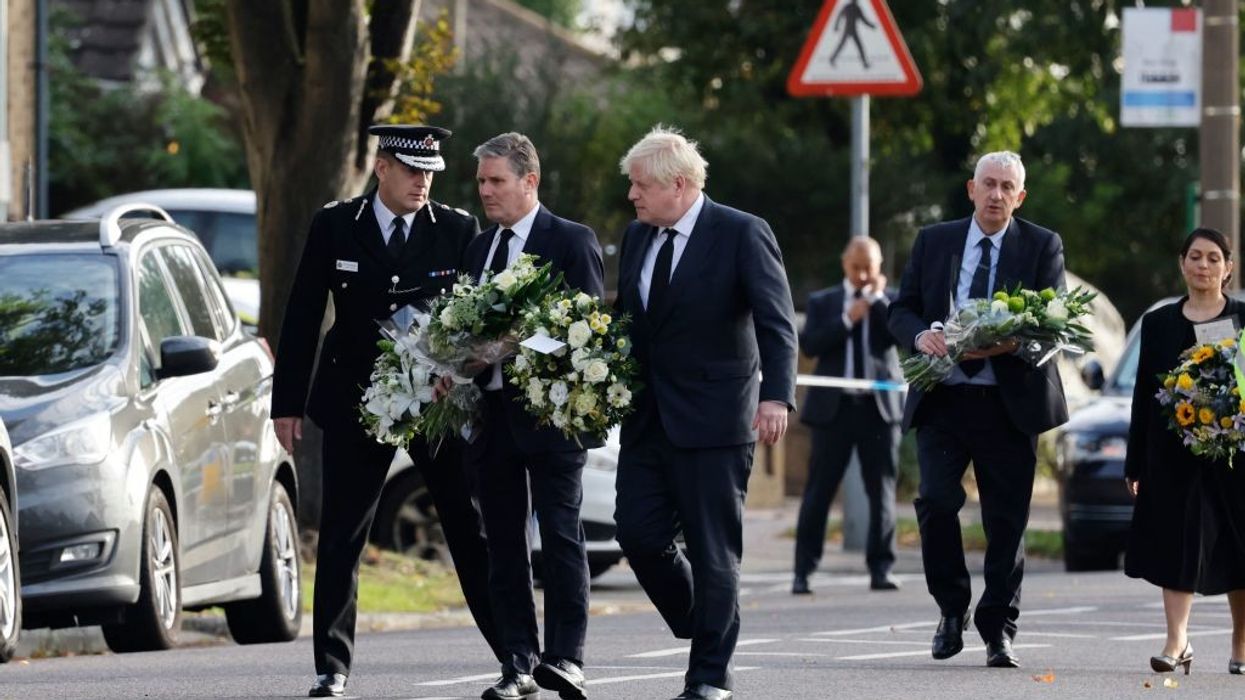
Prime Minister Boris Johnson visited the scene to pay his respects on Saturday, laying floral wreaths outside the church with the leader of the opposition, Labour leader Keir Starmer in a rare show of unity, along with the Speaker of the House of Commons Lindsay Hoyle and Home Secretary Priti Patel.
Members of the public also came to lay bouquets next to the police tape surrounding the crime scene.
Britain's politicians were stunned by the highly public attack, which recalled the murder of a pro-EU lawmaker ahead of the Brexit referendum.
In June 2016, Labour MP Jo Cox was killed by a far-right extremist, prompting demands for action against what lawmakers said was "a rising tide" of public abuse and threats against elected representatives.
Cox's sister Kim Leadbeater, who became an MP in the same constituency this year, said Amess' death had left her "scared and frightened".
"This is the risk we are all taking and so many MPs will be scared by this," she added.
Home secretary Patel on Friday ordered police across the country to review security arrangements for all 650 MPs.
Speaker Hoyle promised no "knee-jerk reactions" but told Sky News: "We will take further measures if we need to".
Tobias Ellwood, a Conservative MP who tried to save a stabbed police officer during a 2017 terror attack near the Houses of Parliament, on Twitter urged "a temporary pause in face to face meetings" until the security review is complete.
Deep political divisions after Brexit
MPs and their staff have been attacked before, although it is rare.
But their safety was thrown into sharp focus by Brexit, which stoked deep political divisions and has led to often angry, partisan rhetoric.
Cox's killer repeatedly shouted "Britain first" before shooting and stabbing the 41-year-old MP outside her constituency meeting near Leeds, northern England.
A specialist police unit set up to investigate threats against MPs in the aftermath said 678 crimes against lawmakers were reported between 2016 and 2020.
Most (582) were for malicious communications, although other crimes included harassment (46), terrorism (nine), threats (seven), and common assault (three).
Separate figures indicated a sharp rise in reports since 2018, including three threats to kill.
Ex-MP Anna Soubry, who quit the Conservative party because of her opposition to Brexit, has spoken of being sent bullets during an intimidation campaign that also targeted her family.
"I do get frightened," she said at the time.
Amess himself wrote about public harassment and online abuse in his book "Ayes & Ears: A Survivor's Guide to Westminster", published last year.
"These increasing attacks have rather spoilt the great British tradition of the people openly meeting their elected politicians," he said.
MPs have had to install security cameras and only meet constituents by appointment, he added.
MPs' staff have also spoken of bearing the brunt of abuse.
"I would get in and all I would do is go on Facebook and report death threats and delete them," said Jade Botterill, who worked for senior Labour MP Yvette Cooper from 2013 to 2019.
"I reckon I reported over 1,000 death threats," she said, adding it caused her sleepless nights and fears she would be attacked.
Brexit had been a turning point for staff working in constituency offices while an MP was in parliament were often on the frontline of daily public anger, she added.






 Curator Emma Slocombe with ikat robes and arabachi coats in the Peter the Great Room in Blickling Hall Amit Roy
 View of the entrance to Blickling Hall on a rainy autumn dayAmit Roy
 Kente cloth from Ghana in the Long Gallery in Blickling Hall
 Decoration in the Great Hall at Blickling Hall Amit Roy
 Palampore fragment made in coastal south-east India in the Brown Room in Blickling Hall Amit Roy
 Bed valance dating from early 1700s in the Italian Print Room at Blickling Hall Amit Roy
 Indian inspired fabric draped on sofas in the South Drawing Room in Blickling Hall Amit Roy
 Indian inspired fabric draped on sofas in the South Drawing Room with Indian carpet in Blickling Hall Amit Roy
 Karun Thakar has picked out the geometric patterns in the bookcase and the Kente cloth in the Long Gallery in Blickling Hall Amit Roy
 Large tapestry depicting Peter the Great defeating the Swedish army at the Battle of Poltava in 1709 Amit Roy
 ikat robes and arabachi coats in the Peter the Great Room in Blickling Hall Amit Roy
 Baghs and kanthas made by women provide contrast to the men only portraits in the Great Hall at Blickling Hall Amit Roy
 Baghs and kanthas in the entrance Great Hall at Blickling Hall Amit Roy
 Baghs and Kanthas in the Great Hall in harmony with stained glass window at Blickling Hall Amit Roy
 Kimonos reflect Japanese influence in Upper Ante Room in Blickling Hall Amit Roy
 Kimono in Upper Ante Room in Blickling Hall
 A view of the Palace and fort at Agra shows romantic side of India Amit Roy
 Blickling Hall Amit Roy
 Table carpet, European 1670-1680 Amit Roy
 Unfinished 17th century Italian embroidery in the Print Room at Blickling Hall Amit Roy
 Picture of Kashmir shows a romantic view of India Amit Roy
 A panel of Ashburnham bed hangings made in Gujarat for sale in Europe in the Brown Room in Blickling Hall Amit Roy
 Colcha made in the 1600s by women in Bengal for the Portuguese market in the Long Gallery at Blickling Hall Amit Roy




