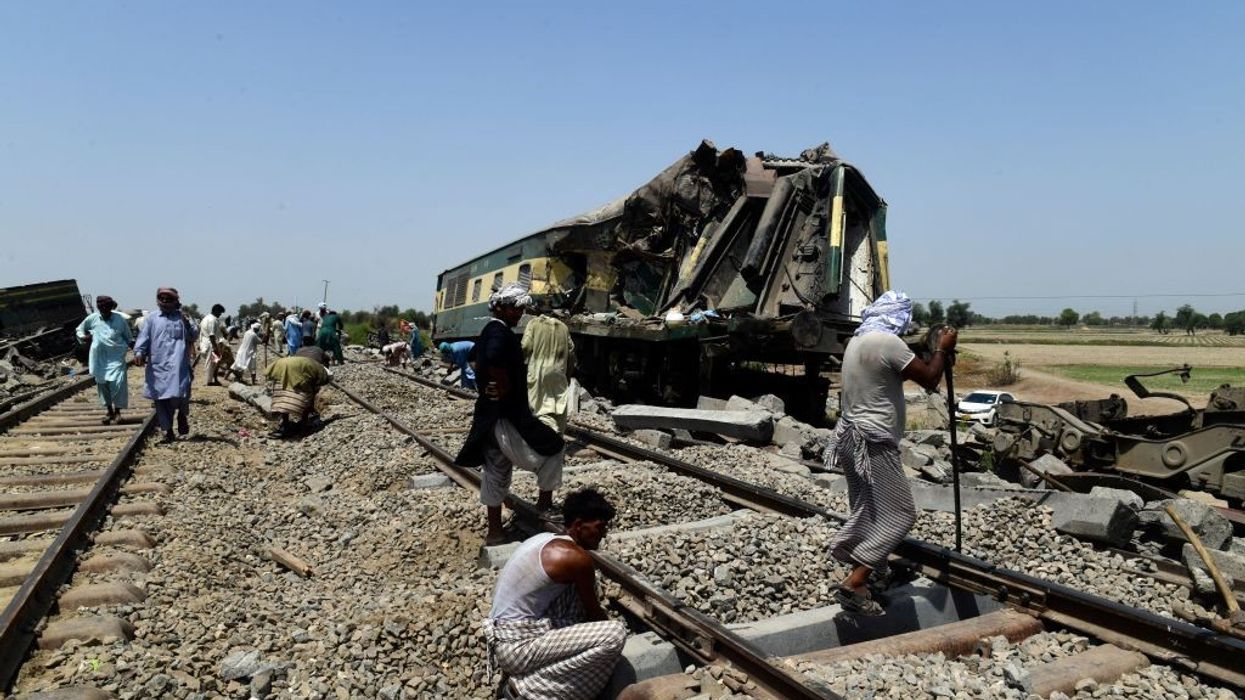

A TRAIN that derailed onto the path of another oncoming passenger express began its journey despite a faulty carriage link, Pakistan's railway minister said on Wednesday (9), as authorities probed the cause of the crash that killed 63 people.
The Sir Syed Express passenger train on Monday (7) ploughed through carriages of the Millat Express, which had derailed minutes earlier near Daharki in Sindh province.
The accident has reignited debate about the parlous state of Pakistan's public transport system - particularly the rail network that has seen little investment in decades.
"The buffer joint of coach number 10 of Millat Express was faulty and bolts were also loose, that led to the derailment," railways minister Azam Swati told a press conference in Lahore.
The buffer joint, or coupling, connects carriages.
Swati blamed the accident on the ageing rolling stock - some of which is more than 50 years old - and called for massive investments in the country's creaking and accident-prone rail network.
"We are a poor country and do not even have new technology to overhaul coaches," he said, adding technicians were "still using hammers".
Swati said some 22 senior and junior level officials had some responsibility for a chain of errors that lead to the accident and would be "taken to task".
He said most of the casualties came from the collision of the trains rather than the derailment.
While locals rushed to the scene to help, it took hours for specialist machinery to arrive to extricate people from the tangled wreckage.
A majority of Pakistan's train passengers are working-class people who cannot afford the quicker bus journeys.
More than 300 people were killed and 700 injured in 1990 when an overloaded 16-carriage inter-city train crashed into a stationary freight train near the city of Sukkur in Sindh.
More recently, at least 75 people died when a train caught fire while travelling from Karachi to Rawalpindi in October 2019.