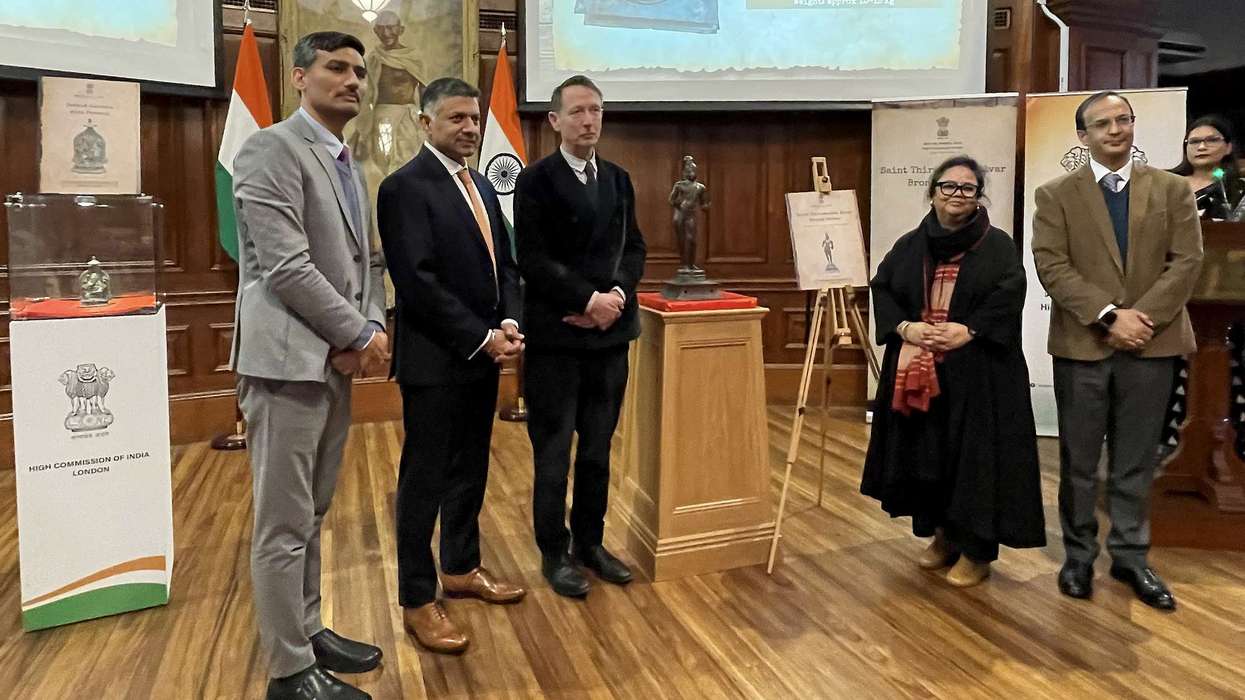

THE University of Oxford's Ashmolean Museum on Tuesday (3) returned a 16th century bronze idol to India, marking the first time the museum has repatriated an artefact in its history.
The bronze figure of Saint Thirumankai Alvar was acquired by the museum at a Sotheby's auction in 1967. Its origins at the Shri Soundararaja Perumal temple in Thadikombu, Tamil Nadu state, came to light in November 2019 when an independent researcher alerted the museum. The idol is believed to have been stolen from the temple, where it was replaced with a modern replica.
Following the researcher's findings, the museum contacted the High Commission of India in London to confirm the provenance. Experts from the museum also travelled to India to work with the Archaeological Survey of India (ASI), Tamil Nadu state officials and temple authorities. The process concluded at a formal hand-over ceremony at India House in London this week.
The bronze will now be shipped to India, where the ASI will work with the state government on its restoration to the temple.
Dr Xa Sturgis, director of the Ashmolean, founded in 1683 as Britain's first public museum, said the decision to return the figure followed naturally from the evidence.
"It was over five years ago that we first became aware that there was evidence that this bronze had been photographed in the temple in Tamil Nadu," he said. "At that point it became evident that there was no legitimate way in which it could have left India. And, even though the museum acquired this bronze in 1967 in good faith, we opened a conversation with the Indian High Commission about the possibility of returning this object to India."
Vikram Doraiswami, Indian high commissioner to the UK, said the return set a precedent.
"This is the first time, I understand, they have actually returned anything. It is a major step for the museum to recognise that while being a repository of the art heritage of the world, integrity requires that items have been reached in the right way," he said.
The hand-over ceremony also included four further artefacts stolen from India and recovered through a joint operation involving Homeland Security Investigations (HSI), the investigative arm of the US Department of Homeland Security, the Metropolitan Police's Art and Antiques Unit, and India's Directorate of Revenue Intelligence.
The items included statuettes of a Seated Ganesha with Parasol; a Dancing Ganesha; a Dancing Child Saint Sambandar/Bal Krishna, and a Pedestal.
William Crogan of HSI at the US Embassy in London said further work remained. "While today's event celebrates the successful recovery and return of these cultural items, there's more work to be done so other criminal organisations can be held to account for depriving access to significant antiquities," he said.
William Lyne, head of the Metropolitan Police's Economic and Cybercrime Command, said cross-border cooperation was essential to tackling the trade. "The illicit trade in cultural property is almost always transnational, with criminals exploiting differences in legislation and the complexities of sharing information across jurisdictions," he said.
Baroness Thangam Debbonnaire, a House of Lords peer, said the return carried personal significance. "I am really excited that this statue is on its way home to Tamil Nadu, the part of India where my dad's from. Particularly important is the difference between just seeing it as a beautiful work of art, which it is, but also as a sacred object from a living temple," she said.
(PTI)