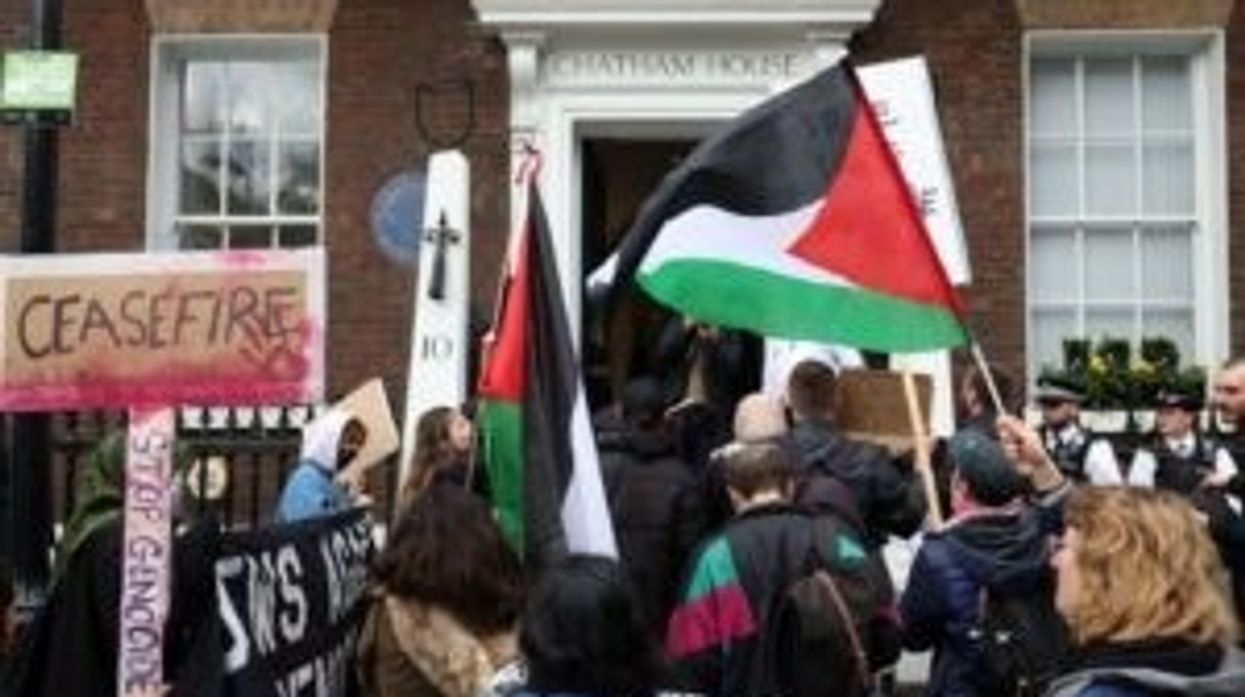

Hundreds of thousands of protesters are anticipated to participate in a pro-Palestinian march in London on Saturday (11). The event, criticised by prime minister Rishi Sunak as disrespectful, raises concerns about potential violence on the day dedicated to the remembrance for war veterans.
The "National March for Palestine" is the fourth to be staged in the British capital since the October 7 Hamas attacks on Israel, but ministers have said it should be cancelled as it coincides with Armistice Day, which marks the end of World War One, and commemorations for those killed in military action.
Police have said they will have almost 2,000 officers on duty, vowing to crack down on any disorder caused either by those involved in the march or a counter-protest by opposing right-wing groups and veterans.
"I do believe if the groups come together, there will be serious disorder," said Deputy Assistant Commissioner Laurence Taylor, the officer in charge.
"The policing operation this weekend is huge," he told reporters, saying it would be "challenging and tense".
There has been strong support and sympathy for Israel from Western governments, including Britain's, and many citizens over the Hamas attacks. But the Israeli response has also prompted anger, with weekly protests in London demanding a ceasefire.
Organisers from the Palestine Solidarity Campaign have said Saturday's march will steer clear of the Cenotaph war memorial near Sunak's Downing Street office, and will conclude at the U.S. embassy about two miles away.
Police have said they would impose an exclusion zone around areas connected to remembrance events, while an unprecedented 24-hour police guard at the Cenotaph has been in place since Thursday.
"We could have one of the biggest marches in British political history potentially, but I would confidently say hundreds of thousands will be attending," Ben Jamal, the PCS Director said.
"Politicians can only ignore significant bodies of public opinion for so long."
'HATE MARCHERS'
While previous PSC marches have been generally peaceful, there have been more than 100 arrests for offences including showing support for Hamas, which is banned as a terrorist organisation in Britain, or holding placards with offensive slogans.
Three women appeared in court on Friday charged with terrorism offences for supporting Hamas by wearing paraglider images, and police say the behaviour of breakaway groups at the rallies has become more violent.
Home secretary Suella Braverman, the minister in charge of policing, has courted controversy by calling the protesters "hate marchers", and Sunak has come under pressure from his own lawmakers to sack her after she accused the police of double standards over how they treated "pro-Palestinian mobs".
The prime minister himself has said Saturday's protest was disrespectful, but should be allowed to go ahead, although he said he would be holding London's police chief accountable for safeguarding remembrance events.
Lawmakers have voiced concern that far-right groups will seek to use the occasion as an excuse for violence.
Stephen Yaxley-Lennon, the former co-leader of the English Defence League, which staged often violent demonstrations against Islam, has called for his supporters to mass in the capital.
"We want to show the world that the British people ain't having it," Yaxley-Lennon, who goes by the name of Tommy Robinson, said on a social media video. "So ... I hope this Saturday I see as many of you as possible in London."
DAC Taylor said police were hoping to prevent trouble, but clashes were likely.
"There will be times this weekend where you see pockets of confrontation, despite the conditions and everything that I've put in place to manage that," he said.
"I hope we don't, but I think it's likely you will see police having to use force to manage some of the situations that we have to deal with."
(Reuters)






 Curator Emma Slocombe with ikat robes and arabachi coats in the Peter the Great Room in Blickling Hall Amit Roy
 View of the entrance to Blickling Hall on a rainy autumn dayAmit Roy
 Kente cloth from Ghana in the Long Gallery in Blickling Hall
 Decoration in the Great Hall at Blickling Hall Amit Roy
 Palampore fragment made in coastal south-east India in the Brown Room in Blickling Hall Amit Roy
 Bed valance dating from early 1700s in the Italian Print Room at Blickling Hall Amit Roy
 Indian inspired fabric draped on sofas in the South Drawing Room in Blickling Hall Amit Roy
 Indian inspired fabric draped on sofas in the South Drawing Room with Indian carpet in Blickling Hall Amit Roy
 Karun Thakar has picked out the geometric patterns in the bookcase and the Kente cloth in the Long Gallery in Blickling Hall Amit Roy
 Large tapestry depicting Peter the Great defeating the Swedish army at the Battle of Poltava in 1709 Amit Roy
 ikat robes and arabachi coats in the Peter the Great Room in Blickling Hall Amit Roy
 Baghs and kanthas made by women provide contrast to the men only portraits in the Great Hall at Blickling Hall Amit Roy
 Baghs and kanthas in the entrance Great Hall at Blickling Hall Amit Roy
 Baghs and Kanthas in the Great Hall in harmony with stained glass window at Blickling Hall Amit Roy
 Kimonos reflect Japanese influence in Upper Ante Room in Blickling Hall Amit Roy
 Kimono in Upper Ante Room in Blickling Hall
 A view of the Palace and fort at Agra shows romantic side of India Amit Roy
 Blickling Hall Amit Roy
 Table carpet, European 1670-1680 Amit Roy
 Unfinished 17th century Italian embroidery in the Print Room at Blickling Hall Amit Roy
 Picture of Kashmir shows a romantic view of India Amit Roy
 A panel of Ashburnham bed hangings made in Gujarat for sale in Europe in the Brown Room in Blickling Hall Amit Roy
 Colcha made in the 1600s by women in Bengal for the Portuguese market in the Long Gallery at Blickling Hall Amit Roy




