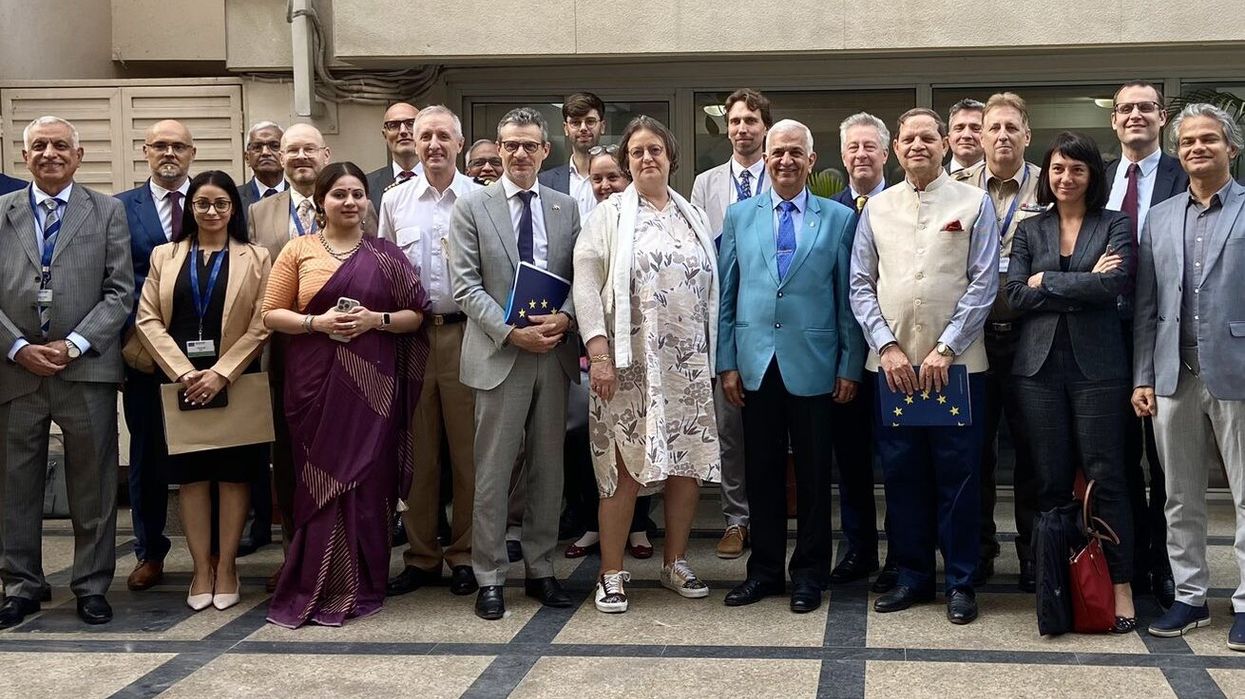

India and the European Union (EU) have pledged to expand cooperation in the Indo-Pacific to tackle shared security challenges and foster peace and stability in the region.
This commitment was discussed during a security and defence dialogue held in Delhi on Monday.
Co-chaired by Vishvesh Negi from India's defence ministry and Joanneke Balfoort from the European External Action Service, the meeting saw discussions on enhancing collaboration in the Indo-Pacific region.
Both sides reaffirmed their dedication to a free, open, inclusive, and rules-based maritime order in the Indo-Pacific, highlighting principles like respect for territorial integrity, sovereignty, democracy, rule of law, and freedom of navigation and overflight.
They also stressed the importance of unhindered lawful commerce and peaceful dispute resolution in accordance with international law, particularly the United Nations Convention on the Law of the Sea (UNCLOS).
The EU aims to contribute to stability, security, prosperity, and sustainable development in the Indo-Pacific, with a focus on promoting democracy, rule of law, human rights, and international law.
A seminar organised by the EU delegation in India further explored the security environment in the Indo-Pacific and the EU's role as a security actor, with a specific emphasis on cooperation with India.
Attendees included security and defence experts, think tank representatives, diplomats, Indian officials, and EU member state representatives. Joanneke Balfoort highlighted India's strategic importance, stating, "We see India, a country with considerable strategic weight on the global security balance, as a key partner for the EU in the Indo-Pacific."
EU Ambassador to India, Herve Delphin, emphasised the need for cooperation amidst a volatile global environment, stressing the importance of working together with international partners like India to address common security challenges and promote peace and stability.
He underscored the increasing interconnectedness between Europe and the Indo-Pacific, emphasising the growing significance of cooperation with Asian partners, particularly India.






 Curator Emma Slocombe with ikat robes and arabachi coats in the Peter the Great Room in Blickling Hall Amit Roy
 View of the entrance to Blickling Hall on a rainy autumn dayAmit Roy
 Kente cloth from Ghana in the Long Gallery in Blickling Hall
 Decoration in the Great Hall at Blickling Hall Amit Roy
 Palampore fragment made in coastal south-east India in the Brown Room in Blickling Hall Amit Roy
 Bed valance dating from early 1700s in the Italian Print Room at Blickling Hall Amit Roy
 Indian inspired fabric draped on sofas in the South Drawing Room in Blickling Hall Amit Roy
 Indian inspired fabric draped on sofas in the South Drawing Room with Indian carpet in Blickling Hall Amit Roy
 Karun Thakar has picked out the geometric patterns in the bookcase and the Kente cloth in the Long Gallery in Blickling Hall Amit Roy
 Large tapestry depicting Peter the Great defeating the Swedish army at the Battle of Poltava in 1709 Amit Roy
 ikat robes and arabachi coats in the Peter the Great Room in Blickling Hall Amit Roy
 Baghs and kanthas made by women provide contrast to the men only portraits in the Great Hall at Blickling Hall Amit Roy
 Baghs and kanthas in the entrance Great Hall at Blickling Hall Amit Roy
 Baghs and Kanthas in the Great Hall in harmony with stained glass window at Blickling Hall Amit Roy
 Kimonos reflect Japanese influence in Upper Ante Room in Blickling Hall Amit Roy
 Kimono in Upper Ante Room in Blickling Hall
 A view of the Palace and fort at Agra shows romantic side of India Amit Roy
 Blickling Hall Amit Roy
 Table carpet, European 1670-1680 Amit Roy
 Unfinished 17th century Italian embroidery in the Print Room at Blickling Hall Amit Roy
 Picture of Kashmir shows a romantic view of India Amit Roy
 A panel of Ashburnham bed hangings made in Gujarat for sale in Europe in the Brown Room in Blickling Hall Amit Roy
 Colcha made in the 1600s by women in Bengal for the Portuguese market in the Long Gallery at Blickling Hall Amit Roy




