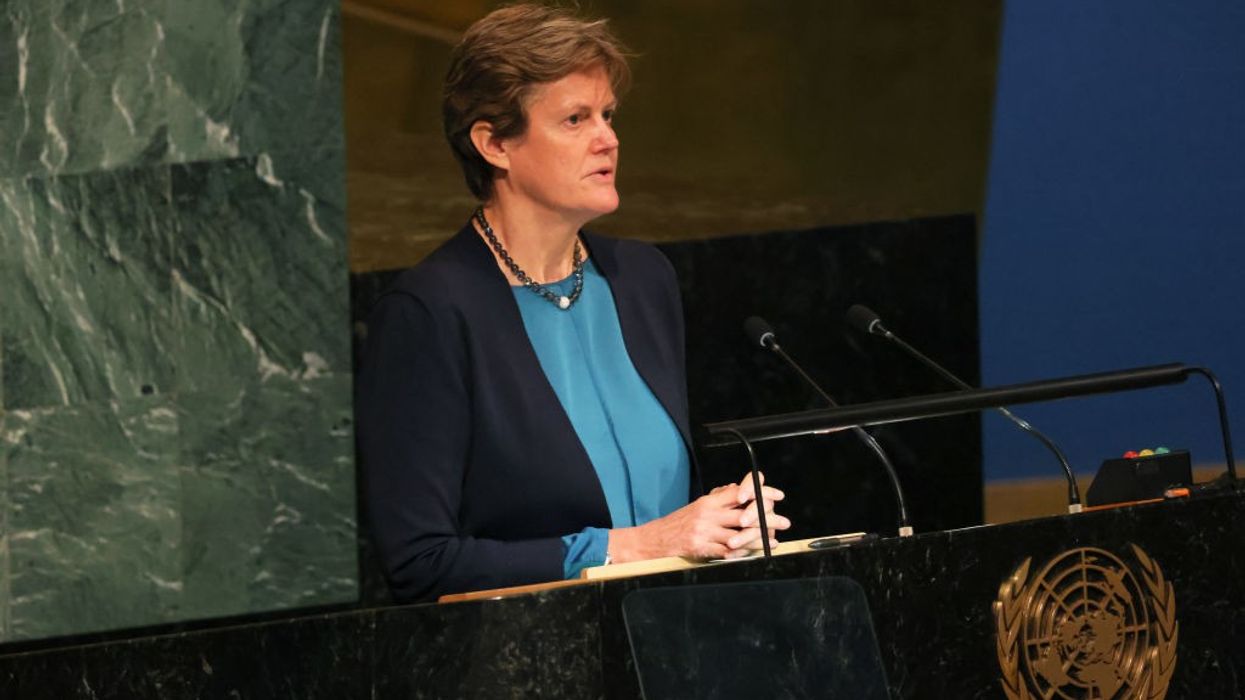

France and the United Kingdom, two veto-wielding permanent members of the Security Council, reiterated their support for a permanent seat for India at the powerful horse-shoe table.
“France supports the candidacy of Germany, Brazil, India and Japan as permanent members. It also wishes to see a stronger presence of African countries, among both permanent and non-permanent members,” French Ambassador at the UN Nicolas De Riviere said in his remarks at the UN Security Council open debate on ‘Maintenance of International Peace and Security: New Orientation for Reformed Multilateralism’ chaired by External Affairs Minister S Jaishankar.
Riviere said the Security Council remains the “keystone of our collective security architecture”.
“I want to reaffirm forcefully that France is in favour of a reform of the Security Council…We support an enlargement of the Security Council to take into account the emergence of new powers that are willing and able to assume the responsibility of a permanent presence in the Security Council.”
UK Ambassador Barbara Woodward said as the UK Foreign Secretary James Cleverly “publicly reiterated this week, we support new permanent seats for Brazil, Germany, India and Japan, and permanent African representation”.
Stressing that the world today is very different to the one that gave birth to the UN in 1945, Woodward said, “It is right that we consider how the UN and the multilateral system should evolve. The Security Council must, as others have said, become more representative of the world today and the UK has long called for its expansion, in both the permanent and non-permanent categories.” Jaishankar arrived here Tuesday to preside over two signature events on counter-terrorism and reformed multilateralism being held under India’s current Presidency of the UN Security Council before the curtains come down this month on the country’s two-year tenure as an elected member of the powerful 15-nation group.
(PTI)






 Curator Emma Slocombe with ikat robes and arabachi coats in the Peter the Great Room in Blickling Hall Amit Roy
 View of the entrance to Blickling Hall on a rainy autumn dayAmit Roy
 Kente cloth from Ghana in the Long Gallery in Blickling Hall
 Decoration in the Great Hall at Blickling Hall Amit Roy
 Palampore fragment made in coastal south-east India in the Brown Room in Blickling Hall Amit Roy
 Bed valance dating from early 1700s in the Italian Print Room at Blickling Hall Amit Roy
 Indian inspired fabric draped on sofas in the South Drawing Room in Blickling Hall Amit Roy
 Indian inspired fabric draped on sofas in the South Drawing Room with Indian carpet in Blickling Hall Amit Roy
 Karun Thakar has picked out the geometric patterns in the bookcase and the Kente cloth in the Long Gallery in Blickling Hall Amit Roy
 Large tapestry depicting Peter the Great defeating the Swedish army at the Battle of Poltava in 1709 Amit Roy
 ikat robes and arabachi coats in the Peter the Great Room in Blickling Hall Amit Roy
 Baghs and kanthas made by women provide contrast to the men only portraits in the Great Hall at Blickling Hall Amit Roy
 Baghs and kanthas in the entrance Great Hall at Blickling Hall Amit Roy
 Baghs and Kanthas in the Great Hall in harmony with stained glass window at Blickling Hall Amit Roy
 Kimonos reflect Japanese influence in Upper Ante Room in Blickling Hall Amit Roy
 Kimono in Upper Ante Room in Blickling Hall
 A view of the Palace and fort at Agra shows romantic side of India Amit Roy
 Blickling Hall Amit Roy
 Table carpet, European 1670-1680 Amit Roy
 Unfinished 17th century Italian embroidery in the Print Room at Blickling Hall Amit Roy
 Picture of Kashmir shows a romantic view of India Amit Roy
 A panel of Ashburnham bed hangings made in Gujarat for sale in Europe in the Brown Room in Blickling Hall Amit Roy
 Colcha made in the 1600s by women in Bengal for the Portuguese market in the Long Gallery at Blickling Hall Amit Roy




