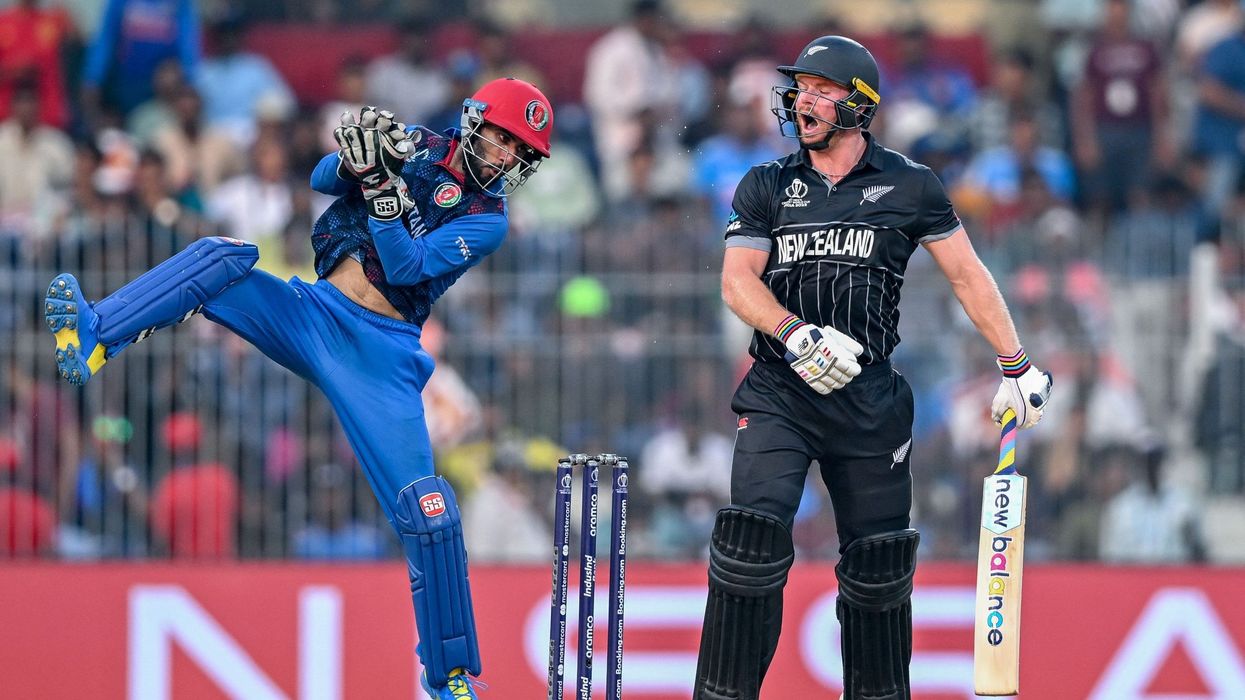
NEW ZEALAND handed giant-killing Afghanistan a brutal reality check on Wednesday (18) when they exploited a disastrous fielding performance to romp to a 149-run victory at the Cricket World Cup.
Glenn Phillips, Tom Latham and Will Young all scored half centuries and benefitted from dropped catches to score a fighting 288-6.
The Black Caps then ran through Afghanistan, who had shocked defending champions England last time out, for just 139 in 34.4 overs.
"I thought 250 was par. We are in an environment where we keep working for each other and play as a team," said man of the match Phillips who made 71.
The victory gives New Zealand, runners-up at the last two World Cups, a fourth victory in as many games and comfortably on course for the semi-finals.
Fast bowler Lockie Ferguson took 3-19, spinner Mitchell Santner claimed 3-39 while veteran seamer Trent Boult chipped in with 2-18 as New Zealand turned the screw.
Afghanistan have one win and three defeats from their four games.
"We are very disappointed because at this level you have to take those kind of catches. End of the day those catches hurt us," admitted captain Hashmatullah Shahidi, one of the worst culprits.
They had hoped Rahmanullah Gurbaz could repeat his fireworks against England when he made 80.
However, on Wednesday, the opener was cleaned up by Matt Henry in the sixth over for just 11.
Boult dismissed Ibrahim Zadran (14) and Azmatullah Omarzai (27) while Rachin Ravindra dismissed Rahmat Shah who was the top-scorer for Afghanistan with 36.
Santner completed 100 wickets in his 98th ODI when he dismissed Mohammad Nabi for seven before wrecking the rest of the batting in the company of Ferguson.
Earlier, Phillips hit 71 off 80 balls, Latham made 68 off 74 and opener Young 54 off 64 balls to lift New Zealand from a precarious 110-4 after they were sent in to bat on a slow pitch.
Mark Chapman fired a rapid 25 off 12 balls with two fours and a six as New Zealand scored 62 runs in the last five overs.
Afghanistan dropped as many as five catches.
These included Young being dropped by Rahmat Shah off Fazalhaq Farooqi before he had scored in the first over while skipper Hashmatullah Shahidi let off Ravindra on nought and Latham on 38.
New Zealand were off to a slow start of 30 in the seventh over when Mujeeb Ur Rahman removed Devon Conway for 20.
Young, replacing skipper Kane Williamson who fractured his thumb in the last game, added 79 for the second wicket with Ravindra who scored a 41-ball 32.
But Afghanistan hit back with three wickets off just nine balls for one run as pacer Omarzai dismissed Ravindra and Young in the same over.
Young had three sixes and four boundaries in his knock.
In the next over spinner Rashid Khan had Daryl Mitchell for one as New Zealand lost their way.
It was left to Phillips, who cracked four sixes and as many fours, to join stand-in skipper Latham in a solid fifth wicket stand of 144 to revive the innings.
Latham hit three fours and two sixes but he and Phillips fell for the addition of just one run, leaving Chapman to provide late impetus.
Fast bowlers Naveen-ul-Haq and Omarzai took two wickets apiece.
(AFP)
Clinical New Zealand rout Afghanistan
It was a disastrous fielding performance by the Afghans who dropped five catches