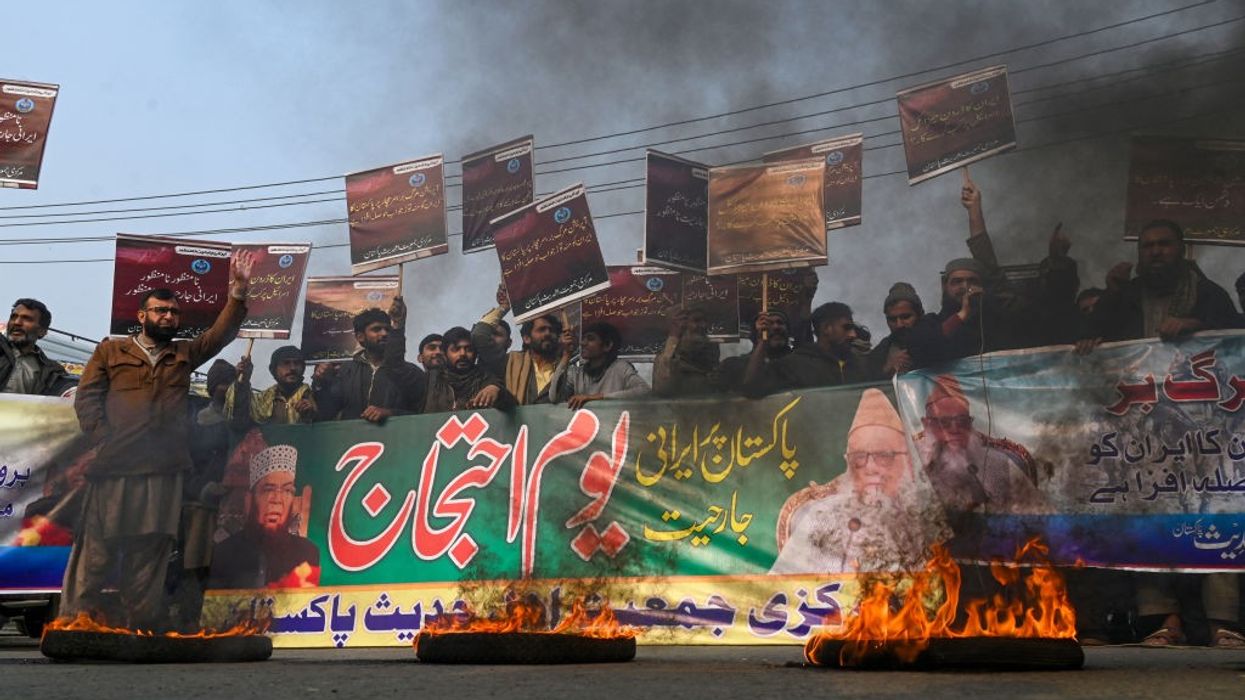

CHINA has assured Islamabad of its support in defending its sovereignty and territorial integrity even while welcoming on Tuesday (23) the restoration of diplomatic ties between Tehran and Islamabad after their recent air strikes against each other.
As China’s foreign minister Sun Weidong visited Pakistan on a mediation mission, a statement from the ministry on Monday (22) said it is maintaining close contacts with Pakistan and Iran to “bridge their differences.”
China on January 18 offered to play a “constructive role” to ease tension between Pakistan and Iran following their missile strikes against each other and asked the two countries to "exercise restraint and calmness and avoid escalation.”
Earlier, Pakistan conducted "precision military strikes" against what it called "terrorist hideouts" in Iran's Siestan-Balochistan province that killed nine people.
The attack was seen as retaliation to Iranian missile and drone attacks on January 16 which targeted two bases of the Sunni Baloch militant group Jaish al-Adl in Pakistan's unruly Balochistan province.
Chinese foreign ministry spokesperson Wang Wenbin said, “China welcomes the good progress that Iran and Pakistan have made in repairing their ties and supports them in further enhancing mutual trust and deepening cooperation through friendly consultation.”
China and Pakistan are all-weather strategic co-operative partners, Sun was quoted as saying after his meeting with Pakistan president Arif Ali on Monday. Sun is a former ambassador to both Pakistan and India
China appreciates Pakistan's firm adherence to the one-China principle and “supports Pakistan in safeguarding its sovereignty, independence and territorial integrity,” as well as its unity, stability, development and prosperity, Sun told Alvi.
He also said, China is willing to work with Pakistan to follow through on the important common understandings reached between the leaders of the two countries, deepen political mutual trust, expand practical cooperation, upgrade the China-Pakistan Economic Corridor (CPEC), and “accelerate the building of a closer China-Pakistan community with a shared future in the new era.”
Sun held talks with a host of Pakistan officials including the Army Chief General Syed Asim Munir during which too he assured China’s support to Pakistan in defending its sovereignty and territorial integrity.
He also took part in the key meeting of $60 billion CPEC over which India protested as it is being laid through the Pakistan-Occupied Kashmir, (POK).
Wang Wenbin reiterated its stand on mediation and said in response to a question: “We stand ready to work with Iran and Pakistan to strengthen mutually beneficial cooperation and safeguard regional peace, stability and development.”
Iran and Pakistan have mutually agreed that the ambassadors of both the countries may return to their respective posts by January 26. Following the air strikes against each other, the two countries had expelled the others’ envoys.
Meanwhile, vice foreign minister Ma Zhaoxu in a phone call with Iranian deputy foreign minister Ali Bagheri Kani asked him to reduce tensions.
China is also concerned over Iran’s missile strikes in Balochistan where most of its investments are located especially, the Gwadar port, the starting point of the CPEC project that connects to China’s Xinjiang province.
(PTI)






 Curator Emma Slocombe with ikat robes and arabachi coats in the Peter the Great Room in Blickling Hall Amit Roy
 View of the entrance to Blickling Hall on a rainy autumn dayAmit Roy
 Kente cloth from Ghana in the Long Gallery in Blickling Hall
 Decoration in the Great Hall at Blickling Hall Amit Roy
 Palampore fragment made in coastal south-east India in the Brown Room in Blickling Hall Amit Roy
 Bed valance dating from early 1700s in the Italian Print Room at Blickling Hall Amit Roy
 Indian inspired fabric draped on sofas in the South Drawing Room in Blickling Hall Amit Roy
 Indian inspired fabric draped on sofas in the South Drawing Room with Indian carpet in Blickling Hall Amit Roy
 Karun Thakar has picked out the geometric patterns in the bookcase and the Kente cloth in the Long Gallery in Blickling Hall Amit Roy
 Large tapestry depicting Peter the Great defeating the Swedish army at the Battle of Poltava in 1709 Amit Roy
 ikat robes and arabachi coats in the Peter the Great Room in Blickling Hall Amit Roy
 Baghs and kanthas made by women provide contrast to the men only portraits in the Great Hall at Blickling Hall Amit Roy
 Baghs and kanthas in the entrance Great Hall at Blickling Hall Amit Roy
 Baghs and Kanthas in the Great Hall in harmony with stained glass window at Blickling Hall Amit Roy
 Kimonos reflect Japanese influence in Upper Ante Room in Blickling Hall Amit Roy
 Kimono in Upper Ante Room in Blickling Hall
 A view of the Palace and fort at Agra shows romantic side of India Amit Roy
 Blickling Hall Amit Roy
 Table carpet, European 1670-1680 Amit Roy
 Unfinished 17th century Italian embroidery in the Print Room at Blickling Hall Amit Roy
 Picture of Kashmir shows a romantic view of India Amit Roy
 A panel of Ashburnham bed hangings made in Gujarat for sale in Europe in the Brown Room in Blickling Hall Amit Roy
 Colcha made in the 1600s by women in Bengal for the Portuguese market in the Long Gallery at Blickling Hall Amit Roy




