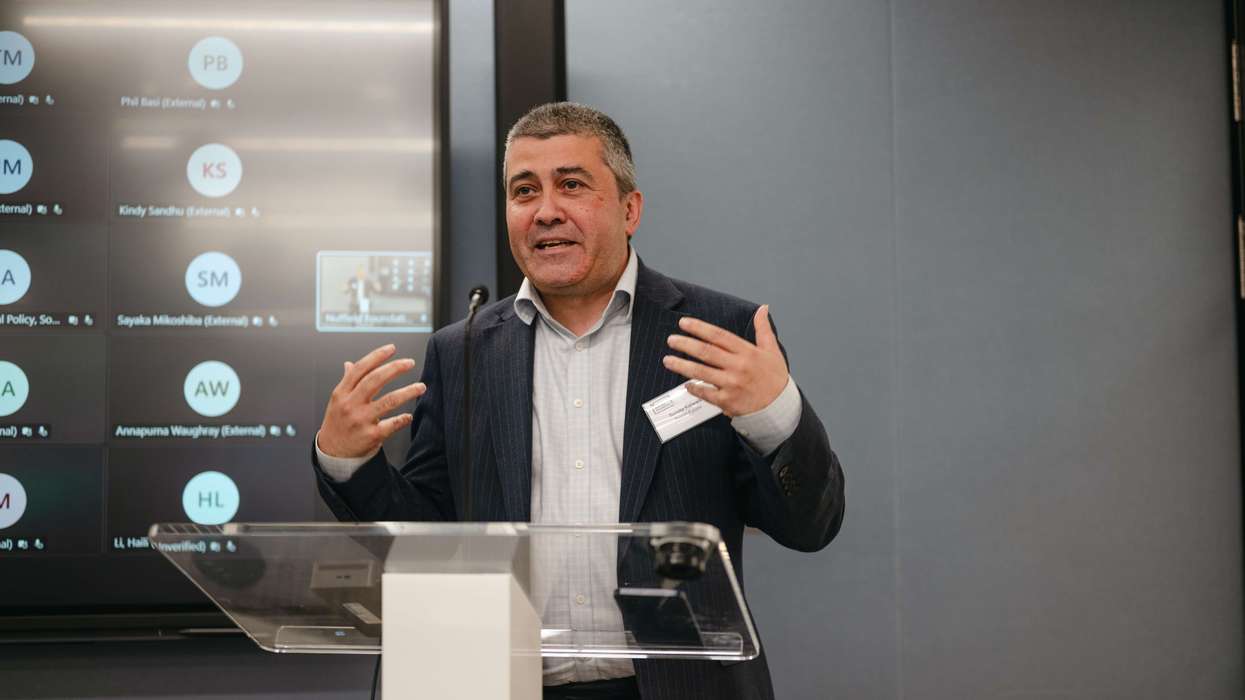

SUNDER KATWALA has spent much of his career asking a deceptively simple question: how does a diverse country tell a shared national story? As director of the thinktank British Future, he has become one of the most influential voices shaping Britain’s debate on race, immigration and identity – a bridge-builder in a public conversation too often dominated by polarisation.
One recent initiative captures both his method and his mission. In 2025, British Future partnered with Eastern Eye and the Royal British Legion to launch the ‘My Family Legacy’ campaign, encouraging British Asian families to share stories of relatives who served in the world wars.
The project sought to highlight a frequently overlooked historical fact: more than 2.5 million South Asians fought in the Second World War, forming the largest volunteer army in history. By gathering photographs, letters and personal memories, the campaign aimed to weave those contributions more firmly into Britain’s national story.
For Katwala, such projects are not simply about historical recognition. They are about strengthening a sense of belonging in modern Britain. “It shows how our national traditions of Remembrance can bring today’s modern, diverse Britain together ever more powerfully when we commemorate all of those who served to secure the freedoms that we enjoy today,” he commented.
Born in Doncaster to an Indian father and an Irish mother who had both come to Britain to work for the NHS, Katwala grew up with a personal understanding of the complexities of identity in Britain. His childhood moved from Yorkshire to Ellesmere Port on the Wirral, experiences reflected in his football loyalties to Everton and Southend United. Like many children of immigrant families in the 1970s and 1980s, he encountered racism early in life, an experience that would shape his later interest in questions of belonging and citizenship.
After studying philosophy, politics and economics at Oxford University, he began his career in journalism and publishing. He worked as a leader writer and internet editor at The Observer, served as research director at the Foreign Policy Centre, and later became commissioning editor for politics and economics at Macmillan. But it was his eight years as general secretary of the Fabian Society, from 2003 to 2011, that cemented his reputation as an influential figure in Britain’s policy and intellectual networks.
In 2012 he founded British Future, a thinktank dedicated to improving the national conversation about immigration, integration and identity. Rather than framing these topics as ideological battlegrounds, the organisation focuses on research, dialogue and practical policy ideas. Its polling and analysis often highlight what Katwala calls the “balancing middle” of British public opinion – the large group of people who combine concerns about immigration levels with recognition of migrants’ contributions to the economy and public services.
British Future’s work has ranged widely, from research on public attitudes towards immigration to initiatives designed to strengthen social cohesion in diverse communities. Its Immigration Attitudes Tracker surveys, for example, have helped reveal the nuance of public opinion, showing that attitudes often vary depending on the type of migration under discussion.
One of its most influential pieces of work last year has been ‘The State of Us’, a major report produced with the Belong Network examining the health of social cohesion across the UK. The research warned that economic pessimism, declining trust in institutions and polarised politics were putting pressure on the bonds that hold communities together. It described a worrying “doom loop” in which governments respond to crises only after tensions erupt, rather than building resilience in advance.
Yet the report also found reasons for optimism. While national politics may appear deeply divided, most people report that their own neighbourhoods remain places where different communities get along well. For Katwala, this gap between political rhetoric and everyday reality reveals something important about Britain’s character.
“In the long run, Britain’s story is of increasing tolerance and liberalism across generations, despite cities and towns having contrasting experiences of economic change,” he wrote in Eastern Eye.
His 2023 book How to Be a Patriot: Why love of country can end our very British culture war – a must-read on British national identity and immigration – argues that patriotism need not be the preserve of nationalists. Instead, he suggests that a confident national identity can provide the common ground needed for a multi-ethnic society to flourish.
In recent years, the urgency of those ideas has grown. Britain’s debates about immigration and national identity have become more heated, with Katwala frequently finding himself in the thick of those debates, offering commentary in national media and advising policymakers across the political spectrum.
He has also confronted the darker side of the digital public square. Like many prominent voices discussing race and immigration, Katwala has experienced online racial abuse, prompting him to document and report incidents in an effort to hold social media platforms accountable for enforcing their own rules against hate speech.
Yet despite the intensity of contemporary debates, Katwala remains cautiously optimistic about Britain’s long-term trajectory. He often points to the everyday normality of diversity in British public life. The presence of ethnic minority leaders across politics, media and business – from local councils to national institutions – would have seemed remarkable only a generation ago. Today, it is largely taken for granted.
That belief in incremental progress underpins much of his work. As chair of the Independent Commission on Inclusion and Belonging in the London borough of Newham, one of the most diverse areas in the country, Katwala has overseen efforts to examine how communities can maintain strong connections amid rapid demographic change. The commission’s report highlighted the importance of shared public spaces, community events and local leadership in fostering a sense of belonging across different backgrounds.
Across these different roles – writer, commentator, thinktank director – Katwala’s influence lies in shaping the terms of debate. He operates not through slogans but through careful argument and evidence, seeking to move conversations away from zero-sum politics towards a more constructive centre ground.
It is a patient project, sometimes frustratingly incremental. But for Sunder Katwala, it remains the most important work of all.