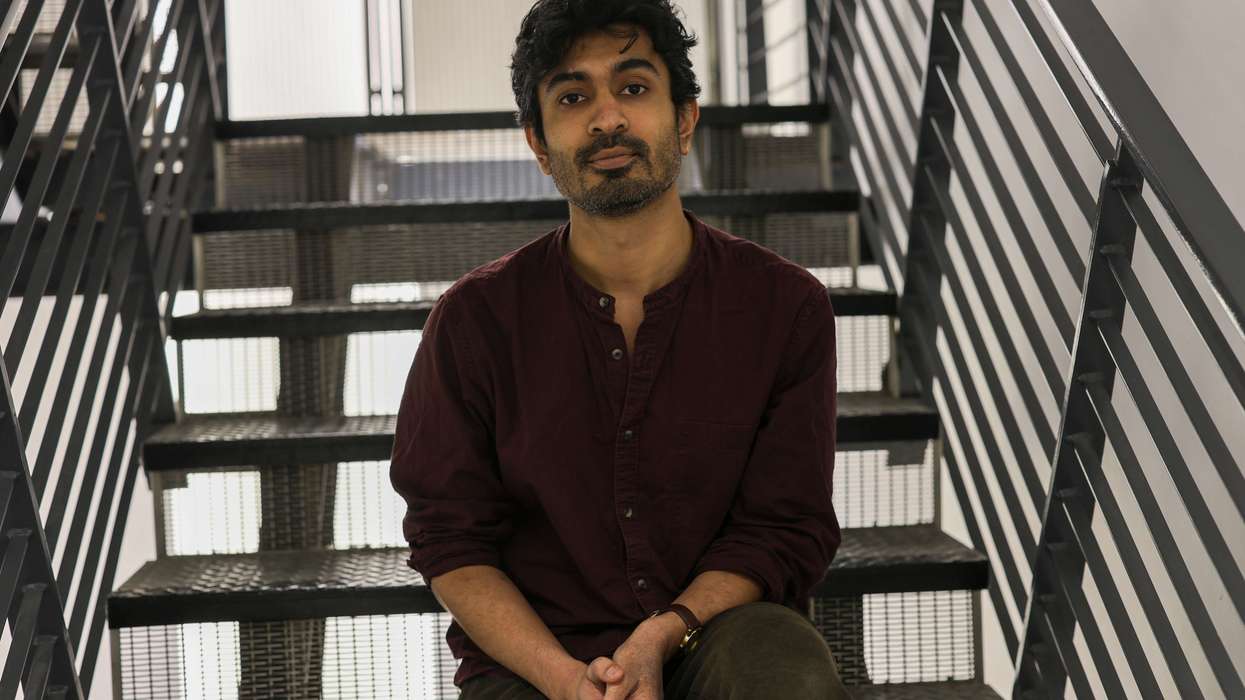

Ahead of the release of his new film Apnas, Ganatra said such projects reflect a growing effort to place British Asian characters within mainstream narratives, without reducing them to stereotypes.
He told Eastern Eye, “We’ve seen progress. But there’s still a tendency to tell our stories in a very narrow way. What’s interesting about Apnas is that it does not try to simplify people. It shows contradictions within families, communities and individuals.”
Set in Manchester, Apnas is the debut feature film from AFA Productions and was released in cinemas across the UK and Ireland on March 20. The film follows two British Pakistani cousins whose lives become entangled in organised crime.
At the centre of the story is Awais (James Greaney), a mild-mannered accountant who becomes involved in laundering money for a family-run drugs network, and his cousin Majid (Asim Ashraf ), who embraces a more overt and dangerous role within the criminal underworld.
Ganatra plays Aslam, Awais’s father, a taxi driver.
“Aslam is a man who’s done everything ‘right’,” Ganatra said. “He’s worked hard, he’s raised his children with clear values, and he expects a certain outcome from that. When things start to fall apart, he’s not equipped to deal with it in the way the younger generation might be.”
Ganatra added, “There’s a sense of confusion in him. He doesn’t fully understand the world his children are navigating. That gap between generations is something many families will recognise.”
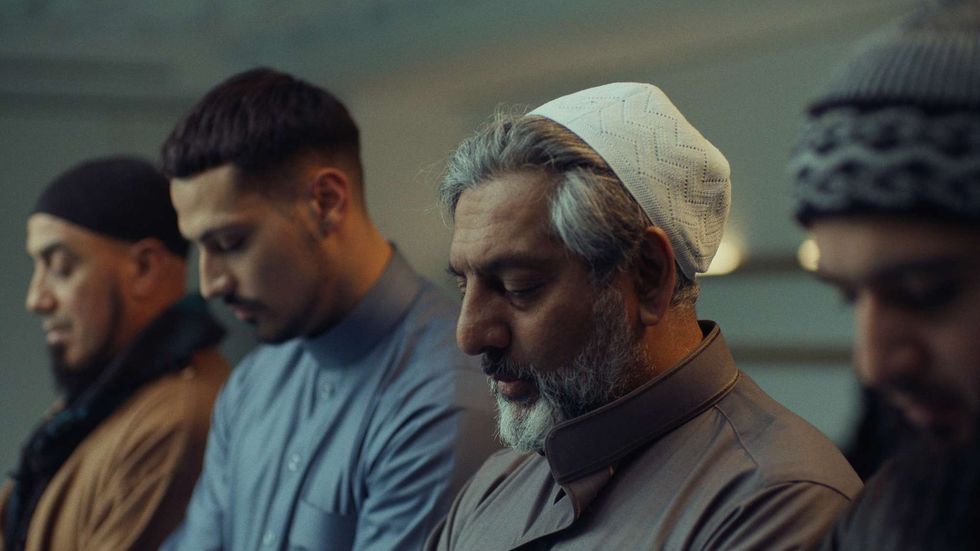 A still from Apnas Apnas
He noted the script avoids presenting Aslam as either rigid or sympathetic in a one-dimensional way. Instead, it situates him within a broader context of immigrant experience. “People like him came here with very specific goals, stability, safety, opportunity for their children. When those expectations are challenged, it creates a kind of emotional tension that isn’t always visible, but it’s very real.”
Despite the film’s backdrop of organised crime, Ganatra said, “It’s not just about drugs or money laundering, it’s about the choices people make under pressure and how those choices affect the people around them.”
While Awais is drawn into the criminal network reluctantly, Majid embraces it with confidence, creating a contrast that drives much of the film’s conflict.
“You’ve got one character who is trying to hold on to a sense of normality and another who’s completely immersed in this other world,” Ganatra said. “And both of them are shaped by the same family.”
The story also reflects broader questions of identity among second-generation British Asians. Ganatra said this is where the film finds its strongest footing. “There’s always this negotiation between who you are at home and who you are outside,” he said. “For the younger characters, that negotiation becomes more complicated when they’re pulled into something like organised crime.”
- YouTube www.youtube.com
He pointed out that the film does not attempt to resolve these tensions neatly. “Life isn’t like that. People don’t just choose one path and everything makes sense. There’s always overlap, always conflict.” The film’s trailer drew more than 3.4 million views ahead of its release.
“It shows there’s a demand for these stories. The industry often says there isn’t, but when you see that level of engagement, it challenges that assumption,” Ganatra said.
He added that the family dimension distinguishes the film from more conventional crime narratives. “If you strip away the crime elements, you’re left with a story about relationships, between parents and children, between cousins, between siblings. That’s what people connect with.”
Ganatra’s career has spanned theatre, television and film, with roles whose themes spanned identity and community. He said his latest movie fits within that trajectory but also reflects changes in the industry.
“When I started out, there were fewer opportunities to tell these kinds of stories,” he said. “Now there’s more space, but it’s still competitive, and there’s still a need to prove that these stories can reach a wide audience.”
He also emphasised the importance of avoiding a single narrative about British Asian life. “There isn’t one experience,” he said. “There are multiple perspectives, multiple realities. Films like Apnas add to that diversity, but they’re only one part of a bigger picture.”
Reflecting on representation in British cinema, Ganatra said progress would depend on sustained effort rather than isolated successes.
“You can’t rely on one film or one moment,” he said, adding “It has to be consistent.” He pointed to the need for more opportunities behind the camera as well as on screen.
“Writers, directors, producers, that’s where change really happens. When you have diversity in those roles, the stories become more varied.”