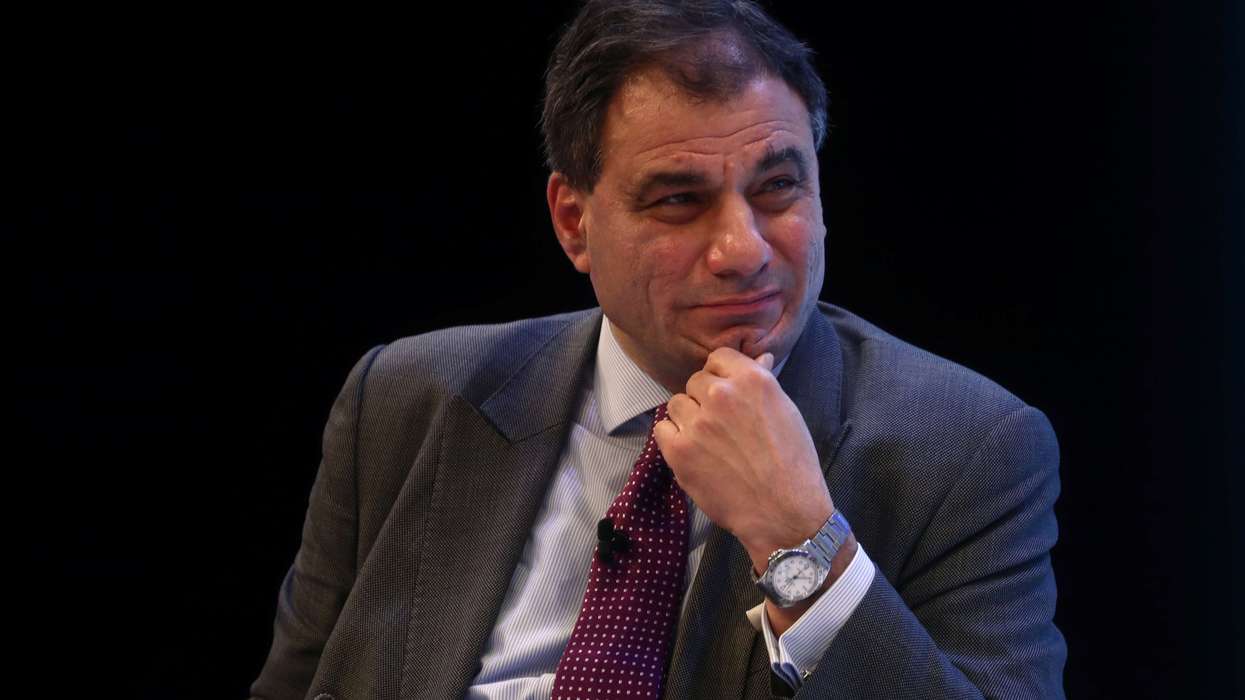

LORD KARAN BILIMORIA remains one of the most consequential British Asian business figures of his generation. He arrived in Britain with little more than a scholarship, a student debt and an idea born in a Cambridge curry house. In the decades since, he has become a baron, a global business leader, a university chancellor and one of the most prominent champions of the UK-India relationship.
His story is not simply one of entrepreneurial triumph. It is also one of resilience – in business, in public life and in the most private corners of family life. He has come close to ruin and rebuilt. When he speaks at international forums today, it is with the authority of someone who has played the long game and survived its sharpest turns.
Behind the titles, honours and public roles, Lord Bilimoria has also shown a rare willingness to reveal vulnerability. In a deeply personal essay published in Eastern Eye last September, he described a night when time stopped.
In December 2024, his 26-year-old daughter Zara fell from the terrace outside her first-floor bedroom at the family’s home in Cape Town in what he described as a freak accident.
“We all rushed down and she was lifeless,” he wrote. “We thought she had died.”
Scans revealed a shattered vertebra and serious spinal cord damage. Zara had already survived bacterial meningitis and sepsis earlier in life, something not lost on her father as he stood beside her hospital bed.
By chance, one of Cape Town’s leading neurosurgeons, Dr David Welsh, happened to be on duty that night. He performed emergency surgery within 12 hours. In the days that followed, Bilimoria later wrote, he “would cry in the bathroom, so she would not see me, and cry all the way home late at night”.
What happened next bordered on the extraordinary. Zara left intensive care after just eight days – a unit where patients with similar injuries often remain for more than a month. Expected to spend three months in rehabilitation, she walked out unaided after nine days. Three weeks after the accident, when she returned to her surgeon’s consulting rooms, he greeted her with the words: “You are one of my Christmas miracles.” By April 2025, she had returned to work full-time.
Prayers had been offered for her recovery in Parsi fire temples across India and Iran, in Sikh gurdwaras, Hindu temples and Christian churches throughout Britain and India. Bilimoria recalled the words of Alfred Lord Tennyson – a favourite poet of his mother’s: “More things are wrought by prayer than this world dreams of.”
The experience reinforced a conviction that no amount of business success had diluted. “Your family is the most important thing by far,” he wrote. “Everything else comes second, by a long way.”
Yet Bilimoria’s influence stretches across business, politics and education. In 2006 he was appointed Lord Bilimoria of Chelsea, becoming the first Zoroastrian Parsi to sit in the House of Lords, where he serves as an Independent Crossbench peer. His parliamentary focus has consistently centred on strengthening ties between Britain and India. He is co-chair of the All-Party Parliamentary Group for International Students and co-chair of the India APPG.
In January 2025 he was appointed chairman of the International Chamber of Commerce UK, adding another significant responsibility to a portfolio that already includes serving as president of the Confederation of British Industry from 2020 to 2022, when he became the first person of black, Asian, and minority ethnic background to hold the post.
Through the UK India Business Council, which he founded and chaired, and as a founding member of the prime minister of India’s Global Advisory Council, he has helped shape many of the institutional links underpinning UK–India trade today.
Few figures in British public life have advocated as persistently for deeper economic ties between the two countries. Bilimoria was president of the CBI when negotiations for the UK-India Free Trade Agreement began in 2020, and he later described witnessing its signing in July last year as a defining personal moment. Posting on LinkedIn after attending the ceremony at Chequers, he wrote: “A historic agreement. A defining partnership. A moment I’ll never forget.”
Bilimoria has maintained a strong presence in higher education. He is a former chancellor of the University of Birmingham, the first Indian-born chancellor of a Russell Group university, and Thames Valley University (now the University of West London), the youngest university chancellor at the time of his appointment. He holds honorary fellowships and doctorates from a host of institutions.
Bilimoria was born in Hyderabad in November 1961 into a Zoroastrian Parsi family with a distinguished military and business heritage. He graduated at just 19 with a Bachelor of Commerce (Honours) from Osmania University before moving to London on a scholarship. There he earned a diploma in accounting from London Metropolitan University, qualified as a chartered accountant with what is now EY, and later completed a law degree at the University of Cambridge.
The idea that would define his career emerged not in a boardroom but in a Cambridge curry house. As a student, Bilimoria noticed that traditional lager was too gassy to drink comfortably with food, while ale was too bitter to accompany a meal. He imagined a beer that combined the refreshing qualities of lager with the smoothness of ale – designed specifically to complement Indian cuisine.
In 1989, with his friend Arjun Reddy, he founded Cobra Beer from a flat in Fulham. Carrying student debt of £20,000, he borrowed another £30,000 and began personally delivering crates of beer to restaurants across London in a battered Citroën 2CV.
The brand grew rapidly as Indian curry became one of Britain’s favourite cuisines, but heavy borrowing left the business exposed. Cobra entered administration in 2009 before Molson Coors acquired a 50.01 per cent stake, creating the Cobra Beer Partnership. Bilimoria exited the business in November 2024.
For Bilimoria, the journey has never been defined purely by financial success. It has demanded creativity, resilience and vision – qualities that have carried him from a student flat in Fulham to the red benches of the House of Lords, and onto the global stage where Britain and India increasingly meet.