
RUSSIAN president Vladimir Putin’s “special military operation” against Ukraine makes us forget that Russia has a long artistic tradition.
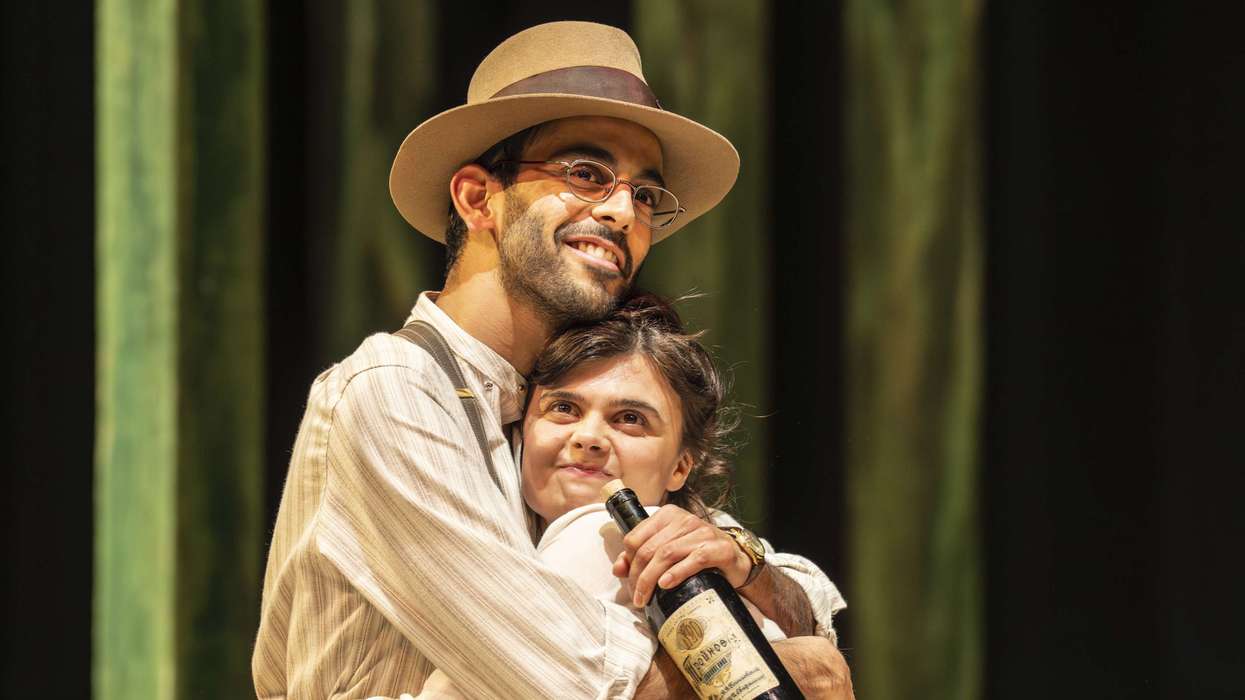
Maxim Gorky’s Summerfolk, staged at the National’s Olivier Theatre with a cast of 23, takes us back to the summer of 1905 in Russia.
This new version is an adaptation by siblings Nina Raine and Moses Raine of the original written by Gorky in 1904 and first staged in 1905.
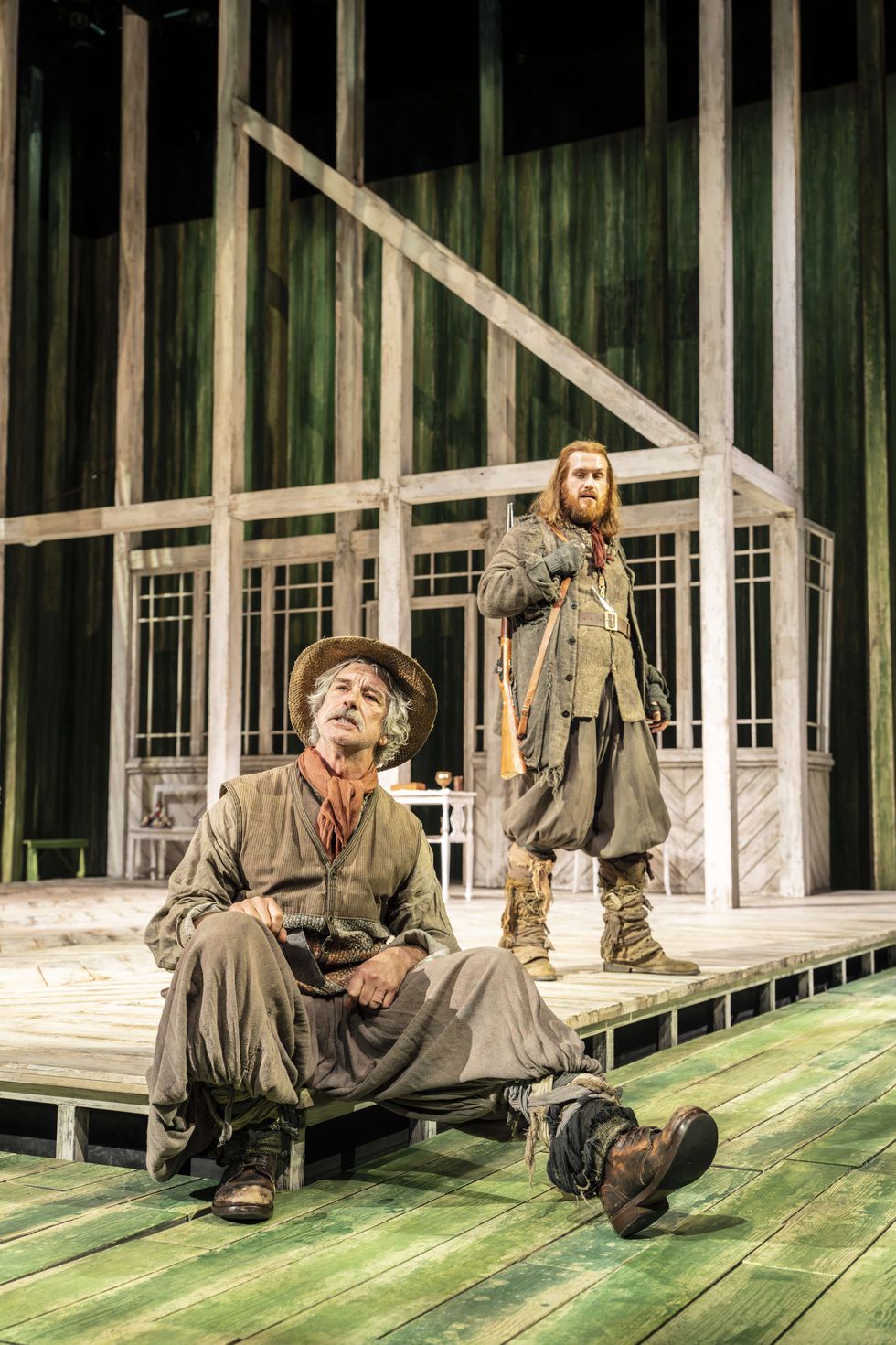 Richard Trinder as Pustobaika and Sam Jenkins-Shaw as Kropilkin.
A wealthy group of friends and relatives, who are part of the nouveau riche, have gathered at a dacha, a holiday home in the country, to sip champagne, engage in backbiting, listen to the poets among them, put on a performance of A Midsummer Night’s Dream, and try to seduce wives not their own. They are largely unaware their Russian idyll is about to be shattered.
“The dacha held the potential of a perfect summer idyll away from the crowds, with a simpler life of relaxation and pleasure and cooler air,” states Alison Smith, professor of history at Toronto University, in the programme.
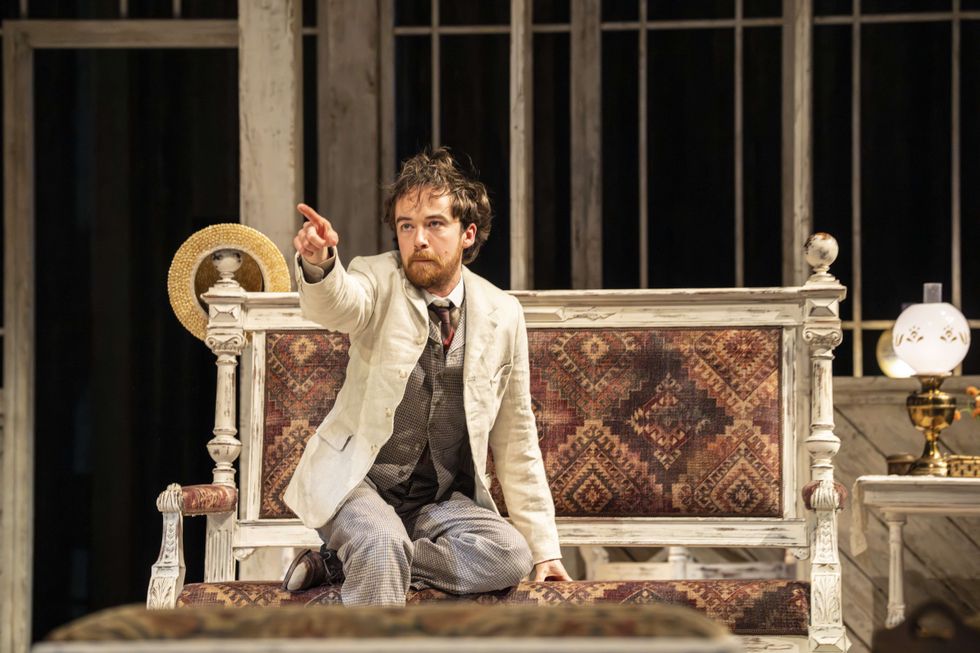 Alex Lawther as Vlass Mikhailich.
And also in the programme, Rosamund Bartlett, author of biographies of Leo Tolstoy and Anton Chekhov and a forthcoming book on Russia’s cultural history in the years leading up to the 1905 revolution, says Gorky had no qualms “about using his new play to fire a terrifying warning shot at those who could afford to rent dachas in the summer months – that self-satisfied, isolated part of the Russian intelligentsia which, in his words, had ‘lost contact with the people, its blood relatives, forgot about their interests, and about the need to broaden life’s possibilities for them’.”
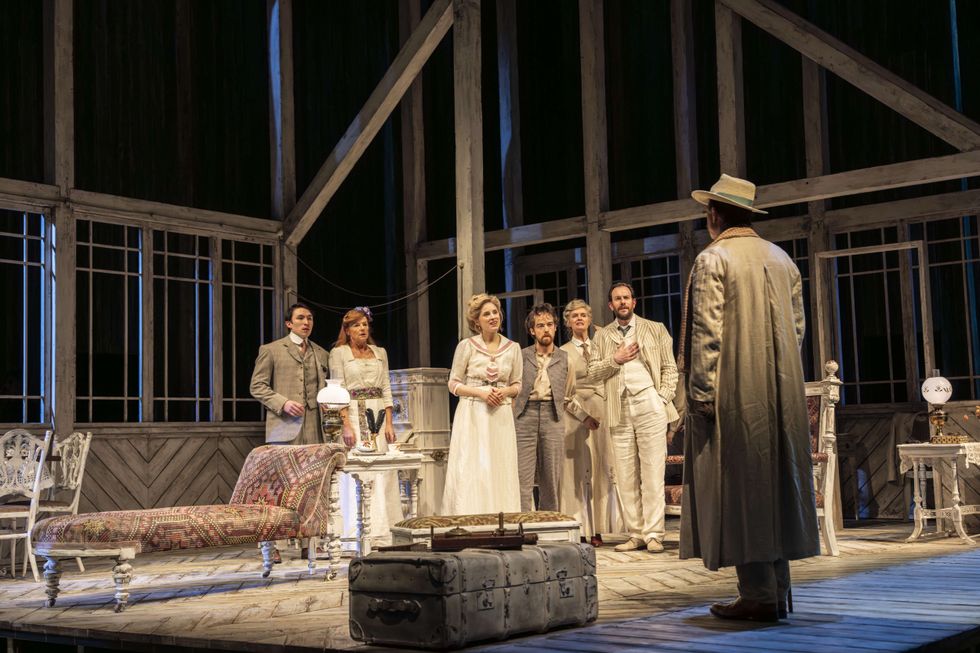 A still from Summerfolk at the National Theatre.
The 1905 Russian Revolution was a wave of mass political and social unrest against Tsar Nicholas II, sparked by the “Bloody Sunday” massacre on January 22, 1905, when troops fired on peaceful protesters. This was followed by the Bolsheviks seizing power in the 1917 revolution.
Summerfolk, with superb acting by the entire cast, is directed by Robert Hastie, deputy artistic director of the National. The set and costume director, Peter McIntosh, and the lighting designer, Paul Pyant, have done a wonderful job of evoking the beauty of the birches, pines, and spruces in Russian countryside.
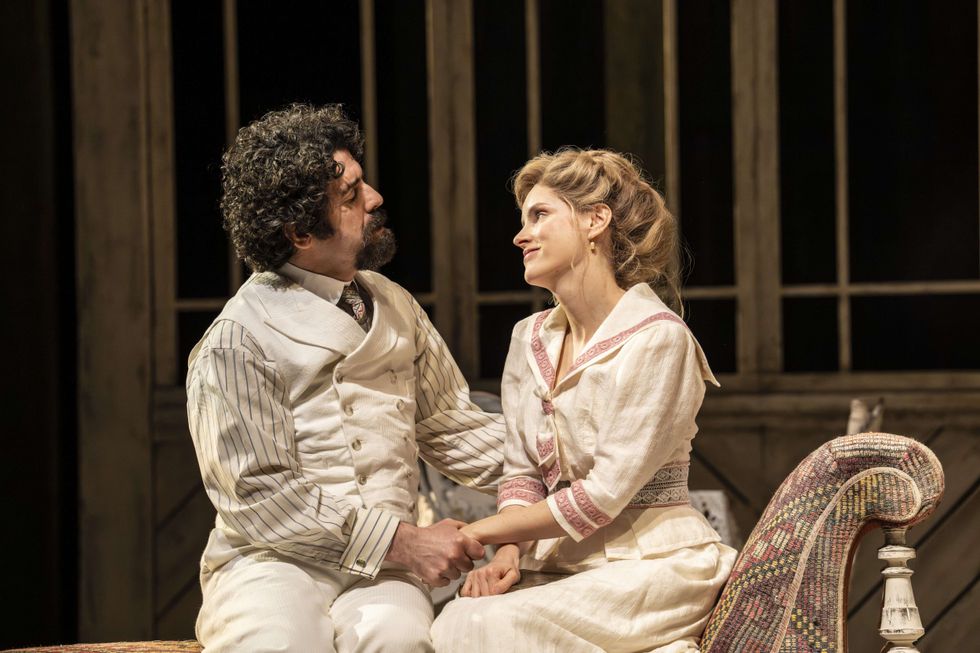 Paul Ready as Sergei Vassilich Bassov and Sophie Rundle.
The actors are dressed in pale colours, adding to the sense the drama is set in high summer. In the second half, there is even a stream, allowing bare-legged women to relax languidly by the water’s edge.
With 23 characters on stage, it takes a while to work out how they relate to each other. The British Asian actor, Sid Sagar, is cast as Kirill Dudakov, a doctor, married to Olga Dudakova (Gwyneth Keyworth).
The dacha, where the action takes place, is owned by Sergei Bassov (Paul Ready), 40, a lawyer who is married to Varvara Bassova (Sophie Rundle), 27. Their marriage is not in good shape. Varvara and Olga are close friends.
Varvara, one of the few people who has a sense all is not well, picks up a newspaper and says: “I’ve got this sense of doom. Looming doom.”
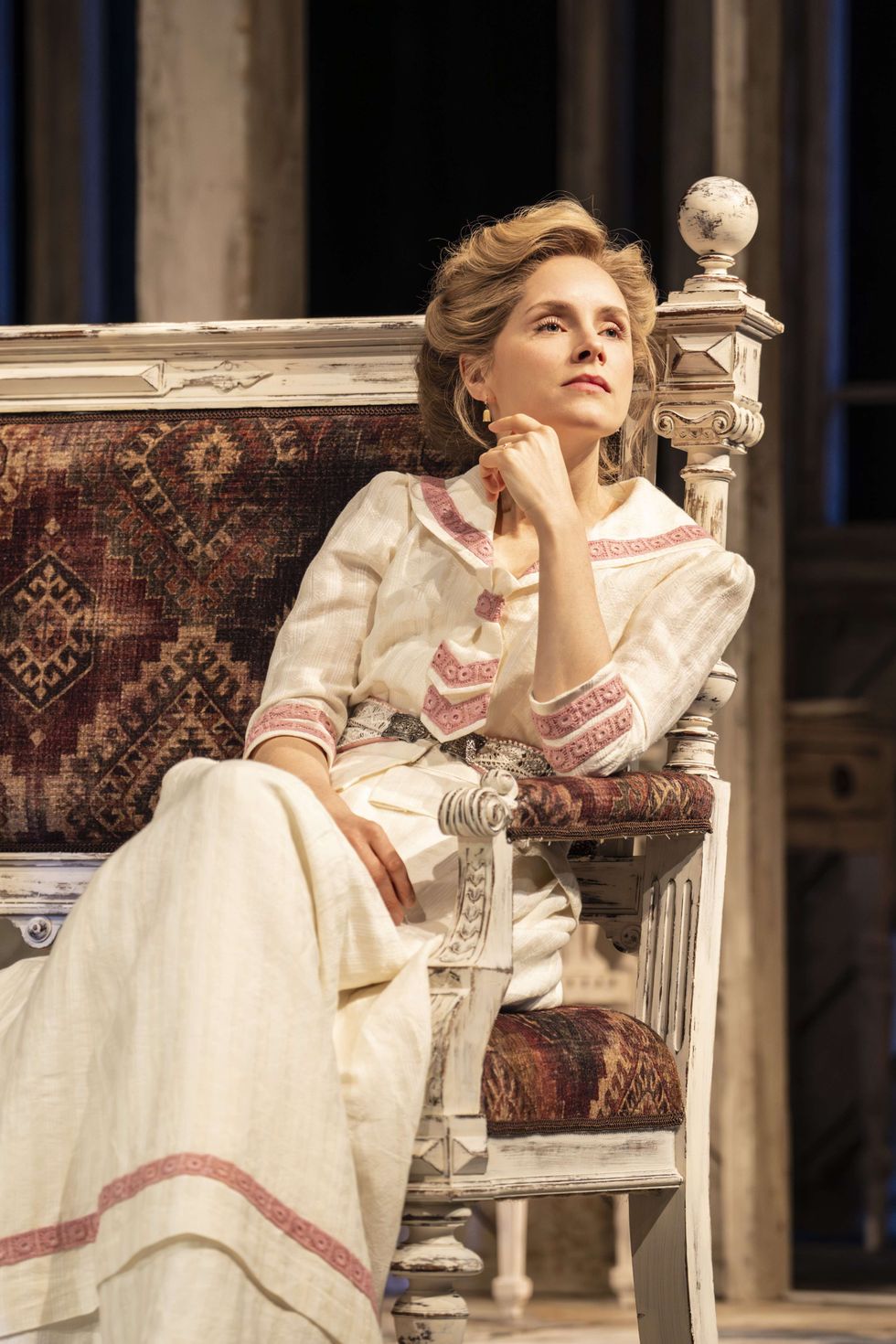 Rundle as Varvara Mikhailovna.
She is addressing her brother, Vlass (Alex Lawther), 25, a dishevelled youth who has been reluctantly given a job as a clerk by his disapproving brother-in-law.
Vlass is a poet, as is Sergei’s sister, Kaleria (Doon Mackichan), 29. The two poets do not get on.
One of the more entertaining episodes occurs when young Vlass declares his love for Maria Lvovna (Justine Mitchell), 37, a doctor and single mother with an 18-yearold daughter, Sonya (Tamika Bennett).
“I love you!” he pleads with an initially shocked Maria. “Crazily, with all of me. I love your heart, your mind…. I love your brave grey hair…. your eyes, the way you speak…”
She protests: “This is unbearable. Go away…. I’m an old woman! You need to leave. Now. Go.”
Vlass does leave on the understanding they will talk about things “later”, but Varvara notices her friend, Maria, is distraught: “Whoa! What is wrong?”
After much prevarication, Maria surprises the audience by coming out with her real feelings: “I love him! Does that sound ridiculous? Well, I love him. Yes, I’ve got grey hair. But I must, I want to live. I’m starving for it. Life! My marriage was three years of torture. I’ve never been in love. And now…. god, it’s embarrassing to hear myself… I’m desperate for some tenderness. Some tender, strong, loving. Sex, I deserve it. I know! It’s bloody late in the day. Darling Varya, please, help me.
Tell him he’s making a mistake, that he doesn’t really love me. I’ve been hurt so much already. I can’t take any more.”
Sergei finds the prospect of a relationship between Maria and Vlass to be almost gross, but encouraged by Varvara and her own daughter, Sonya, the unlikely couple do manage to get together.
One of the standout performances is by Semyon Dvoyetochiye (Peter Forbes), 55, rich uncle to an engineer, Peter Suslov (Arthur Hughes), 40. The latter is loathed by his wife, Yulia Suslova (Adelle Leonce), 30, who at one point pulls out a pistol from under her skirt and threatens to shoot her husband.
Yulia says her husband has called her a tart: “Maybe he’s right. I’m not sure what ‘tart’ means. I certainly am quite curious about the opposite sex. I’m beautiful. That’s my trouble. I was only in the sixth form at school when the male teachers started to stare at me in that way. And I used to blush. They liked that.”
Meanwhile, Dvoyetochiye reveals he had been married several times. “But, two of my wives died. One ran away. And I had children. Two little girls. Both died. A little boy too. He drowned. Alyosha.”
“That’s why you are getting everything,” he tells his undeserving nephew.
Dvoyetochiye, who still retains a full head of hair, admits: “With women, I’ve been very lucky. I picked them up here, in Russia. It’s so easy to take them off you Russians. You make terrible husbands. I used to get here, from Siberia, look around, think there’s an interesting woman, worth paying attention to, her husband would be some sort of dull bloke wearing a hat. Bald, probably. Easy pickings, really. Yes, I had lots of fun. But now – nothing doing.”
The men reflect on the pointlessness of life as they teeter round clutching bottles of champagne. As the women disparage husbands, particularly their own, endless cups of tea are served by Sasha (Rebecca Banatvala), the Bassovs’ maid.
Periodically, eerie whistles are heard from the woods which are dark and deep. A couple of watchmen, Kropilkin, (Sam Jenkins-Shaw), and Pustobaika (Richard Trinder), guns slung ominously over their shoulders, express their disenchantment with the folk gathered at the dacha.
Pustobaika observes: “This mess! Load of pigs! ..They cut down the forest, build their stupid dachas….” Kropilkin responds: “Ohhh these summerfolk….They think they shite Christmas cake.”
Pustobaika suggests: “Someone should teach these lot a lesson.”
Kropilkin (darkly): “They will. They will.” As the play ends and the lights dim and the characters disappear into the forest, there is a volley of gunfire.
Summerfolk is at the National Theatre until April 29