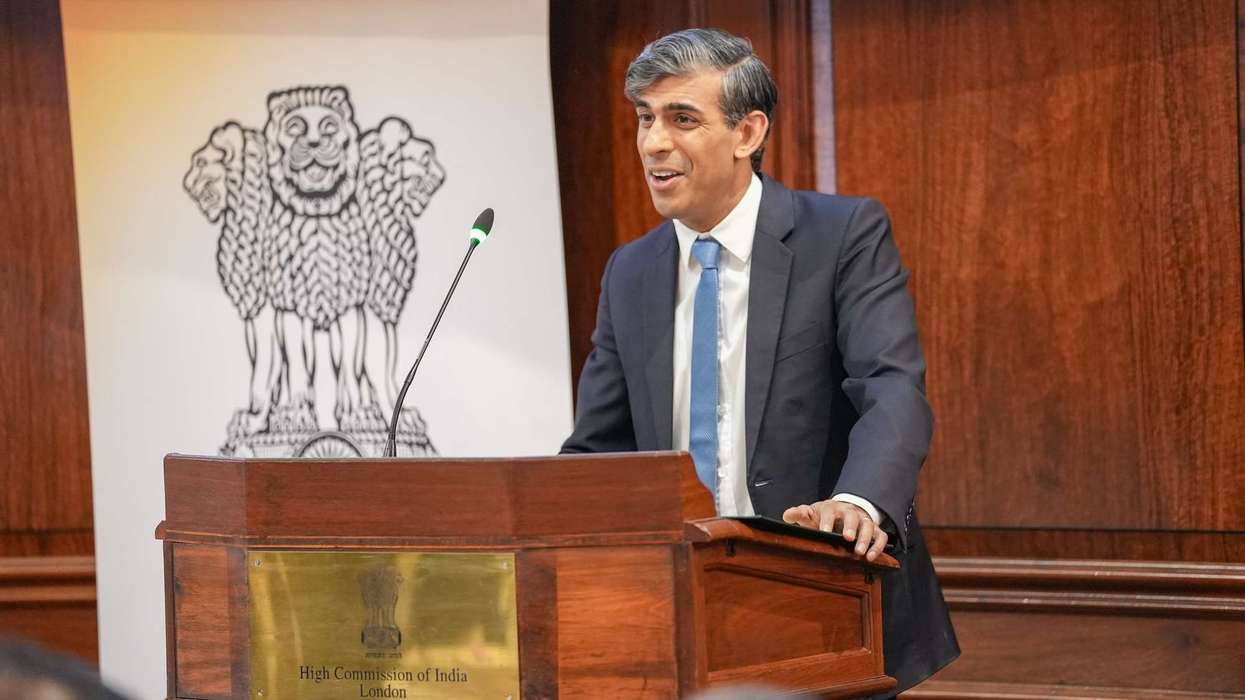

RISHI SUNAK, the former British prime minister, has said the UK and India are both “AI superpowers” and are perfectly placed to be the closest of partners in the development of artificial intelligence for the benefit of mankind.
Sunak was speaking last Tuesday (24) at an oversubscribed AI event at India House organised jointly by the Indian High Commission and the India Business Forum set up by the Confederation of Indian Industry (CII).
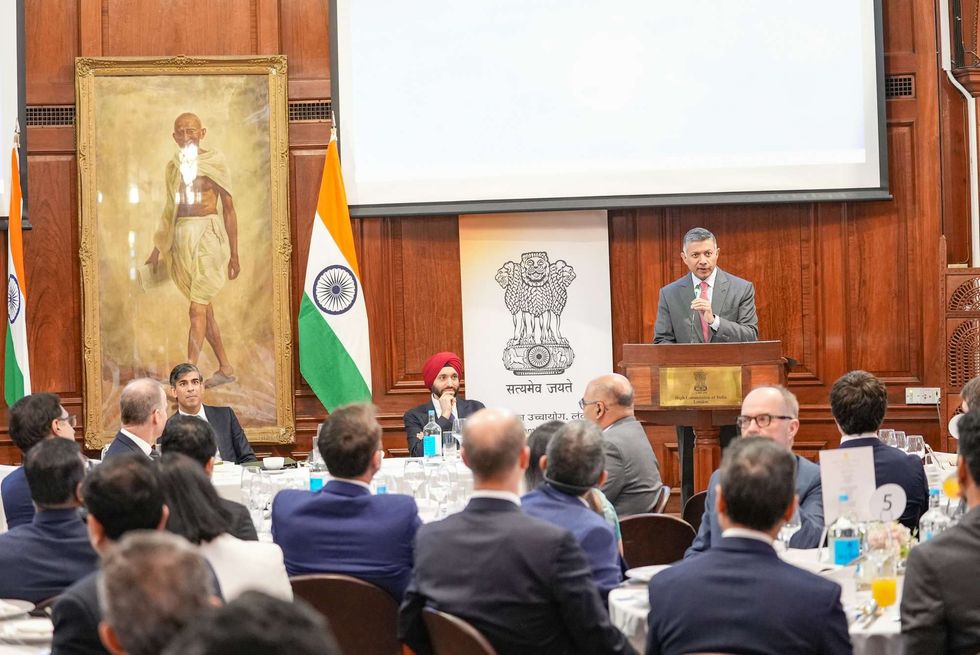 Vikram Doraiswami addresses guests Indian High Commission
A portrait of Mahatma Gandhi looked down on around 70 leading CEOs, politicians and academics packed into the Gandhi Hall at the Indian High Commission.
It is generally accepted that the Mahatma wasn’t a Luddite, but he was suspicious of modern technology and wanted to ensure that scientific advances did not harm poor villagers in India.
Perhaps the irony is that while India, with a young population, is on the whole very enthusiastic about AI, there are much greater reservations about what this will mean in the UK.
Sunak, who convened the first global AI summit at Bletchley Park in 2023 when he was prime minister, has turned out to be one of its foremost champions. He was one of the keynote speakers at the fourth global summit convened by the Indian prime minister, Narendra Modi, in February this year. The event was attended by 250,000 people, compared with 250 at Bletchley Park.
Last week’s event at India House was called ‘Beyond the New Delhi AI Summit: India and the UK Shaping the AI Age – India-UK Dialogue on Artificial Intelligence.’ Sunak stressed: “AI is already here. It’s beginning to reshape our economies and societies today, creating new opportunities.”
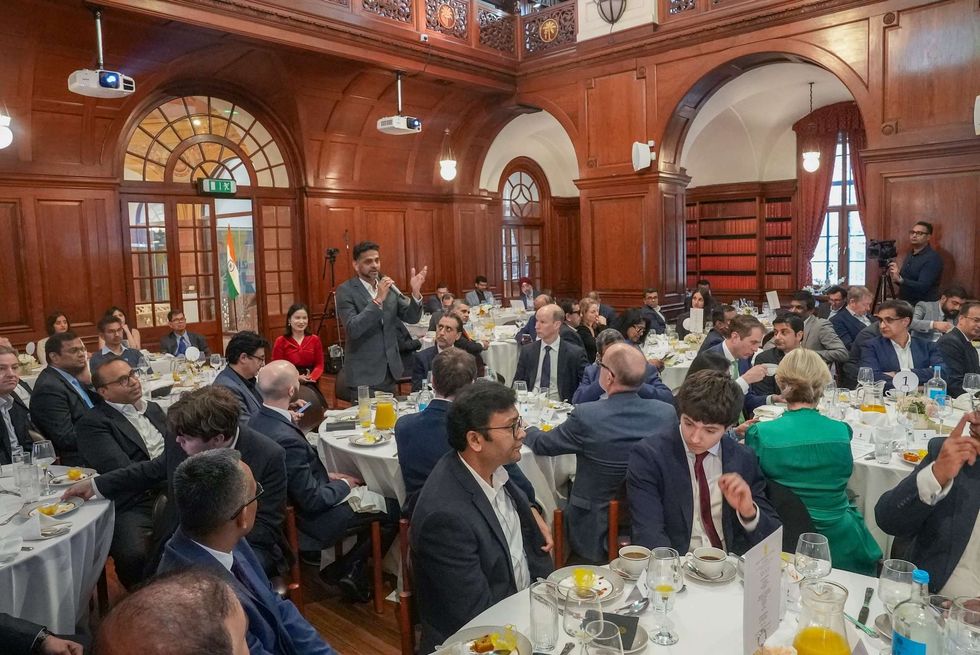 Attendees at the India House event in London last Tuesday (24)Indian High Commission
He went on: “The AI debate is now moving from technology to strategy, from what the tools can do to what countries choose to do with them, so political leaders must now treat AI not as a specialist topic, but as a central responsibility of government. According to the globally respected Stanford University AI index, both India and the UK, I’m pleased to say, are ranked as AI superpowers, although I do have to acknowledge that India just overtook the UK. India and the UK share a common outlook. Neither of us wishes to emulate the top down regulatory approach of the EU. Both embrace a pragmatic, pro-innovation attitude.”
Indian food was served as Sunak told his audience: “Looking around this room, I see many familiar faces, and lots of you were, like me, in New Delhi. It was a wonderful event that served as a reminder of what our two countries bring to the world. Actually, I would venture that nothing illustrates the strength and depth of the UK-India relationship today better than AI. It underscores our shared perspectives.
“I came away more convinced than ever that AI can raise the floor for humanity, that it can enhance human dignity and improve health and education in every corner of our world. I truly believe that there is nothing that will be more transformative for our economies, our societies, our lives, than artificial intelligence. It will change everything far more quickly than people realise. It is by showing the world that this technology is safe that we will be able to fully reap the benefits that it brings.
“I was very pleased last year when India set up its own AI security institute. One of the things that we must foster is greater cooperation between all of these AI institutes in the same way that our intelligence sharing has kept us safe by allowing countries to share information about terrorist threats. Joint working between our AI institutes will help to facilitate this. It’s a powerful example of security cooperation between Britain and India for the 21st century. The strength of this initiative doesn’t just bring our governments together. It encourages businesses and universities to cooperate. It’s creating a true India-UK technology ecosystem.
“Now, one of the great opportunities for the UK and India is to marry this country’s design strengths with India’s manufacturing arms. The new design centre in Bangalore shows what can be achieved when you combine India’s semiconductor manufacturing capability with British IP. And I think it’s striking that India is now where our workforce is growing the fastest. We both have thriving technology economies. India has produced 125 technology unicorns. The diaspora is also acting as a living bridge between our two technologies.”
He pointed out that “Indian IT giants are also critical to the deployment of AI in the UK public sector”.
Giving an example, he said that “TCS (Tata Consultancy Services) are transforming the NHS supply chain with ERP (Enterprise Resource Planning) systems” and “Indian firms are fast becoming the AI integration layer for British businesses. So, any which way you look at it, there is an enormous scope of collaboration between our two groups.”
He said the British and Indian governments understood the importance of AI. “This gives us a chance to partner with each other to build an AI-enabled alliance for an age where technological strength equals national power.”
Sunak concluded: “The more closely that Britain and India work together on AI, the stronger we will both be. So let us use today to accelerate that work, to catalyse innovation and to make our countries and our people more prosperous and more secure.”
As Sunak arrived at India House, he was welcomed as a VIP by the Indian high commissioner, Vikram Doraiswami, who is moving to China later this month as the country’s ambassador.
Doraiswami welcomed guests by saying: “Today is an opportunity for us to pick up on the momentum generated by the AI summit in India.”
He said India wanted to ensure that “AI actually delivers a growth dividend for all of our countries, that AI delivers a people’s dividend, and that AI delivers an inclusion dividend across nations and geographies.
“Some of the work that was showcased in the UK to start with now nearly three years ago, and some of the work that was showcased a few weeks ago in India suggest to us that there is considerable opportunity for us to be able to bring together the enormous capabilities that the UK has already deployed on AI and the enormous capabilities that India is beginning to display in AI. The opportunity that you see in India today is arising out of using India’s many diversities – linguistic diversity, income diversity and geographical diversity.
“AI is providing solutions in terms of governance benefits, in terms of financial inclusion benefits, and in terms of benefits across key sectors where AI needs to be able to deliver like healthcare and farming. If we are to look at AI as something that can include every citizen on our planet, then I believe India is already well positioned to make some of that difference.
“And if we are to be able to find ways in which we can scale that up at pace, then the UK is by far our best partner to make that happen.”
Other speakers at the event included Jade Leung, the chief technology officer of the AI Security Institute and AI adviser to the UK prime minister Sir Keir Starmer; Dame Wendy Hall, Regius professor of computer science and associate vice president (international engagement) at Southampton University; and the Conservative MP Alison Griffiths, a member of the Commons business and trade select committee.