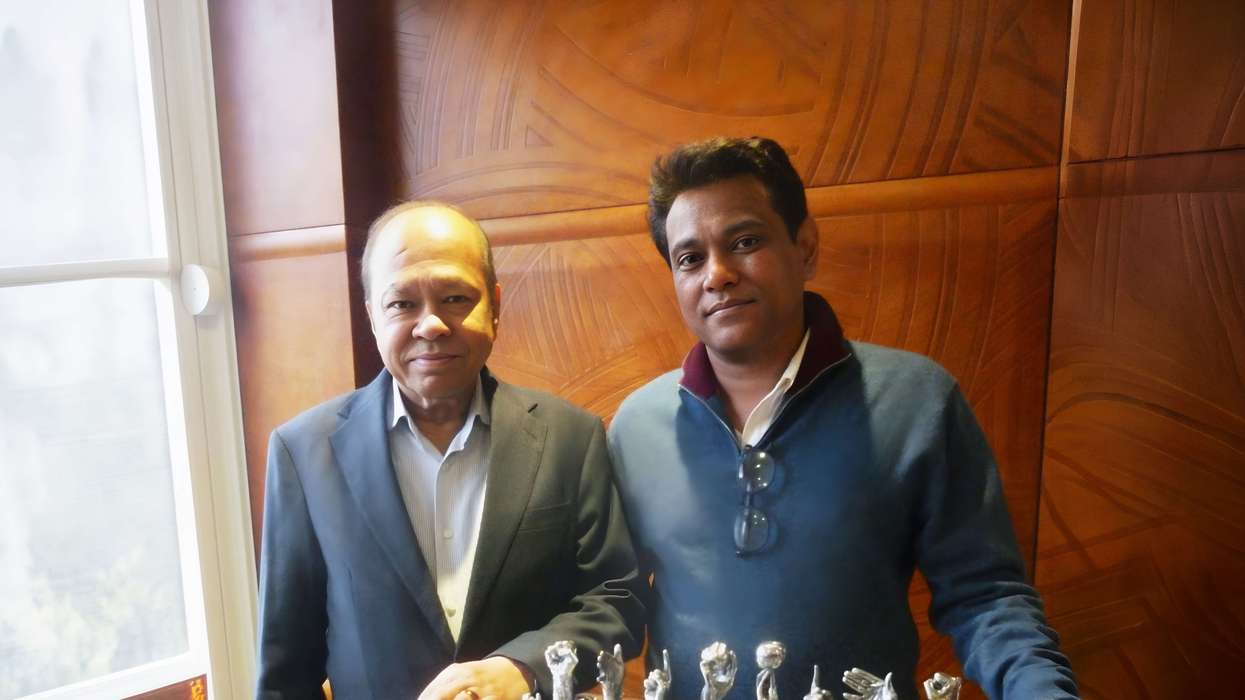

SRI PRAKASH LOHIA, 73, is chairman of the Indorama Corporation, which has global interests in everything from polyester to fertilisers and employs 26,000 people at 40 sites across the world.
His son, Amit Lohia, 51, is Indorama's vice-chairman. He also happens to be an accomplished poet.
Amit acknowledged the debt to his father: “I've been working alongside my father for 30 years so I have definitely learnt a lot from him.”
Amit's mother, Seema, is the younger sister of steel tycoon Lakshmi Mittal. Both Sri Prakash and Amit spoke at the memorial service for Lakshmi's father, Mohanlal Mittal, who passed away in London in January this year at the age of 99.
Amit, the oldest grandchild, told the audience: “I will always regard him as India's first global entrepreneur, a man whose example showed that it was possible to build a truly Indian global business. He was the very, very strong glue that held the family together.”
For the Lohias, manufacturing fertilisers – at plants in China, India, Brazil, Georgia, Uzbekistan, Senegal, and Nigeria – is becoming the firm's core business, with its products reaching an estimated five million farmers.
Indorama's London offices are on the sixth floor of a building in Jermyn Street in Piccadilly, next to shops selling shoes for £500 and shirts for £100.
“My influence is more in the business field,” said Lohia senior. “We are not political.”
His current pet project is an 82-storey office tower in Dubai's business bay. He showed off drawings of ‘Indorama Tower’, which he anticipates will attract entrepreneurs from across the world. “Dubai is a good place to save tax,” he reasoned. “Many Indians like Dubai because it is near India. In Dubai, you meet a lot of Indian friends.”
He is disenchanted by chancellor Rachel Reeves driving entrepreneurs out of the UK – for example by imposing inheritance tax on global assets. “Economics will teach her what mistakes have been made. By then it will be too late to bring people back.”
Culturally, “we will always be Indian. That cannot change, but we are global citizens.”
Amit spoke at length about fertilisers, which he said were essential to sustaining global food production. Those who advocate organic farming, he argued, fail to reckon with the quantities the world's growing population demands.
“I explain a fertiliser by comparing it to the human body,” he began. “A plant is a living organism. Crops need three things to grow. You need the seed – in human terms, the embryo. You need food: a fertiliser is food for the plant. And the third part is herbicides, pesticides, insecticides – medicine. Plants need medicine to deal with an attack from a certain worm, just as the human body does.”
The numbers make the case starkly. “We produce a product called urea, one of the most common fertilisers. Nitrogen concentration in urea is 46 per cent. In an organic fertiliser, it is 2-3 per cent. That makes a night and day difference in terms of impact for the farmer.”
Both organic and chemical fertilisers share the same composition – nitrogen, potassium, phosphate, sulphur, zinc, boron, calcium, magnesium – but the concentration in organic fertilisers is simply too low to achieve the same yields. “Fertilisers have quadrupled yields all over the world in the last century. India is now self-sufficient in essential grains – wheat, rice, and even fruits and vegetables – which is fantastic.”
The Lohias attach research laboratories to their fertiliser plants to customise products for farmers. “Farmers come to us and say, 'I need help. I want to improve my productivity.' We'll analyse the soil and propose a better recipe. Farmers need to have high trust in the quality of their fertilisers. We cannot break that trust.”
Fertilisers have become a business comparable in scale to Indorama's textiles and petrochemicals operations. The company has also been awarded a permanent seat on the board of the International Fertiliser Association, headquartered in London. “We got it because of our size,” said Amit simply.
World fertiliser consumption is growing by 2 per cent a year. Russia remains the world's largest exporter, and most countries have declined to sanction Russian fertilisers precisely because of food security concerns – though the war has pushed up European gas prices, and gas is a major input cost for nitrogen fertilisers.
“I travel 10 to 15 days a month,” remarked Amit. “The best part of my job is time spent in the factories. We believe strongly in decentralised management – we empower our CEOs to run the businesses and support them. That's what has allowed us to grow.”
One American academic suggested family businesses flourish best when outside managers dominate at a 75-25 ratio. “In our case it is even higher than that,” said Amit. “Our CEOs are like family. If you treat them as your family, that is how they will treat you.”
Amit was born in Delhi, grew up in Indonesia, attended Wharton School of Business and joined the family firm in 2000. He has lived in London for nearly a decade and has no intention of moving to Dubai, despite visiting several times a year.
Crucially, he does not share the view – popular among right-wing politicians – that Britain is broken.
“I love how open-minded this society is. I can speak my mind without being afraid of offending another person. Society here is very open, very tolerant. I am truly impressed by that. It's great for my kids to be in this kind of environment.”
His wife, Aarti, chair of the charitable Lohia Foundation, is deeply embedded in London's arts world. She has sat on Tate's South Asian Acquisitions Council and the Serpentine Galleries' international council and amassed around 200 works to become one of the most significant collectors of contemporary art in the UK. The SP Lohia Foundation has also served as lead patron of the National Gallery's modern and contemporary art programming.
At home, meanwhile, the family has another distinction to celebrate: their son Sohum, 16, became a chess international master last year and is on the verge of becoming a grandmaster.