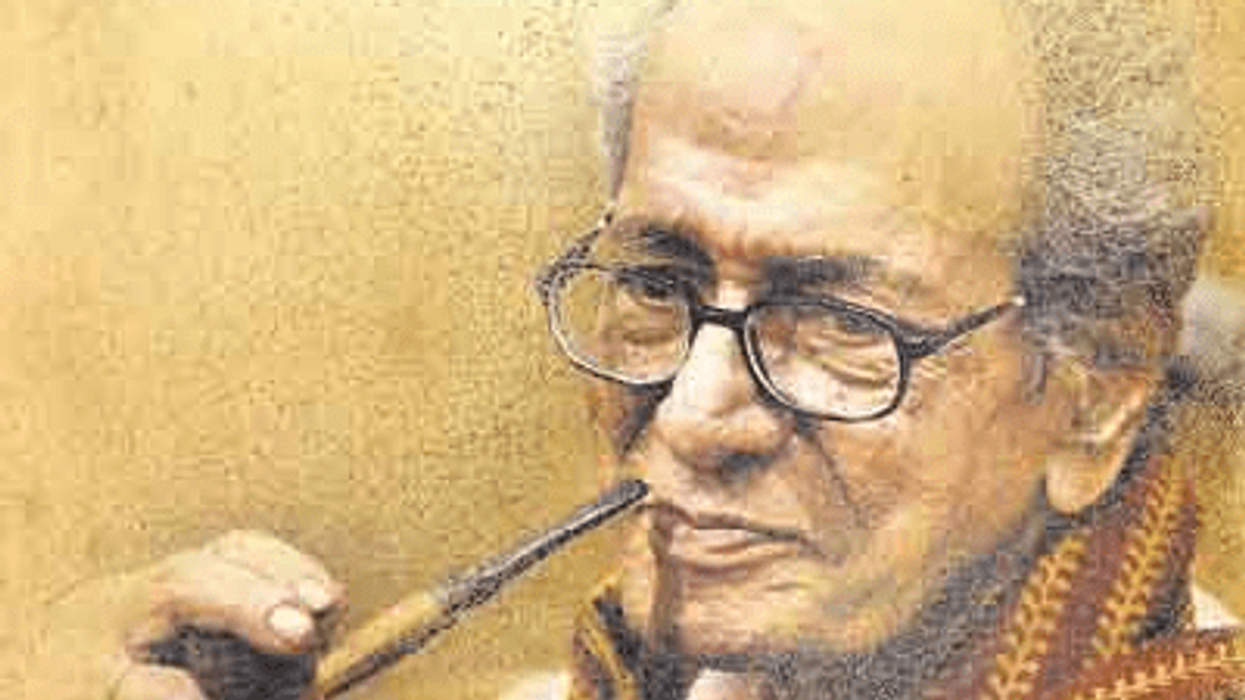

Legendary playwright Habib Tanvir's acclaimed play Charandas Chor will be turned into a feature film by Karmic Films, the production banner announced on Friday.
The studio has acquired the rights to the play with the aim to capture the story's "brilliance and social commentary for a new generation of audience", a press release stated.
Karmic Films Private Limited made the announcement on the occasion of the birth centenary of the legendary playwright.
Originating in 1975, Charandas Chor is about the titular thief who is also a man of principles. Discontent with his life, Charandas is on the run after stealing a gold plate. He eventually meets a guru who grants him vows that will set him free.
The play was previously brought alive on the big screen by acclaimed director Shyam Benegal with a feature film that was released in 1975.
"Bringing Charandas Chor to life as a feature film is a thrilling endeavour for us," Suniel Wadhwa, Co-Founder of Karmic Films, said in a statement.
"This tale's resonance through the ages fuels our commitment to faithfully represent its narrative richness. This acquisition marks a significant stride in our mission to craft compelling cinematic experiences," he added.
The project is currently in the pre-production stage and the studio will soon announce its director and the actors.
Writer Kundan Judge, who is also the co-founder of Karmic Films, said they are honoured to intertwine Tanvir's legendary legacy into the company's creative tapestry.
"This adaptation promises to reintroduce audiences of all ages to the enchantment that Charandas Chor embodies on screen. Beyond fulfilling the aspirations of burgeoning talent, it caters to the hunger for meaningful entertainment that audiences seek," he added.
Nageen Tanvir, daughter of the late Habib Tanvir, also expressed excitement over the project.
"Witnessing Charandas Chor transition towards a feature film is heartening. My father's legacy thrives through this venture, and I trust Karmic Films wholeheartedly to translate his vision onto the silver screen," she said.
Born on September 1, 1923, in Raipur, Habib began his career as a journalist and went on to become a highly renowned playwright.
He was also known for his 1954 play Agra Bazar and as the founder of the Naya theatre company in 1959. He scripted many films and acted in a few of them.
He was awarded the Sangeet Natak Akademi Award in 1969 and Padma Shri in 1983.