
Highlights
- Pareshkumar Kakadiya brings Hindu spirituality into a visual language UK audiences rarely encounter
- His work bridges sacred iconography and everyday Indian life
- The artist blends Indian narratives with Western techniques and materials
A different spiritual lens
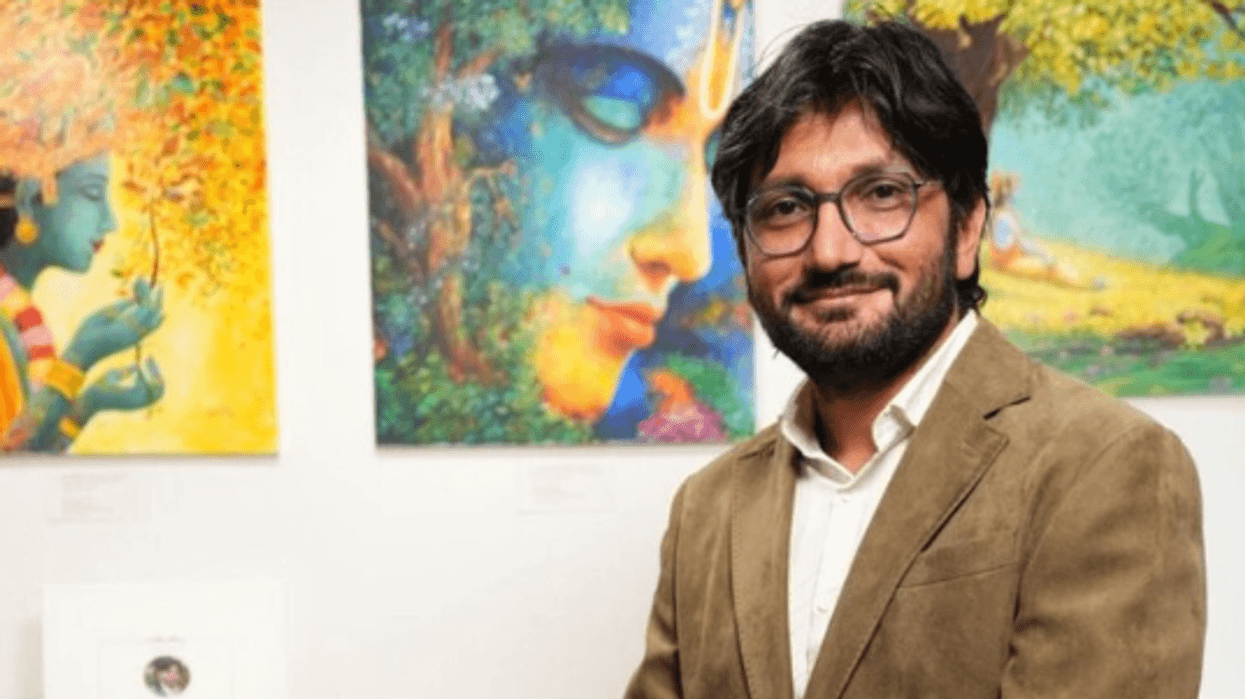
Religion and spirituality have shaped art since its earliest forms, long before the Renaissance or classical Western traditions. While European art history often centres on Greco-Roman gods or Christian imagery, Pareshkumar Kakadiya’s practice offers something less familiar in the UK: a visual exploration of Hindu spirituality.
His paintings introduce audiences to narratives that sit outside Western mythological frameworks. A swan, for instance, may recall the story of Leda and Zeus in European art, but in Kakadiya’s work it becomes the vehicle for Brahmani Maa, the Hindu mother goddess, who floats above the world, offering blessing and light. The compositional echoes of Renaissance Madonnas are visible, yet the meaning is rooted firmly in a different spiritual tradition.
Love, devotion and technique
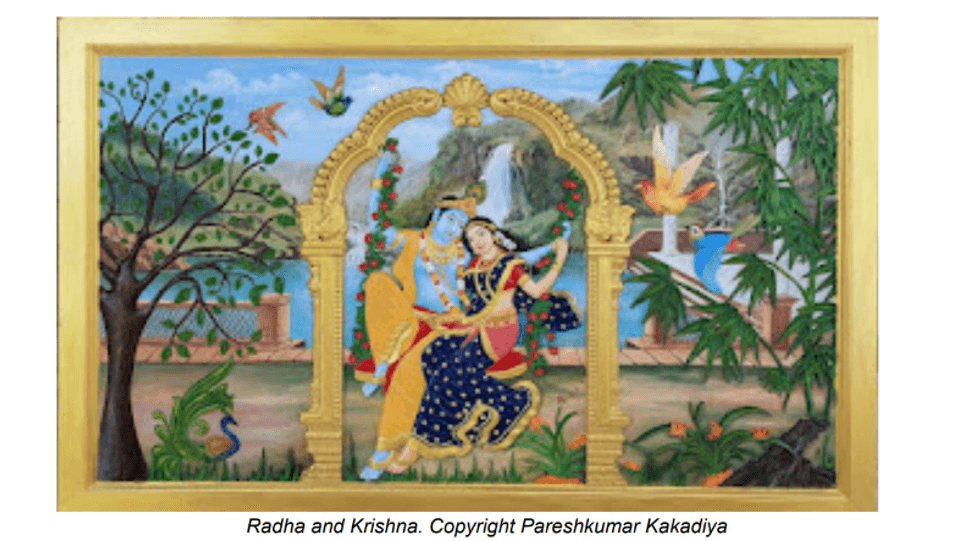
Kakadiya’s technical confidence is evident in his relief painting of Radha and Krishna, the enduring love story at the heart of Hindu belief. The work demonstrates not only narrative understanding but also control of form and surface, allowing the figures to emerge physically from the picture plane.
This balance between skill and symbolism recurs throughout his spiritual works, where material choices and method are closely tied to meaning.
 This balance between skill and symbolism recurs throughout his spiritual worksPareshkumar Kakadiya
India beyond the shrine
Away from religious imagery, Kakadiya turns his attention to the everyday rhythms of India. His murals and paintings on wood capture moments that feel instantly lived-in: an auto-rickshaw weaving through crowded market lanes, or children pulled into an impromptu game of street cricket.
These scenes function as visual records of place and movement. Much as LS Lowry documented industrial Britain, Kakadiya records the colour, energy and informality of Indian street life, offering viewers a grounded counterpoint to his devotional works.
Portraiture and observation
Portraiture forms another strong strand of his practice. His coloured pencil drawings of spiritual leaders are marked by a smoky softness, recalling the sfumato technique associated with Leonardo da Vinci. They also sit comfortably alongside contemporary British drawing, echoing the renewed attention pencil artists have received in recent years.
In oil, his approach is equally assured. A sepia-toned self-portrait of his younger self captures a reflective, almost distant expression, suggesting memory, introspection or personal transition.
 Kakadiya’s strength lies in his ability to draw from his Indian heritage Pareshkumar Kakadiya
Ambition across materials
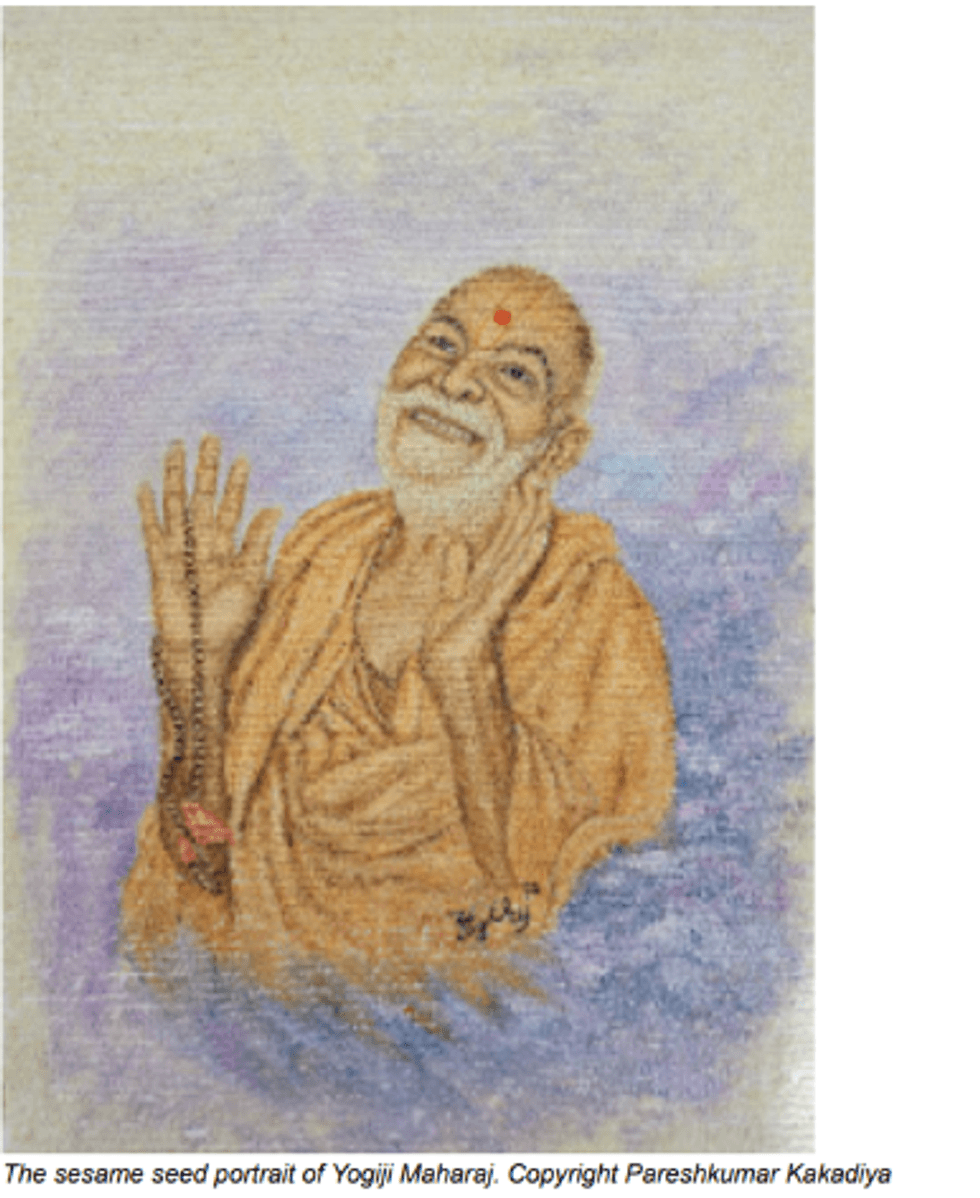
Kakadiya’s willingness to experiment is central to his career. His awards span multiple mediums, including a world record for the largest bubble wrap painting. Perhaps most striking is his portrait of Yogiji Maharaj, created using individually placed sesame seeds to form a densely textured surface.
The work invites comparison with the tactile impact of impasto painting, while the choice of sesame seeds carries symbolic weight within Hinduism, representing immortality, purification and ancestral connection. Displayed at BAPS Shri Swaminarayan Mandir in Neasden, north London, it underscores his commitment to works that are both materially distinctive and spiritually grounded.
Rooted, yet evolving
Kakadiya’s strength lies in his ability to draw from his Indian heritage while working comfortably within historical and contemporary artistic languages. By blending Western techniques with deeply personal and spiritual references, he continues to develop a practice that reflects both his origins and his artistic life in the UK.