
INDIAN prime minister Narendra Modi on Thursday called for the democratisation of artificial intelligence and said AI should be shared openly for the benefit of the world.
He said some countries believe AI should be developed in a confidential and closed manner, but India believes it will serve the good of the world when it is shared and its codes are open.
In New Delhi, Modi unveiled the ‘MANAV’ vision for a human-centric approach to AI, with a focus on sovereignty and inclusivity. He said India does not fear AI but sees a blueprint of tomorrow in it.
“Some countries believe that AI should be developed in a confidential and closed manner. But India is different. We believe AI will truly serve the good of the world when it is shared and its codes are open. Only then will millions of young minds be able to improve it further," he said.
He said there are two kinds of people — those who see fear in AI and those who see fortune — and said India sees fortune and future in AI, backed by talent, energy capacity and policy clarity. He said the welfare and happiness of all is "our benchmark" for AI to ensure that humans do not become a data point or raw material.
"I present the MANAV vision for AI where M stands for moral and ethical systems, A for accountable governance, N for national sovereignty, A for accessible and inclusive, and V for valid and legitimate," Modi said in the presence of world leaders.
He said the MANAV vision will become a link for humanity's welfare in the AI-driven world of the 21st century. AI must be given an open sky, but command must remain in human hands, he said.
Modi said that just as school syllabi are curated, the AI space must also be child-safe and family-guided. He said that as the future of AI is discussed, the aspirations and priorities of the Global South must be placed at the centre of AI governance.
Later, addressing a leaders' plenary session, he said India has built a digital public infrastructure and is sharing it with the world.
"In recent years, India has built a vibrant digital public infrastructure and is sharing it with the world, because for India, technology is not a medium of power but of service, not to dominate but to empower. AI too must follow this direction to ensure the welfare of humanity," he said.
He said the Unified Payments Interface ensured seamless online transactions even in difficult circumstances and played a role in bridging the digital divide. He also said India is providing startups with computing power at affordable rates and has created the AIKosh national dataset platform, through which more than 7,500 datasets and 270 AI models have been shared as national resources.
Recalling Lord Buddha’s teaching that “right action comes from right understanding”, Modi said a roadmap must be created to ensure AI’s positive impact through timely and correct decisions.
“Let us work together to create a roadmap that ensures that AI delivers the right impact, and this can happen when we take the right decisions, at the right time, with the right policies," he said.
He said “aspirational India” has a role in the global journey of AI and that India is taking steps in this direction. He cautioned that while ethics have always been central to human progress, with AI the scope of unethical behaviour is unlimited. Ethical norms for AI must also be unlimited, and AI companies carry responsibility to focus not only on profit but also on purpose, he said.
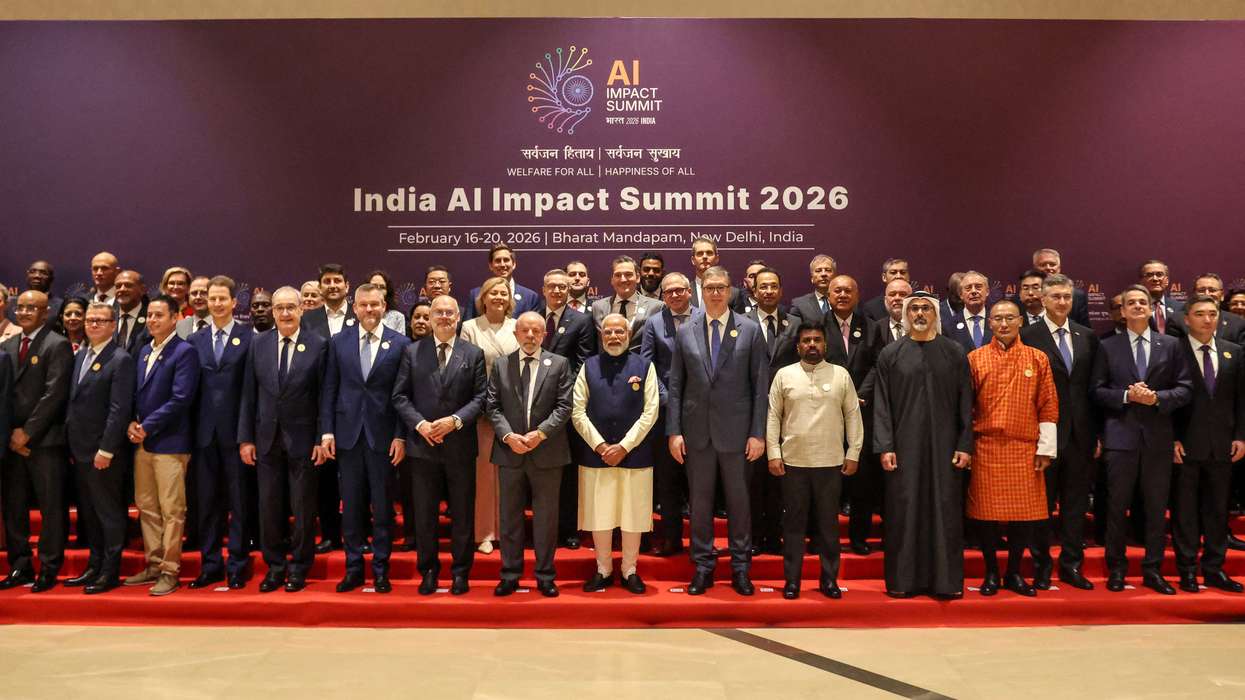
The AI Impact Summit is being held from February 16-20 at Bharat Mandapam. More than 500 global AI leaders, 150 academicians and researchers, and 400 chief technology officers, vice-presidents and philanthropists are participating.
Global leaders including UN Secretary-General Antonio Guterres, French President Emmanuel Macron, Brazilian President Luiz Inacio Lula da Silva, Swiss President Guy Parmelin, Sri Lanka President Anura Kumara Disanayaka, Bhutan Prime Minister Tshering Tobgay, Mauritius Prime Minister Navinchandra Ramgoolam, Croatia Prime Minister Andrej Plenkovic, Serbia President Aleksandar Vucic, Estonia President Alar Karis, Finland Prime Minister Petteri Orpo and Seychelles Vice President Sebastien Pillay were present.
During the summit, India’s AI progress was showcased, with Modi’s speech dubbed live in 11 languages and supported by AI-enabled sign language interpretation displayed on a large screen.
Alongside the policy push, India’s largest conglomerates announced major investments in AI and data infrastructure.
Reliance has committed about $110 billion, and Adani has pledged $100 billion to position India as an emerging hub for AI development. The combined planned investment stands at $210 billion.
"Our resolve is clear: make intelligence as ubiquitous as connectivity," said billionaire Mukesh Ambani, chairman of Reliance, adding that cheaper computing will spur innovation.
Reliance plans to apply to AI the approach it used in 2016 to disrupt the telecom market by cutting data prices and expanding access.
The announcements come as executives gathered in New Delhi for the summit, amid rising investment from Google, Amazon, Meta Platforms and Microsoft in India’s AI and cloud ecosystem.
Reliance and Adani are building renewable-powered data centres, using their own energy assets to reduce reliance on grid power. Locating facilities near power plants cuts transmission losses and reduces exposure to rising electricity prices.
"With their backward integration, renewable-powered data centres are simply the cheapest option for them in the long run," said Ambareesh Baliga, an independent market analyst.
India has had a limited role in the global AI boom so far due to the absence of large-scale chip manufacturing, making data centres its entry point into the infrastructure market.
Reliance unit Jio is developing multi-gigawatt, AI-ready data centres, including a facility in Jamnagar expected to add more than 120 megawatts of capacity in the second half of this year.
Adani Enterprises said on Tuesday it plans to invest $100 billion by 2035 to build AI-enabled and renewable-powered data centres.
Reliance aims to build a fully integrated AI stack in India, but execution and monetisation remain key risks, said Aishvarya Dadheech, founder and chief investment officer at Fident Asset Management.
(With inputs from agencies)