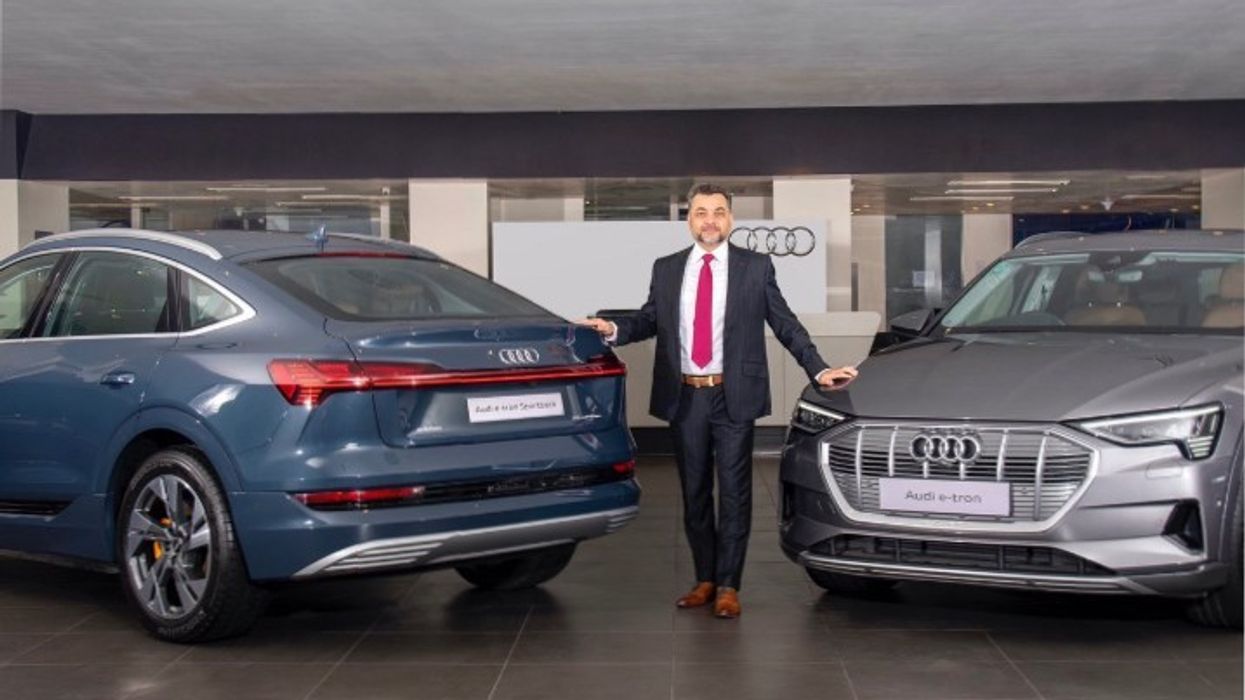

AUTOMAKER Audi India is looking to commence local assembly of electric vehicles, a move which would help it roll out models at an affordable price helping expand its customer base in the country.
The automaker currently imports its entire EV range into the country.
It, however, assembles petrol models like Q3, Q3 Sportback, Q5, Q7, A4, and A6 at its Aurangabad (Maharashtra) based manufacturing plant.
Audi India head Balbir Singh Dhillon said the local manufacturing of EVs is a work in progress with active discussions going on with its global headquarters.
"We are working with Audi AG very positively and hopefully at some point in time we will be able to announce this (local assembly of EV models)," he said.
When asked about the expected timeline of commencing the process, Dhillon did not share any specific date but stated that the India unit is discussing the matter with the global headquarters very "positively".
"Hopefully we should have some solution at some point in time. That is the time when you can reach even more (set of customers) because then you will get the best advantage in terms of price point," he said.
"I think the next 2-3 years will be very crucial (2024-2026). These years will see many more new electric cars coming at different price points. Then I think our reach to our existing customers or first-time buyers will go up."
The company's current EV model lineup is priced over Rs 10 million thus serving a very niche set of customers.
Currently, cars imported into India as Completely Built Units (CBUs) attract customs duty ranging from 60 per cent to 100 per cent.
The country's customs duty system treats electric cars and hydrocarbon-powered vehicles equally, imposing significant tariffs to encourage domestic manufacturing.
Audi, globally, is looking to introduce multiple electric models in the next 2-3 years many of which would also come to India thus helping the Indian operations to choose which ones to localise.
In order to rev up sales volume, Audi India would look out for models which sit below the current range in price terms.
The company currently gets around 2 per cent of its total sales from EVs.
It reported 89 per cent growth in retail sales in India at 7,931 units last year as compared with a total of 4,187 units in 2022.
Audi on Monday (18) globally premiered the Q6 e-tron, a new EV model which would sit below the Q8 e-tron range.
To be manufactured at the company's Ingolstadt, Germany plant, the model is expected to roll out in various markets globally this year.
It is also expected to make its way to Indian shores early next year.
Dhillon said the model would help in widening the company's customer base in India.
"That's the expectation that our penetration in electric mobility should go up with this model (Q6 e-tron)," he noted.
Audi expects 50 per cent of its sales in India to come from electric vehicles by 2030.
Globally, Audi has decided to become a fully electric vehicle manufacturer from 2033 onwards.
The Q6 e-tron is the first production model on the company's Premium Platform Electric (PPE), marking the next step in the company's transformation into a provider of premium electric mobility.
The electric SUV will be available to order from this month with deliveries expected to customers in the third quarter of 2024.
The Q6 e-tron comes with a range of up to 625 kms.
"The PPE shows how we are pooling expertise within the Volkswagen Group and thus making electric mobility scalable," said Gernot Dollner, Audi AG chairman of the board of management.
(PTI)