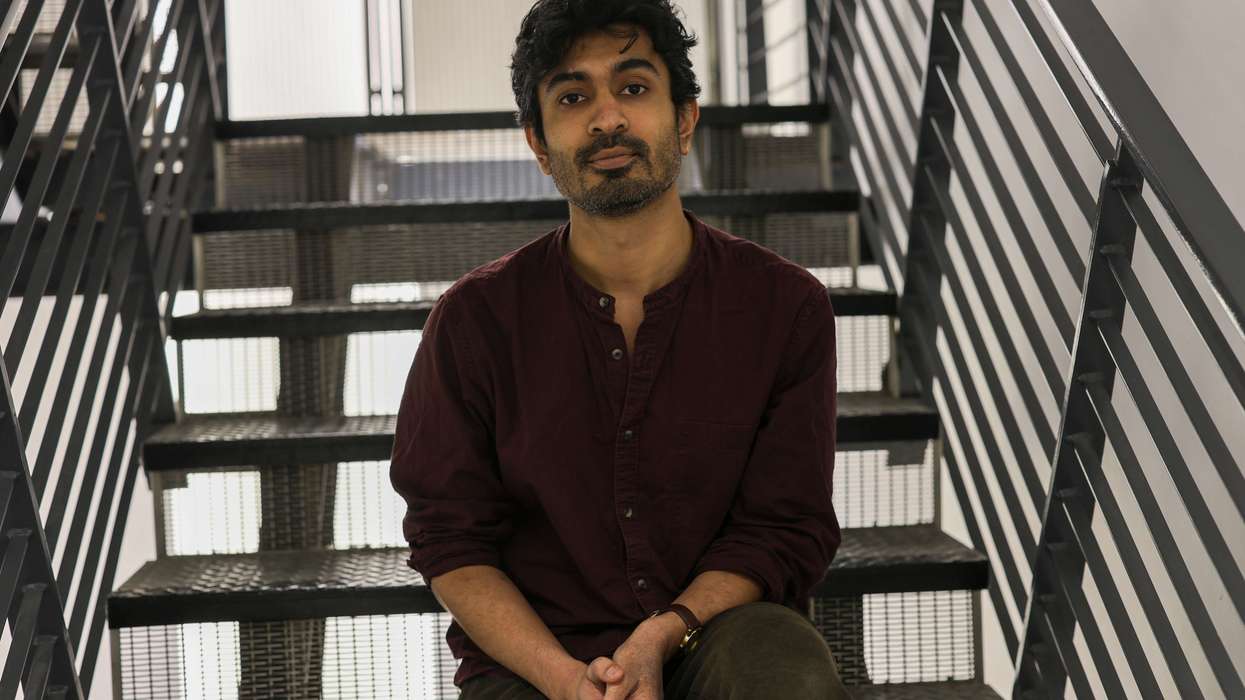

YOUNG people today are growing up in a world marked by war, climate anxiety and deep social divides, yet theatre can still offer something rare: a shared, live experience that allows audiences to confront fear, power and responsibility together, an award-winning Asian director has said.
That belief sits at the heart of a new production of Dracula, directed by Atri Banerjee and staged by the National Youth Theatre. The production reimagines the famous gothic novel for a new generation, placing young performers and contemporary concerns at the centre of a story that has been told and retold for more than a century.
Dracula, written by Bram Stoker, is one of the most recognisable stories in literature, with countless stage and screen adaptations. Banerjee acknowledged that familiarity was a challenge when approaching the material.
Working with writer Tatty Hennessy, the London-based Asian director sought to strip away what he described as the “cultural baggage” that has built up around the vampire myth. Instead, the production returned to the novel’s deeper concerns, using the figure of the vampire to explore present-day anxieties.
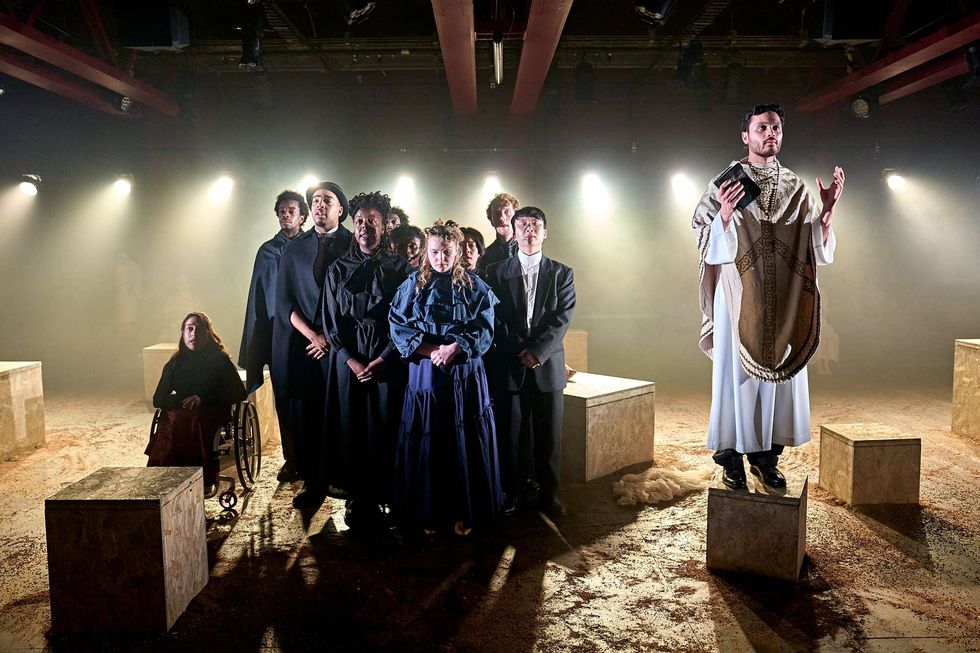 And ,the young cast of the National Youth Theatre’s REP company in a still from DraculaManuel Harlan
Banerjee, 32, told Eastern Eye, “The vampire has always been used throughout history as a metaphor for many different things – addiction, fear of the other, and so on. We were really interested in what vampires mean today, and particularly what they represent for young people, for students.”
“We really wanted to make a good, entertaining night at the theatre. Some horror, some shocks, some scares along the way – and hopefully make people feel spooked, but also make them laugh and perhaps even admit to being frightened.”
The production explores exploitation, consumption and vulnerability, drawing links between the vampire’s hunger and the way power operates today. “We live in a world where consumerism and the draining of resources is very present,” he said. “Whether we think about the climate crisis, or the fact that all of us use mobile phones with chips that have been mined in Central Africa.”
That sense of shared responsibility, he suggested, is uncomfortable but necessary. “Without wanting to be too heavy-handed, the question becomes: are we all vampires in some shape or form?” he asked. “How do we reckon with that, and how do we live a more ethical life knowing it?”
Banerjee also drew attention to the abuse of power that dominates current affairs. “There are lots of extremely powerful people, particularly powerful men, in the world who have been left to drain others unchecked,” he said. “Just look at the news now. If Dracula were a real person today, who would that person be?”
The production is performed by 18 young actors (aged 20 to 27 years), all members of the National Youth Theatre’s REP company.
Banerjee noted their presence was central to the show’s impact. For audiences, he hopes the experience works on more than one level. “I hope it will leave them reflecting on these themes and ideas,” he said. “I also think it’s wonderful for audiences to see these eighteen young actors performing on stage in their first show of the year.”
He said that the young performers in Dracula are entering the arts at a difficult moment. “It’s a tough time to be a young person. The world is a very difficult place now, and I count myself as part of that, I’m not that far off in age from them.” He pointed to the pressures shaping their lives. “Just look at all the problems we have – the wars around the world, the climate crisis, the rise of right-wing politics and fascism,” he said.
An artistic lead at the Gate Theatre, Banerjee began his career with a year-long internship at the National Theatre. He later completed a two-year master’s in directing at Birkbeck, University of London, which included a y e a r- l o n g placement as trainee director at the Royal Exchange Theatre in Manchester. Banerjee’s own path into directing began early and abroad. He spent many of his formative years growing up in Italy, where cinema was his first passion. “As a young teenager in Italy, I decided I wanted to become a film director,” he said. When he returned to the UK around the age of 14, theatre entered his life in a more direct way. “I got involved with the school drama society and started doing plays. I never wanted to be an actor, I always wanted to be a director.”
What drew him to directing was the collaborative nature of the work. “I’ve always really enjoyed the craft of putting together a show for an audience, and working with lots of different collaborators,” he said. “Whether that’s on the music or the visuals. I always liked the task of working with other people to bring out the best in them.”
He has been working professionally since 2017. His career has included work at major institutions and a growing reputation for bold reinterpretations of classic texts.
He recently directed a revival of the classic Angry Young Men 1950s play Look Back in Anger for the Almeida Theatre, helmed a new production of The Glass Menagerie for the Rose Theatre and a production of Julius Caesar.
Banerjee won Best Director award for his production of Hobson’s Choice at the Royal Exchange Theatre in Manchester. For the same production, he was nominated for Best Director at the UK Theatre Awards. While he welcomed the acknowledgement, he stressed that it was not the motivation behind his work. “Awards are lovely,” he said. “But obviously you don’t do it for awards or praise. You do it because of the art, and you keep challenging yourself from project to project.” In a media landscape dominated by streaming platforms, social media and rapidly developing artificial intelligence, Banerjee argued that theatre still has a vital role. He said, “In a climate so saturated with television, film and video content, live theatre holds a genuinely special place. It is an experience the audience comes to witness in real time, here and now, in the flesh.”
He is cautiously optimistic about the state of Asian representation in British theatre, noting gradual change both on stage and behind the scenes. “I think things are changing,” he said.
“There are many more Asian artistic directors now. Things can always be better, but I do think our stories are being seen and represented.”
His advice to aspiring Asian actors, writers and directors was direct. “Your voice is valid, and your voice is needed,” he said. “But also, don’t feel that you are limited by your identity. Don’t feel that it is the only story you can tell. A whole range of stories is available to you.”
He also emphasised resilience and patience. “Being an actor requires a great deal of skill and craft, but also stamina. I hope the main thing the young actors take from the rehearsal process is the importance of trusting the process, knowing that things might not feel clear immediately when you’re making a show, but that as things go on, clarity comes. Not panicking, and letting the work do its work.”
Dracula runs at the National Youth Theatre until next Friday (13)