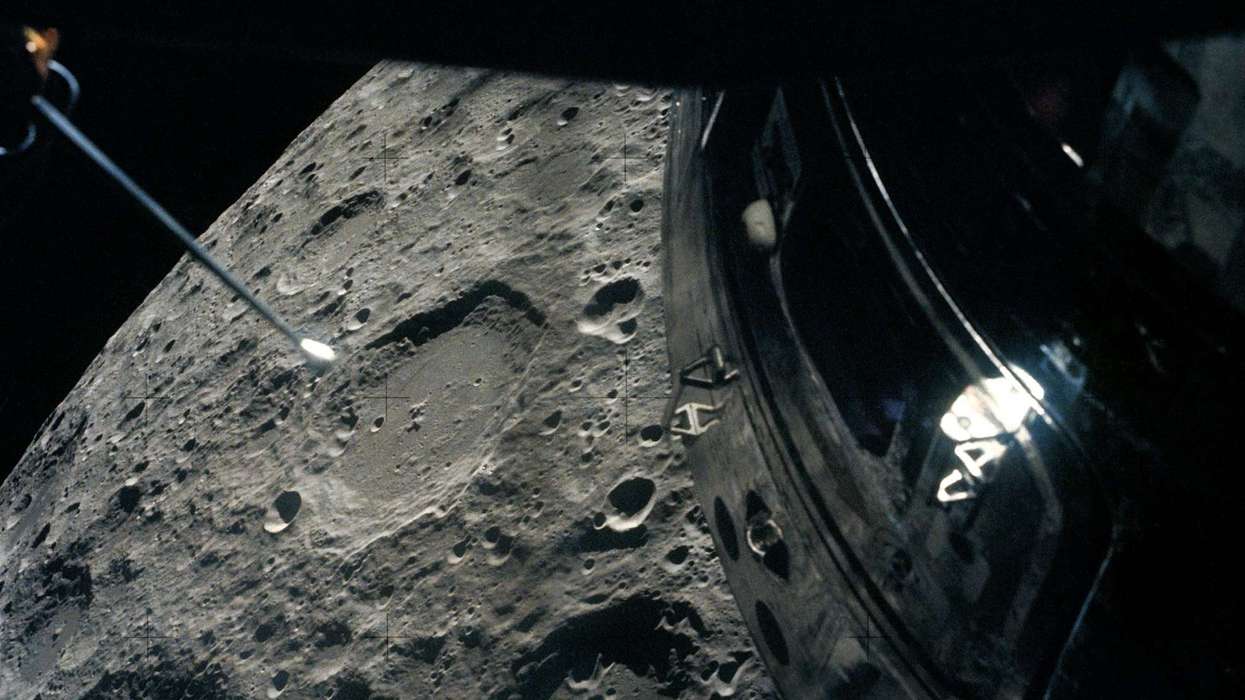

THE FOUR astronauts on NASA’s Artemis II mission travelled farther from Earth on Monday than any humans before, setting a new record as they carried out a flyby of the far side of the moon.
The crew reached a distance of 252,756 miles from Earth, surpassing the previous record set during the Apollo 13 mission in 1970.
During a six-hour pass over the far side of the moon, the astronauts reported seeing “impact flashes” caused by meteors striking the lunar surface.
Scientists at NASA’s Johnson Space Center in Houston tracked the observations in real time as the Orion spacecraft moved around the moon at a distance of about 402,000 km from Earth.
The flyby brought the spacecraft to within 4,070 miles of the lunar surface and came six days into the mission, marking the first time astronauts have travelled to the moon’s vicinity since the Apollo missions more than 50 years ago.
Six Apollo missions landed crews on the moon between 1969 and 1972, with 12 people walking on its surface.
The Artemis programme aims to land humans on the moon again by 2028 and to build a long-term presence, including a base to support future missions to Mars.
Although Artemis II is a test flight, it produced data for scientists, including meteor impact flashes similar to those reported during the Apollo missions.
The crew, travelling in the Orion capsule after launching from Florida last week, woke on Monday to a recorded message from former NASA astronaut Jim Lovell, who flew on Apollo 8 and Apollo 13.
"Welcome to my old neighbourhood," said Lovell, who died last year at age 97. "It's a historic day, and I know how busy you'll be, but don't forget to enjoy the view... good luck and Godspeed."
US astronauts Reid Wiseman, Victor Glover and Christina Koch, along with Canadian astronaut Jeremy Hansen, made spaceflight history by travelling farther from Earth than any humans before.
The previous record of about 248,000 miles was set in 1970 during the Apollo 13 mission, after a malfunction forced the crew to return using the moon’s gravity.
On their way to the far side of the moon, the astronauts suggested names for lunar features without official designations.
In a message to mission control, Hansen proposed naming one crater Integrity, after the Orion capsule, and another after Wiseman’s late wife, Carroll, who died of cancer in 2020.
"A number of years ago we started this journey, our close-knit astronaut family, and we lost a loved one," Hansen said. "It's a bright spot on the Moon, and we would like to call that Carroll."
Hansen later said the crew had seen features that "no human has ever seen before, not even in Apollo."
As Orion moved around the far side, the astronauts captured images of Earth appearing to set and rise over the lunar horizon due to their position.
The far side of the moon always faces away from Earth, and only Artemis and Apollo astronauts have seen it directly.
The flyby placed the spacecraft in darkness and caused a 40-minute communications blackout as the moon blocked signals from NASA’s Deep Space Network.
After the flyby, US president Donald Trump spoke to the crew from the White House.
"Today, you've made history and made all America really proud, incredibly proud," Trump said. "You've really inspired the entire world. Really, everybody's watching."
Koch told Trump that one of her most unforgettable moments was "coming back from the far side of the moon and having the first glimpses of planet Earth again."
When asked about the communication blackout, Glover said, "I said a little prayer, but then I had to keep rolling."
(With inputs from agencies)