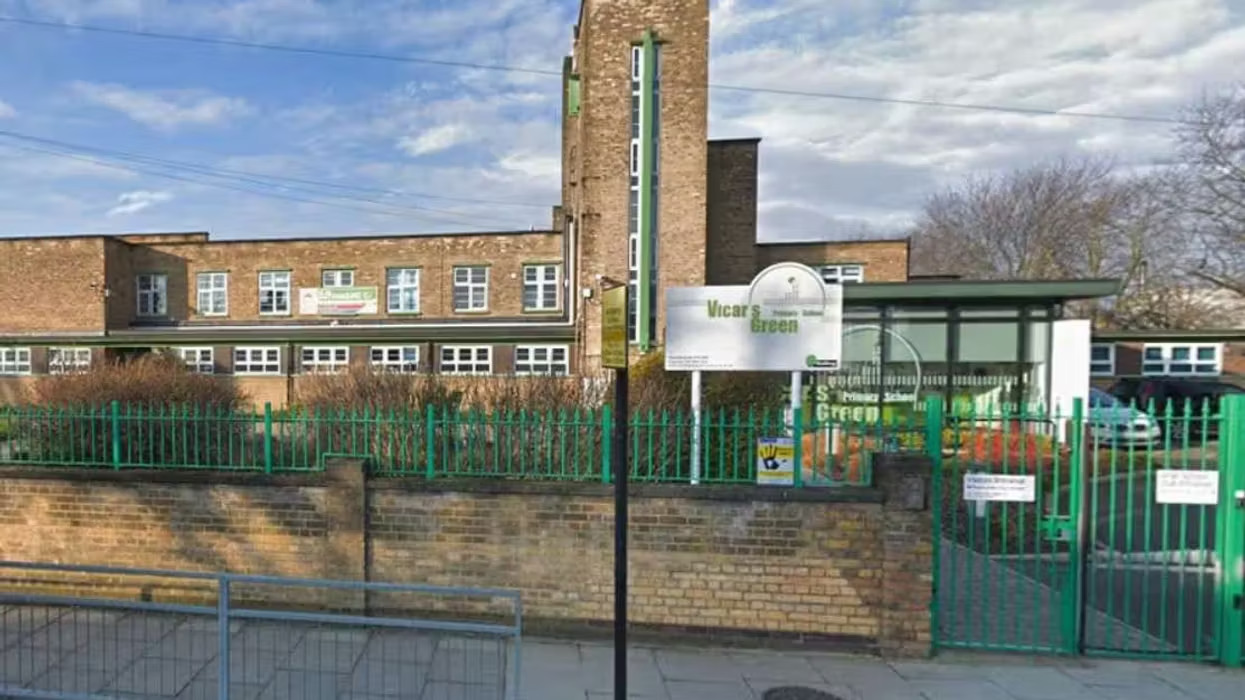

A PRIMARY school in north-west London has been accused of religious discrimination after a diaspora advocacy group said an eight-year-old pupil was challenged for wearing a tilak on his forehead.
INSIGHT UK said on Monday that the incident at Vicar’s Green Primary School in Wembley caused “significant distress” to the child and his family. The group claimed Hindu parents had no option but to remove at least four pupils from the school.
The school denied discrimination at what it described as a “diverse and inclusive” institution, with pupils from more than 50 language backgrounds, including a significant number of Hindus.
“The Tilak-Chandlo is not a cosmetic or cultural accessory, it is an integral religious observance for many Hindus,” an INSIGHT UK spokesperson said.
“Preventing a child from practising their faith, or making them feel ashamed or intimidated for doing so, is wholly unacceptable in a modern and multicultural Britain.
“For over one billion Hindus worldwide, sacred markings such as the Tilak-Chandlo, Bindi, Tikka, Tripundra etc are integral expressions of faith. To trivialise or mislabel such practices in an educational setting reflects a troubling lack of religious literacy,” the spokesperson said.
INSIGHT UK said reports collated by the group showed the school headteacher and governors displayed a lack of “cultural and religious sensitivity” during discussions.
“This was not a good-faith dialogue — it was an imbalance of power, where Hindu religious practices were scrutinised, minimised and ultimately rejected,” the group said.
It called on the school to review its policies and staff training to ensure compliance with equality and safeguarding laws.
Ealing Council, which oversees the school rated “outstanding” by the Office for Standards in Education (OFSTED), responded to an inquiry from PTI with a statement from a spokesperson for Vicar’s Green Primary School.
“Our longstanding school policy asks pupils not to wear visible skin markings, including religious ones. We met with the parents of a pupil who was wearing a Tilak-Chandlo on their forehead to discuss the matter sensitively and sought to understand the reason for it,” the spokesperson said.
“We fully recognised the family’s religious beliefs and, in a spirit of conciliation, we offered a reasonable compromise by making an exception to our policy, so the symbol could be worn on a less prominent part of the body. This was, unfortunately, rejected by the pupil’s parents,” the spokesperson said.
The school referred to recent OFSTED inspections, which it said recognised an inclusive environment where children “thrive”.
“The school’s governing body also thoroughly reviewed the case and wrote to the parents explaining the school’s decision in detail, and also offered the reasonable adjustments the school had proposed, as well as special religious occasions. Unfortunately, the parents did not accept either of these adjustments,” the spokesperson said.
“We have always approached these discussions respectfully, sensitively and thoroughly, which has taken up a considerable amount of time and stress for the school and its community. As a school, our priority is always the well-being of all our children.”
Vicar’s Green Primary School said it values and respects the diverse cultural and religious backgrounds of its community. It said its policy is designed to “promote cohesion, fairness, equality and a shared sense of belonging while preventing division or disruption within the school community”.
The UK government classifies the school as a mixed community school that caters to pupils aged between three and eleven.
(With inputs from PTI)