
COMMONS speaker Sir Lindsay Hoyle praised the “whole new level” of Indo- UK bilateral relations, as he said the focus was on mutual support and helping each other.
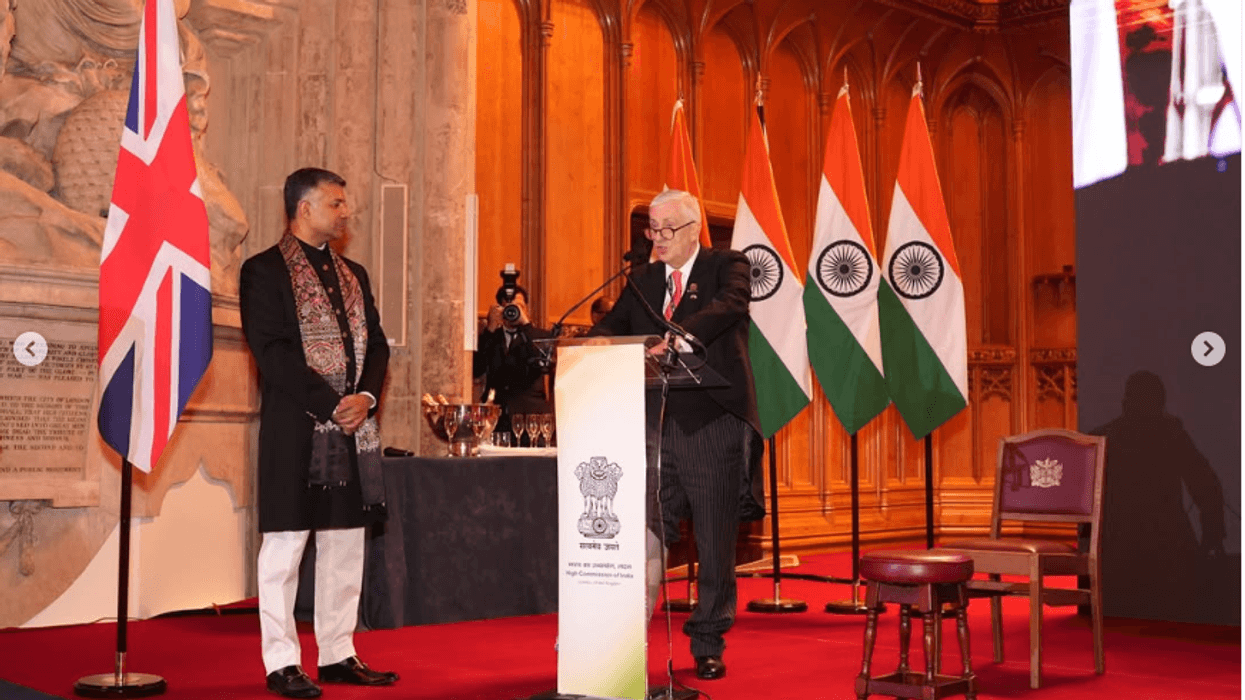
Sir Lindsay was a chief guest at a Republic Day reception hosted by the Indian High Commission in London’s Guildhall on Monday (26) evening, attended by British MPs, diplomats and key members of the community.
Sir Lindsay said, “It’s brilliant that we have working relationships between our two countries. We’re going forward. It’s not about looking back; it’s about looking forward and what we can do to help each other. It is about India. It is about the UK, and a strong future. It is about democracy for the whole world, and it will never divide us.”
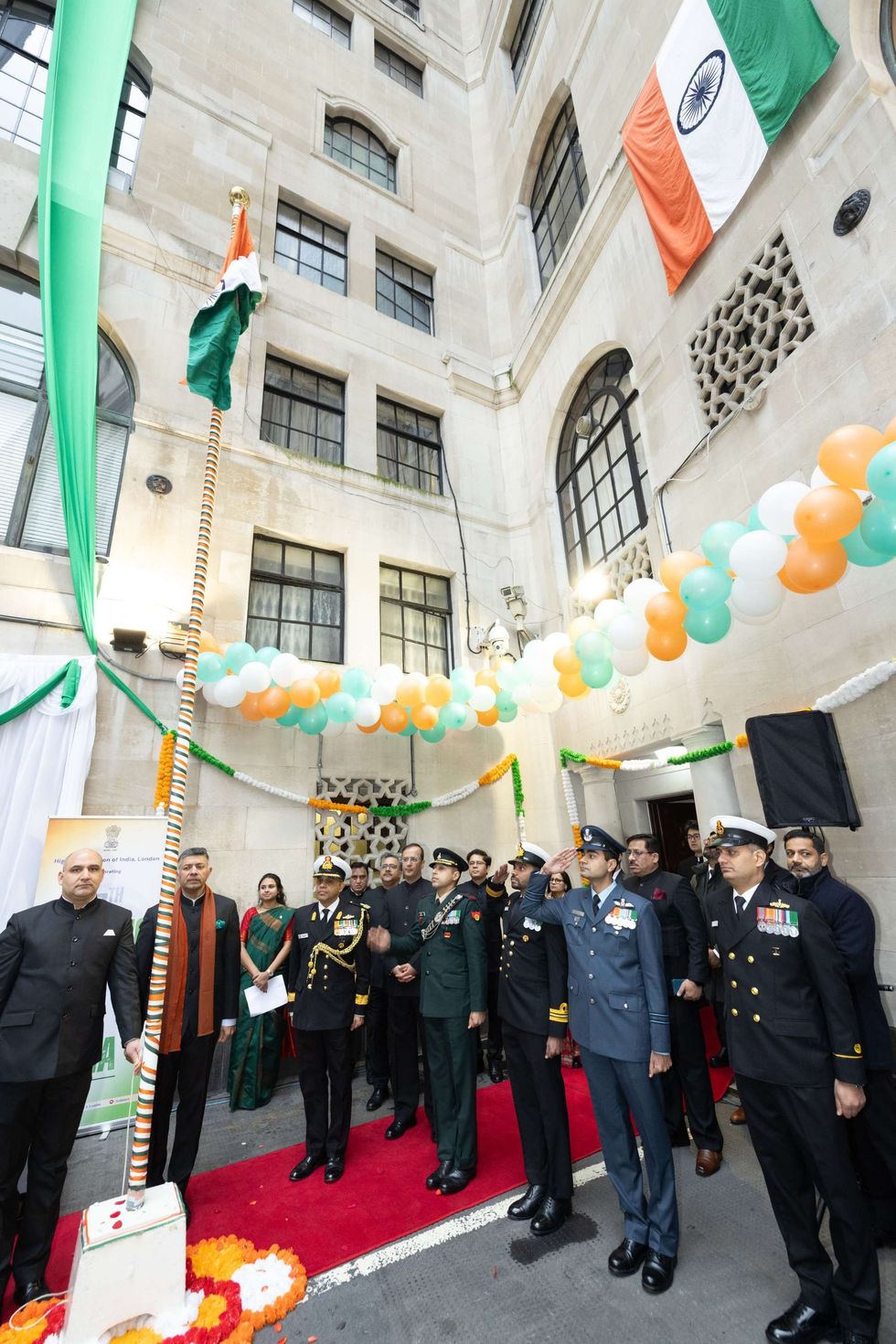 A flag hoisting ceremony at India House in LondonIndia High Commission
The speaker highlighted the strong trade and investment relationship between the countries, which he noted boosts employment and improves prosperity in both nations.
India is the UK’s 11th largest trading partner, with a trading relationship worth £47.2 billion.
“Both our governments have committed to continuing to forge even stronger trade and investment ties, and that’s what matters,” he said.
The speaker also praised India as the world’s largest democracy, noting that the 2024 Indian election was “the biggest the world has ever seen” with just under a billion people eligible to vote.
“When I hear about almost one billion people voting, counting the votes, delivering that result – that is something special,” he told the reception.
The speaker, who has visited India several times including recently for the conference of speakers and presiding officers of the Commonwealth in New Delhi, said he was consistently impressed by India’s achievements.
“Every time I go to Delhi, I am amazed at the way you deliver something special,” he said, pointing to India’s construction of a new Parliament building in just two years. Sir Lindsay also recalled a favourite history lesson from his school days about Mahatma Gandhi’s 1931 visit to Lancashire, where Gandhi met mill workers whose jobs were affected by India’s boycott of British textiles.
“Despite the fears of hostility, Gandhi received a warm Lancashire welcome,” the speaker said. “Gandhi was taken by surprise, and that’s what it’s about. It’s about surprise.” He also quoted Gandhi’s words from a letter: “He wrote that he would ‘treasure the memory of those days to the end of my existence.’”
Sir Lindsay, who represents a Lancashire constituency and lives in the village of Adlington, said the connection between his home region and India “continues to exist until this day.”
India’s high commissioner to the UK, Vikram Doraiswami, said India has opened two new consulates in the UK for the first time in 40 years, in Belfast and Manchester.
He outlined a year of significant progress in UK-India relations, including a historic roadmap agreement reached before Diwali and prime ministerial visits in both directions.
Doraiswami said India and the UK have strengthened education ties, with Southampton University becoming the first to open an Indian campus last July.
UK institutions now account for 60 per cent of foreign universities opening campuses in India. A new Technology Security Initiative brought together businesses, research bodies and government departments from both countries to work on telecoms, future networks, AI centres of excellence, and a first-ever observatory on critical minerals.
Doraiswami added, “These measures are reshaping our ties to become more modern, forward-looking, mutually beneficial and, of course, more efficient. In doing so, we are building a truly new, truly strategic partnership, one that is relevant to the 21st century.” The India- UK partnership was particularly important “as the world around us changes rapidly,” the high commissioner said, adding that both countries face common challenges from the impact of climate change to threats from artificial intelligence and disinformation.
“Global issues have local echoes. These are felt daily, including in the rising cost of travel and the weekly grocery run,” he said.
Doraiswami addressed negative portrayals of both countries on social media, saying Indians and Britons share a “sense of shock” when their countries are unfairly portrayed.
“From the Indian perspective, there is the visible willingness of Indian businesses to bring investment here to the UK or to London, attracted as they are by this luminous city. Yet the contrast on social media – I understand the bemusement of British friends when the UK context is painted in such negative terms that they cannot recognise the place,” he said.
“For millions of Indians used to reading entire reports about India in Western media, hearing British friends express shock about the UK being so unfairly portrayed, the reaction, the sense of shock, is something that we share.”
Doraiswami praised India’s constitution as “the genesis of our journey, the foundation of our dreams and a bedrock that reflects not just the best of the Indian ethos, but the best of democratic traditions from across the world, and that includes this very country.”
He thanked Britons of Indian origin and Indians in the UK “who always believed this partnership would be much more than the sum of its parts.”
Among MPs who attended the reception were Barry Gardiner, Bob Blackman, Bagger Shanker, Deirdre Costigan, Baroness Sandy Verma, peers Lord Popat, Lord Rami Ranger and Southampton University vice chancellor Mark Smith.