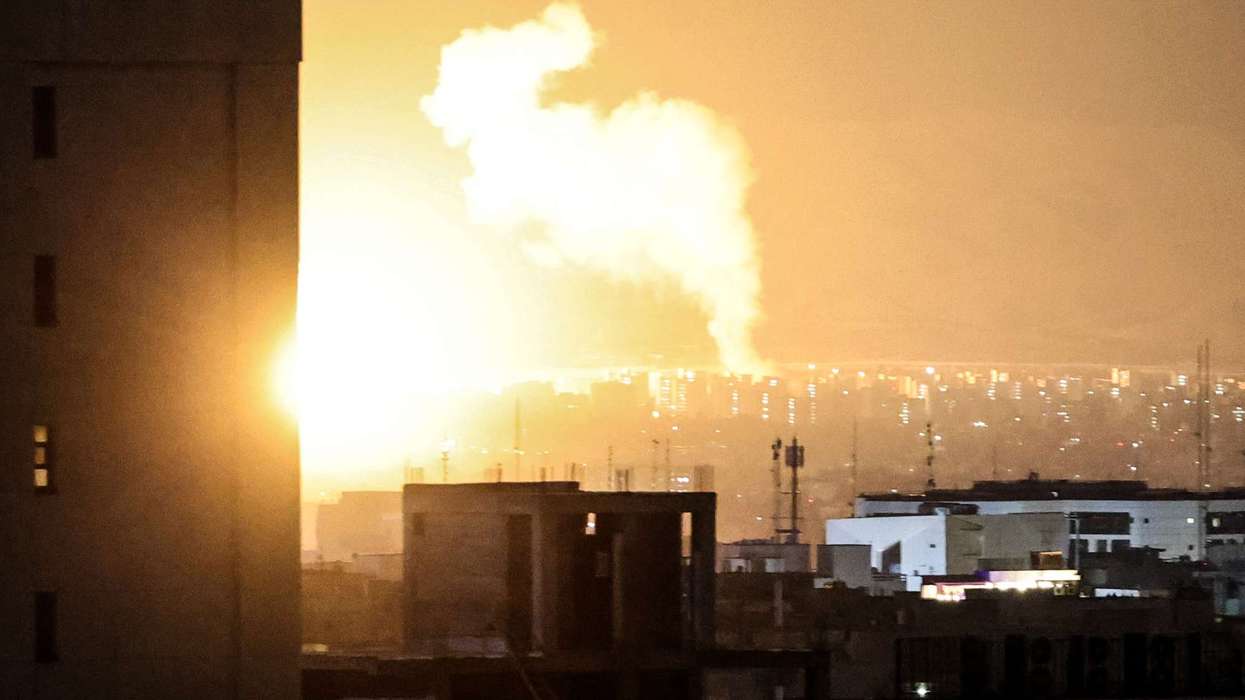

STRIKES hit Iran and Lebanon on Friday as Israel said it was moving into a "new phase" of the war in the Middle East.
Explosions were reported in Tehran early Friday after Israel said it was targeting "regime infrastructure" in the Iranian capital. Iranian media reported heavy strikes and AFP journalists in Tehran heard loud blasts.
The conflict, now in its seventh day, has spread across the region and beyond, affecting several countries and disrupting energy markets and transport routes.
AFPTV images from Beirut's southern suburbs showed damaged buildings and burned vehicles after Israeli bombing overnight. Tens of thousands of people fled the area.
ALSO READ: Second Iranian warship heads to Sri Lanka after submarine attack
Israel's military chief, Lieutenant General Eyal Zamir, said the campaign was entering another stage.
"We are now moving to the next phase of the operation," he said in a televised statement.
"We have additional surprises ahead which I do not intend to disclose," he added.
US Defence Secretary Pete Hegseth said that "firepower over Iran and over Tehran is about to surge dramatically".
According to Iran's health ministry, US and Israeli strikes on the country have killed 926 people, a number AFP could not independently verify.
ALSO READ: UK launches repatriation operation for Britons caught in Gulf war
Iran has launched missile and drone attacks at Israel and Gulf countries since the war began on Saturday. In Israel, at least 10 people have been killed, according to first responders.
The US military has reported the deaths of six of its personnel since the war began.
Internet access in Iran has also been disrupted. Monitor group Netblocks said coverage was running at about one per cent.
In Tehran, residents said security forces had increased their presence.
The Islamic Revolutionary Guard Corps (IRGC) "has closed almost every main street with armed personnel and heavy machine guns to frighten people", a 30-year-old Tehran resident told AFP from Paris.
"The people are the real enemy in their eyes, not the Americans. Their extremists say first you have to deal with the enemy at home."
ALSO READ: Trump calls UK response to Iran strikes 'very disappointing'
US President Donald Trump said it would be a "waste of time" to consider sending US ground troops into Iran at present.
"It's a waste of time. They've lost everything. They've lost their navy. They've lost everything they can lose," he told NBC by telephone.
He added that Iranian Foreign Minister Abbas Araghchi's remark that Tehran was ready for a US or Israeli ground invasion was a "wasted comment".
Trump also said he wanted Iran's leadership removed quickly.
"We don't want someone who would rebuild over a 10-year period," he said.
He also said he would "have to be involved" in choosing Iran's next leader after US-Israeli strikes killed Iran's supreme leader Ayatollah Ali Khamenei at the start of the conflict.
"Khamenei's son is a lightweight. I have to be involved in the appointment, like with Delcy," Trump said.
The war has also drawn in Lebanon after the militant group Hezbollah launched missiles in support of Iran.
Israel carried out strikes on several towns in southern Lebanon overnight and hit Beirut's southern suburbs, an area considered a Hezbollah stronghold and home to about 600,000 to 800,000 people.
Residents fled after Israel ordered people in the area to evacuate immediately.
Hundreds of families gathered at Beirut's Ramlet al-Baida beach after leaving their homes.
"We fled from the suburbs, we were humiliated," one man told AFP, declining to give his name.
"We'll sleep on the road tonight and God alone knows what will happen to us."
Lebanon's health ministry said 123 people have been killed in Israeli strikes since the country was drawn into the conflict earlier this week.
State media also reported Israeli strikes on several towns in eastern Lebanon and on the town of Dours at dawn.
Iran has continued missile attacks on Israel, including strikes aimed at Tel Aviv. Rocket trails were also seen in the sky above Netanya in northern Israel.
The conflict has also reached Gulf countries.
Saudi Arabia said it destroyed three drones east of Riyadh and also intercepted three missiles aimed at an air base.
Qatar said its air defences intercepted a drone targeting the US air base at Al-Udeid, the largest US military facility in the Middle East.
Western embassy staff in Riyadh were told to shelter in place after an earlier attack on the US embassy compound.
Iran also struck buildings in Bahrain. Authorities said a hotel and two residential buildings in the capital, Manama, were hit.
Thirteen people, including seven civilians, have been killed in Gulf countries since the conflict began. Those killed include an 11-year-old girl in Kuwait.
The conflict has extended beyond the Middle East.
A US submarine torpedoed an Iranian frigate near Sri Lanka earlier this week. Sri Lanka later took control of another Iranian navy vessel, the IRIS Bushehr, and offloaded its crew.
President Anura Kumara Dissanayake said Sri Lanka's navy had taken 208 sailors from the ship.
Australian Prime Minister Anthony Albanese said three Australian military personnel were on the American submarine as part of training under the AUKUS defence pact with Britain and the United States.
Azerbaijan has also threatened retaliation after a drone strike hit an airport there.
Countries have begun evacuating travellers from the region as air travel has been disrupted by missile and drone activity.
The conflict has also affected global markets. Crude oil prices have risen by about a fifth in the week since the fighting began and shipping through the Strait of Hormuz has slowed.
"Unless the war ends soon -- and if anything a more intense conflict seems more likely -- markets will struggle," said IG chief market analyst Chris Beauchamp.
"Volatility remains elevated... but a continued decline for the moment seems likely."
(With inputs from agencies)