
IRAN's President Masoud Pezeshkian said on Saturday that Iran would not surrender in its war with Israel and the United States, as Israel said more than 80 fighter jets carried out strikes on targets in Tehran and central Iran.
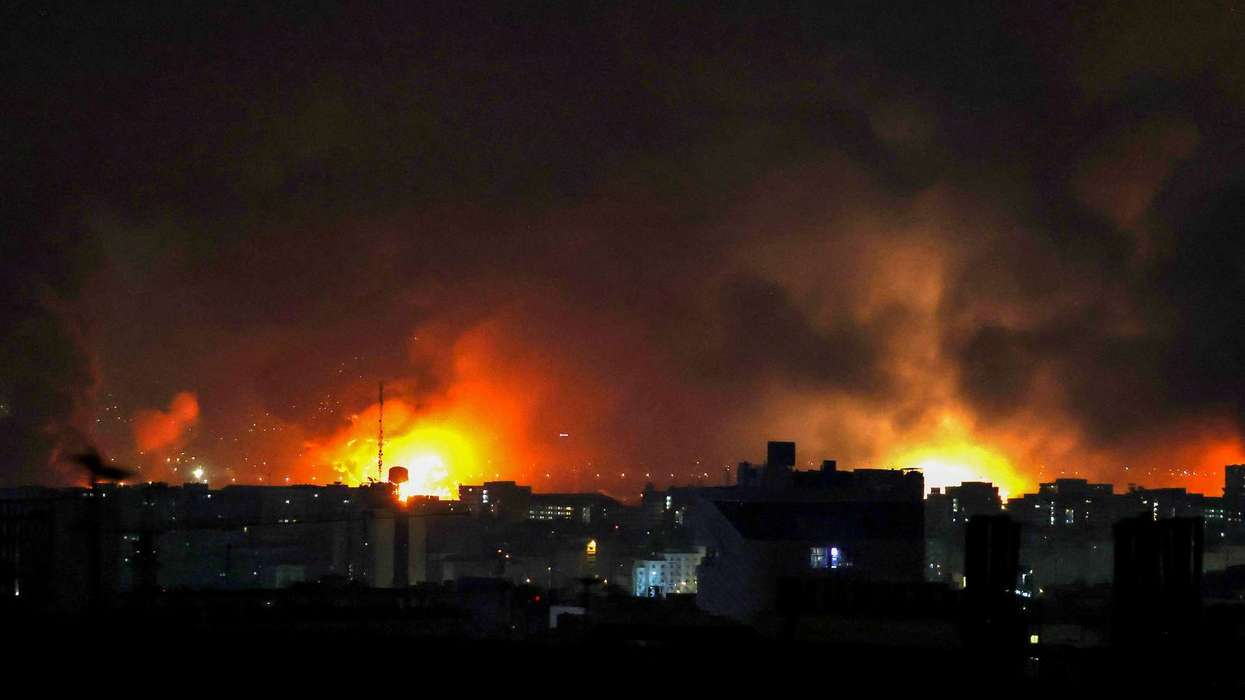
Israel’s military said the aircraft completed a wave of “broad-scale” strikes targeting Iranian military sites, missile launchers and other facilities, including a Revolutionary Guards military academy, an underground command centre and a missile storage facility.
AFP photos showed fire and smoke rising from Tehran’s Mehrabad International Airport after the strikes.
ALSO READ: Israel says war entering ‘next phase’ as strikes hit Iran and Lebanon
Speaking on state television, Pezeshkian rejected calls for surrender after US President Donald Trump said the conflict would end only if Iran accepted “unconditional surrender”.
“The enemies must take their wish for the surrender of the Iranian people to their graves,” Pezeshkian said.
The Israeli military said “over 80 Israeli Air Force fighter jets... completed an additional wave of strikes targeting infrastructure belonging to the Iranian terror regime”.
The military said the aircraft struck a Revolutionary Guards military academy that “was being used as an emergency asset”.
Other targets included an underground command centre, missile storage facilities and launch sites “in order to reduce the scope of fire directed at the territory of the State of Israel”.
ALSO READ: Second Iranian warship heads to Sri Lanka after submarine attack
The strikes were among the largest announced by Israel since the regional war began on February 28.
Israel previously said that 200 fighter jets took part in the initial wave of attacks alongside the United States.
The conflict began after Israeli and US air strikes last Saturday that killed Iran’s supreme leader Ali Khamenei and damaged military, administrative and security infrastructure.
Iran launched attacks across the region in response.
Air raid alerts and explosions were reported over Jerusalem, while AFP journalists heard blasts in Dubai and Bahrain’s capital Manama.
ALSO READ: UK launches repatriation operation for Britons caught in Gulf war
Saudi Arabia’s defence ministry said it intercepted a ballistic missile fired at an air base housing US military personnel.
The kingdom also said it stopped a drone attack on an oilfield near the Emirati border.
Dubai airport briefly suspended operations after what authorities described as “a minor incident resulting from the fall of debris after an interception”.
Emirates earlier said flights were suspended to and from Dubai after an explosion was heard near the airport and planes were seen circling in a holding pattern.
Iran’s army said its navy launched a wave of drone attacks targeting Israel as well as US bases in the United Arab Emirates and Kuwait.
Iran’s Revolutionary Guards said they also targeted an oil tanker named Prima in the Gulf.
“This morning, an oil tanker with the trade name Prima was hit by an exploding drone after ignoring repeated warnings from the IRGC naval forces regarding the prohibition of traffic and the insecurity of the Strait of Hormuz,” the Guards said in a statement carried by Tasnim news agency.
The Guards earlier said they were “waiting” for US forces to escort ships through the strait.
ALSO READ: Trump calls UK response to Iran strikes 'very disappointing'
Pezeshkian apologised to neighbouring countries for Iran’s attacks, saying they would only be targeted if their territories were used as launchpads to attack Iran.
The Guards also said they struck three locations of “separatist groups” in Iraq’s Kurdistan region.
“If separatist groups in the region (of Kurdistan) make any move against Iran's territorial integrity, we will crush them,” the Guards said.
In Lebanon, Israeli strikes continued and clashes were reported near the Lebanon-Syria border.
Lebanon’s state-run National News Agency, citing the health ministry, said Israeli strikes on Nabi Sheet killed at least three people and wounded 16 others.
Lebanon’s health ministry has said at least 217 people have been killed in Israeli strikes.
Prime Minister Nawaf Salam warned that a “humanitarian disaster is looming”.
The Norwegian Refugee Council said around 300,000 people in Lebanon have been forced to leave their homes.
Inside Iran, damage to infrastructure and residential buildings has increased as the war enters its second week.
Residents in Tehran reported anxiety and a large security presence in the streets.
“I don't think anyone who hasn't experienced war would understand it,” a 26-year-old teacher told AFP on condition of anonymity. “When you hear the bombs, you have no idea where they will hit.”
Iran’s health ministry said on Friday that 926 civilians had been killed and around 6,000 injured, though AFP could not independently verify the figures.
The conflict has also widened to Cyprus, Turkey and Azerbaijan and has reached waters off Sri Lanka, where US forces sank an Iranian warship with a torpedo.
The war has killed six US service members.
Trump is expected to attend the return of their bodies at a transfer ceremony at Dover Air Force Base in Delaware on Saturday.
Trump has rejected new talks with Tehran and said on Truth Social that “there will be no deal with Iran except UNCONDITIONAL SURRENDER”.
White House Press Secretary Karoline Leavitt said that once the operation’s goals are achieved, “Iran will essentially be in a place of unconditional surrender, whether they say it themselves or not”.
Trump also said the United States would help rebuild Iran’s economy if Tehran installs someone “acceptable” to him to replace the late supreme leader.
Iran’s ambassador to the United Nations Amir Saeid Iravani rejected that suggestion.
“The selection of Iran's leadership will take place strictly in accordance with our constitutional procedures and solely by the will of the Iranian people, without any foreign interference,” he said.
Russian President Vladimir Putin voiced support for an “immediate” ceasefire during a phone call with Pezeshkian on Friday, the Kremlin said.
US Defense Secretary Pete Hegseth said the United States was “not concerned” by reports that Russia may be providing intelligence to Iran on US troop movements.
While declining to confirm the reports, Hegseth said in an interview with CBS’s “60 Minutes”: “We're tracking everything.”
Foreign ministers of the Arab League are due to hold an emergency meeting on Sunday to discuss “Iranian attacks on the territories of several Arab countries”.
The meeting, requested by Kuwait, Saudi Arabia, Qatar, Oman, Jordan and Egypt, will be held by videoconference, assistant secretary-general Hossam Zaki said.
The US State Department has also approved the “emergency” sale of 12,000 bomb casings to Israel.
“The proposed sale will improve Israel's capability to meet current and future threats, strengthen its homeland defense, and serve as a deterrent to regional threats,” the State Department’s Bureau of Political-Military Affairs said.
(With inputs from agencies)