A 25-year-old homeless man has been locked up for life for the sexually motivated murder of Pardeep Kaur who he brutally attacked as she walked to work.
Vadims Ruskuls killed Kaur, 30, during a violent sex attack near Harlington Bridge in west London in October.
Almost a week after she was reported missing, her partially-clothed body was found hidden in undergrowth at the site.
Ruskuls from Latvia, was jailed for a minimum term of 30 years at the Old Bailey today (12) and was ordered to be deported following the serving of his sentence.
He was thought be sleeping rough beneath the bridge which crosses the M4, alongside his mother, when he killed the hotel housekeeper.
Jurors were shown CCTV footage of Ruskuls following Kaur as she approached the bridge in Hayes.
They then disappeared from view for 25 minutes before Ruskuls appeared again, dragging her partially-clothed body.
Judge Richard Marks QC told the defendant it was apparent that the motive of the attack must have been sexual.
Ruskuls sexually assaulted Kaur, killed her and then did his "level best" to conceal her body", judge Marks said.
"This was a truly shocking and wicked offence of the utmost gravity. Anyone who could do what you did must be regarded as extremely dangerous. What a dreadful way for Pardeep Kaur, a decent, hard-working young woman, to die," he added.
Kaur had come to live in Britain in 2011 with her husband, Rachpal Singh, and the pair worked six days a week to send money to their five-year-old daughter, who lived with her grandparents in India.
In a victim impact statement, Kaur's husband said: "I wonder why it happened to lovely Pardeep and why Vadims Ruskuls killed her. The circumstances of Pardeep's death will always haunt me because [he] has not given an explanation."
The judge told Ruskuls he had not shown "one iota of remorse" for his actions.
Ruskuls was caught after a police constable recognised the figure in CCTV footage as the man he had spoken to the day after Kaur's disappearance.
Following his arrest, Ruskuls' DNA matched samples taken from Kaur's ankle, sock and bra with a probability of "one in a billion".





 Best actress Krishnendu Majumdar with winner Aasiya Shah.EE
 In total, 21 awards were presented at the event.EE
 Crime fiction winners from left: Vaseem Khan Imran Mahmood Abir MukherjeeEE
 Editors special award was collected on behalf of Naz Shah MP.EE
 Best actor stage winner Raj Ghatak's trophy was collected by his father.EE
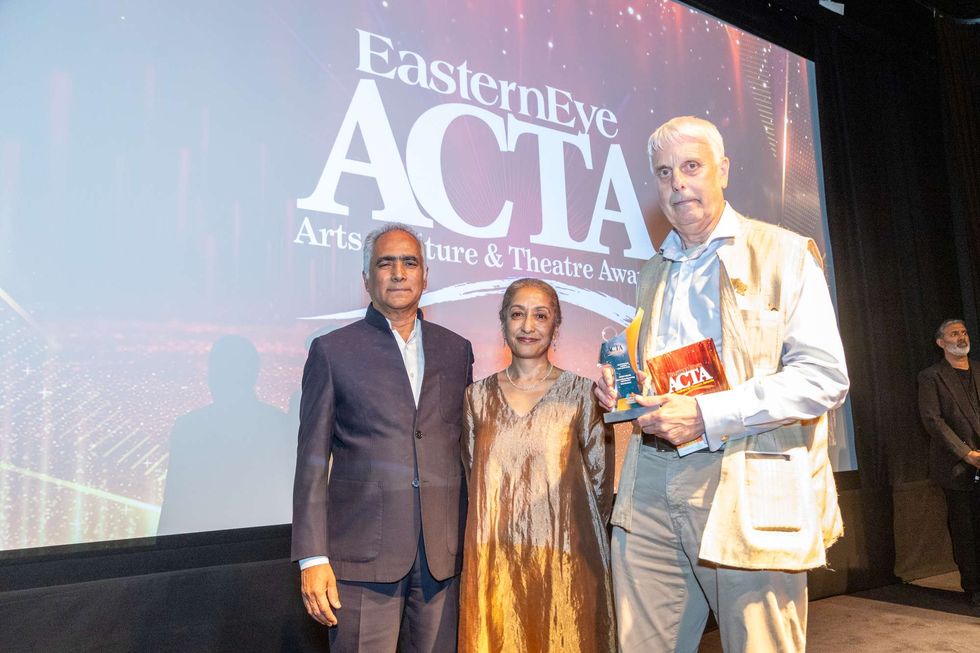 Arts winners, from left: Sundaram Tagore, Divia Patel, NoltieEE
 Eastern Eye editor-at-large and chairman of the ACTA judging panel, Amit Roy.EE