
BRITAIN has sharply condemned Iran for carrying out "reckless" missile and drone strikes on its neighbours in the Gulf, as foreign secretary Yvette Cooper flew to Saudi Arabia in a show of solidarity with regional allies, and defence minister John Healey suggested Russia may be pulling strings behind Iran's tactics.
Cooper, who arrived in Riyadh on Thursday (12), described Saudi Arabia as "an essential partner for the UK in the Gulf" that had been subjected to Iranian attacks on oil facilities and the US Embassy. She said everyone wanted "a swift resolution that brings security and stability back to the region and stops this Iranian threat to its neighbours."
The Foreign, Commonwealth and Development Office said the visit reflected the British government's "intensive, round the clock effort" to support its nationals and safeguard UK interests across what it described as a "volatile and fast-moving situation."
More than 63,000 British nationals have returned home from the region since the conflict began, the FCDO said, aided by five charter flights and boosted capacity on commercial services, with air routes experiencing only limited disruption.
During her visit, Cooper is expected to discuss with Saudi officials how to keep oil flowing through the Strait of Hormuz, which has come under pressure since the conflict began following US and Israeli strikes on Iran on February 28. The International Energy Agency has already announced the release of 400 million barrels from strategic reserves in response.
Cooper also highlighted the UK-Saudi defence relationship and the presence of more than 25,000 British nationals living in Saudi Arabia, whose safety depends in part on the country's air defences. She witnessed a demonstration of a UK air defence battery deployed in the kingdom since 2022.
Britain has also sent four additional Typhoon jets, three Wildcat helicopters, a Merlin helicopter and HMS Dragon to the region, along with RAF operations experts deployed across more than five countries.
Meanwhile, at Britain's military headquarters in Northwood near London, defence secretary John Healey raised a separate and troubling concern — that Russian president Vladimir Putin may be quietly shaping Iran's conduct in the war.
"Putin's hidden hand is behind some of the Iranian tactics, potentially some of their capabilities as well," Healey told reporters, adding that Putin was "not least" a beneficiary of the sky-high oil prices the conflict had triggered.
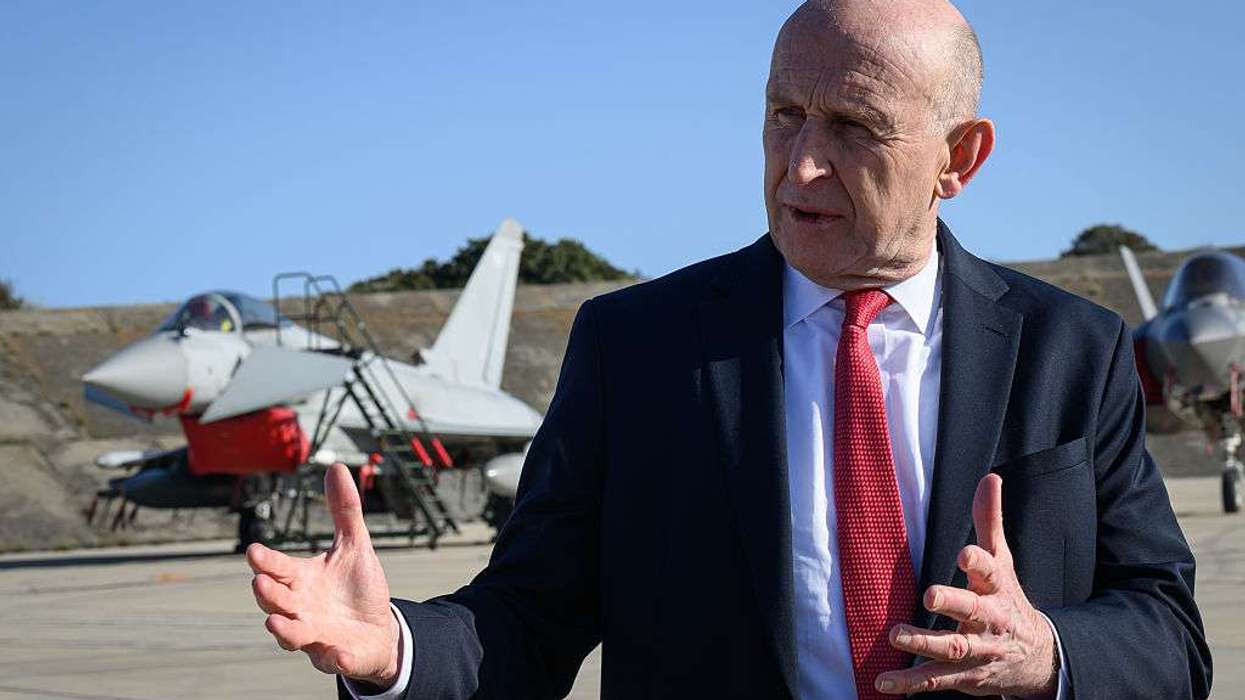 Defence secretary John Healey talks to media standing in front of a British typhoon (L) and F-35 jet at RAF Akrotiri on March 05, 2026 in Akrotiri, Cyprus. (Photo by Leon Neal/Getty Images)
Healey said an Iranian-made drone that struck Britain's Akrotiri air base in Cyprus on March 1 was being examined "for any evidence of Russian or any other foreign components and parts," with findings to be published in due course.
No one was injured in that strike. British warplanes shot down two further drones heading for the base the same day. Separately, UK troops stationed at a coalition base in Erbil, Iraq helped shoot down two Iranian drones on Wednesday (11).
Nick Perry, the British military's chief of joint operations, told Healey there were "definitively" signs of a connection between Russia and Iran, including Tehran's adoption of drone tactics learned from Moscow. Russia and Iran agreed last year to help each other counter what they called "common threats."
US president Donald Trump said at the weekend he had seen no indication that Russia was supporting Iran, but added that even if it were, it was not "helping much."
The British government said its focus remained on shielding people at home from the conflict's economic impact, pledging to "prioritise energy security, protect bill payers, and make sure people pay the lowest possible price at the pump."
(Agencies)