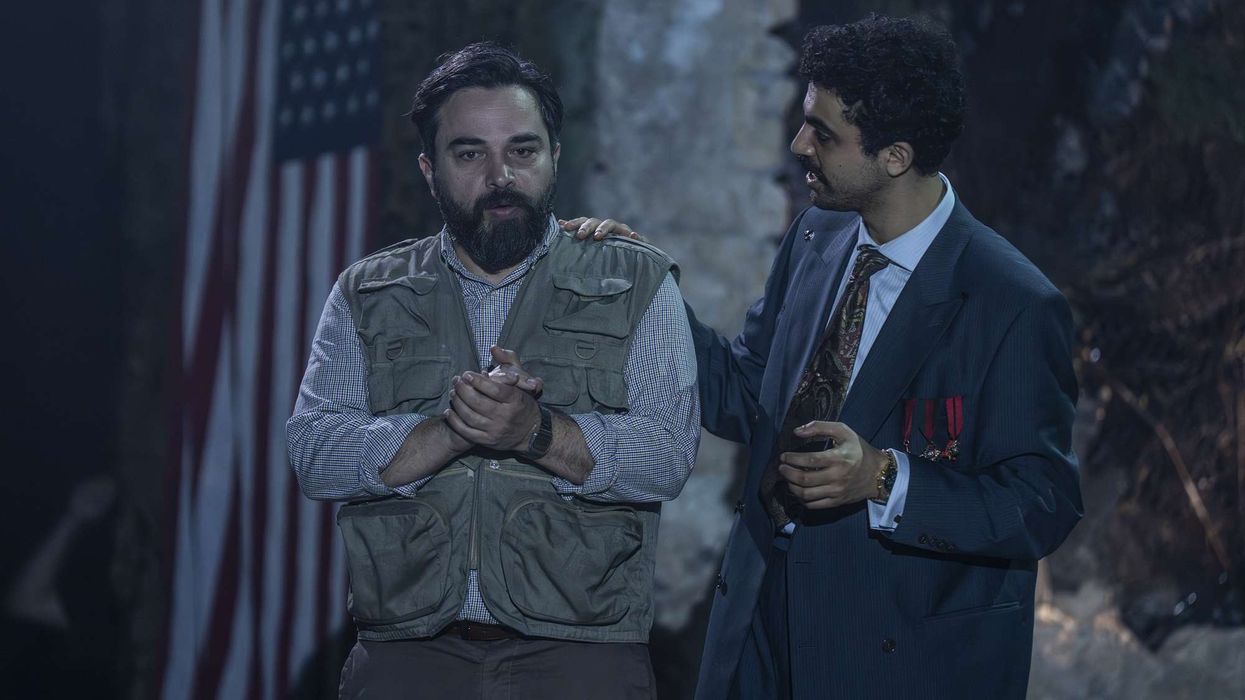

The Young Vic’s European premiere of Bengal Tiger at the Baghdad Zoo arrives with an already weighty pedigree — Tony nominations, Pulitzer recognition, a reputation for blending the tragic, grotesque and grimly funny. Yet seeing it staged in London in 2025, amid fresh global conflicts and new humanitarian crises, gives Rajiv Joseph’s play an even sharper sting.
Its world may be Baghdad in the aftermath of the 2003 invasion, but the wounds it examines feel brutally current.
Baghdad is burning, order shattered, and two American Marines — Tom and Kev — are left guarding a depleted zoo where only one tiger remains. The chain reaction set off by a single violent moment, when the tiger bites off Tom’s hand and is promptly shot, becomes the play’s strange and propulsive heartbeat. The tiger returns as a ghost, prowling through the city’s rubble in search of meaning, dragging the haunted Kev along in his wake.
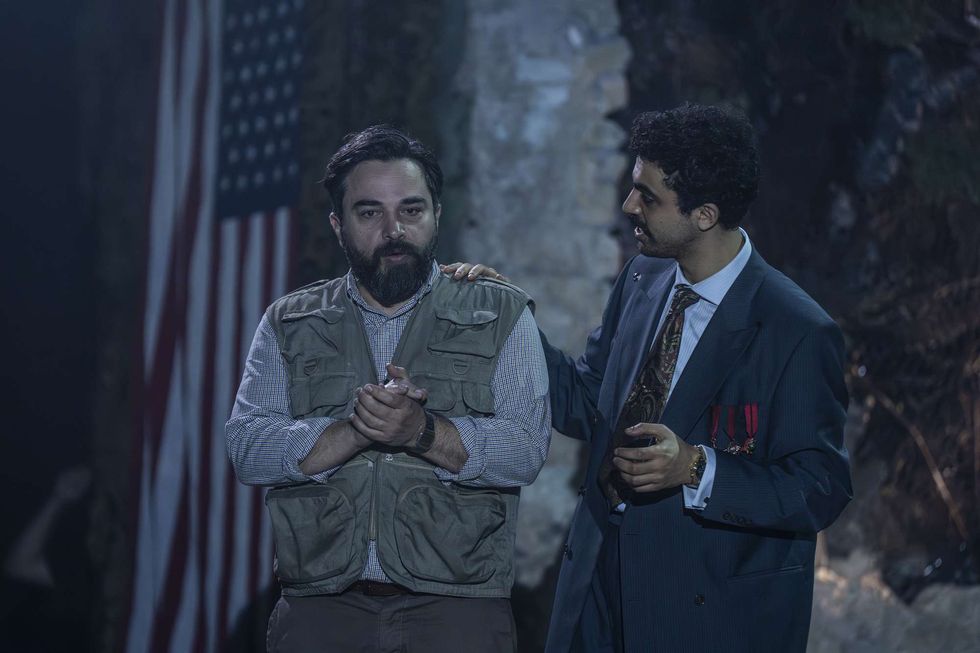 Ammar Haj Ahmad, Sayyid Aki ©EllieKurttz
Kathryn Hunter, stepping in for the ailing David Threlfall, embodies the spectral feline with wiry authority. Her presence is arresting, if slightly tentative — the mark of a last-minute rescue job is faintly visible (including an autocue) — but she lends the tiger a philosophical weariness that grounds even the play’s wilder turns.
The production gives equal weight to the Americans’ unravelling and the Iraqi characters’ trauma, with the strongest gravity coming from Ammar Haj Ahmad’s extraordinary performance as Musa, the translator. Musa is a man crushed between cultures, memories, and ghosts — most grotesquely, the swaggering spectre of Uday Hussein, played by Sayyid Aki with a jarring comedic edge that occasionally slips into Borat-esque parody. Ahmad, though, delivers the evening’s emotional core: layered, furious, aching, and fully alive.
Underneath the play’s spiritual wanderings lies an almost farcical treasure hunt: a missing gold gun and a solid-gold toilet seat coveted for their value. These absurd details, paired with the tiger’s philosophical musings, reinforce the senselessness of war and the ways humans cling to meaning — or loot — to survive.
Joseph’s writing is at its best when it leans into this absurdity; the comedy crackles in the darkest corners.
Yet the production is not without its fractures. The play’s structure is intentionally free-flowing, but it can feel less like a tapestry and more like a scattering of powerful moments stitched together without a fully coherent through-line. The absence of substantial female characters further weakens its emotional architecture — women appear only as ghosts, commodities, or afterthoughts, a missed opportunity in a narrative already so steeped in loss.
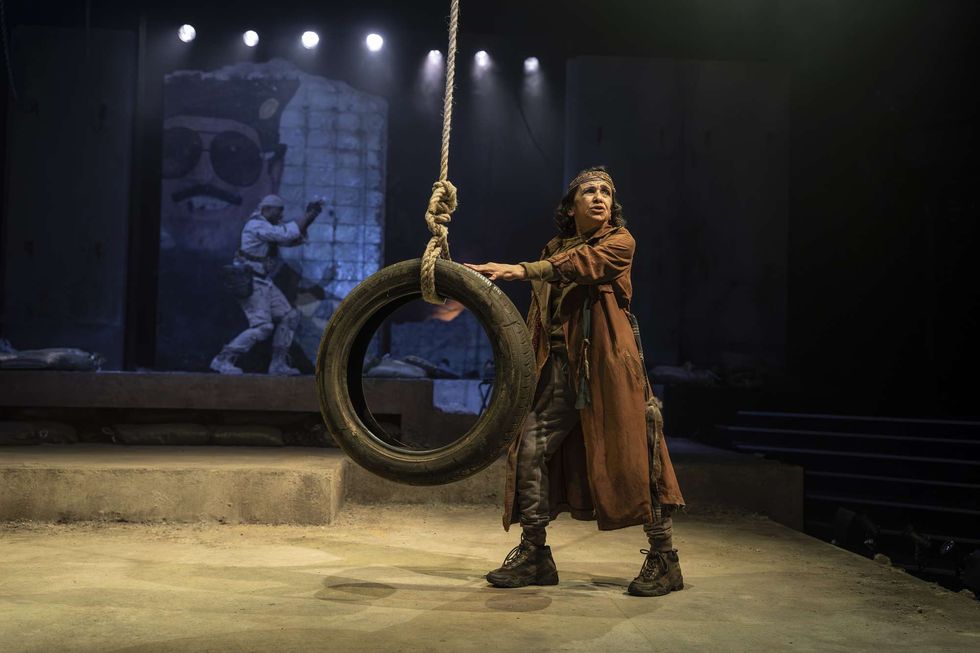 Kathryn Hunter, Arinzé Kene©EllieKurttz
Still, director and designers create a visceral environment: a stark, charred landscape enlivened by evocative sound and lighting that seems to pulse with the city’s unrest. When the play hits its stride, it becomes a surreal odyssey — part ghost story, part war chronicle, part existential comedy.
Bengal Tiger at the Baghdad Zoo will likely split audiences. Some will find its fragmentation frustrating; others will be drawn to its philosophical daring and its willingness to stare into the absurdity of violence without blinking. But for anyone seeking theatre that prods at the world’s open wounds and refuses easy answers, the Young Vic’s production remains a jagged, timely, and undeniably unique experience.
Bengal Tiger at the Baghdad Zoo at the Young Vic in London until January 31