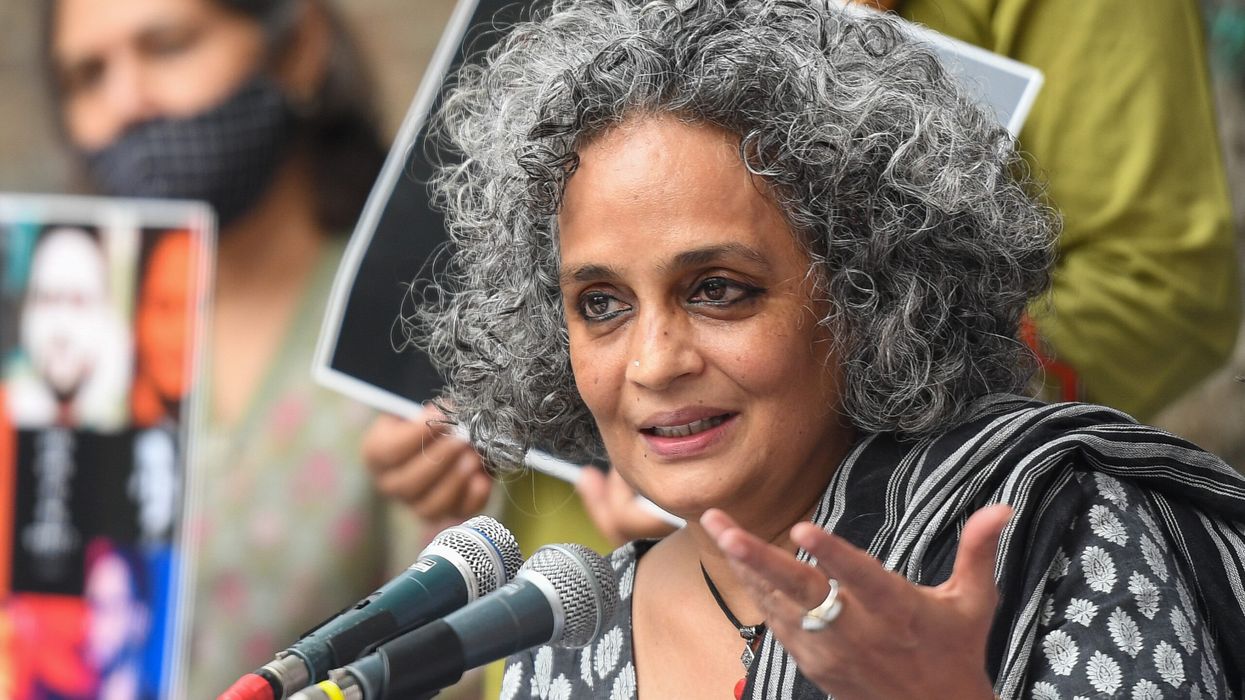

ARUNDHATI ROY’S forthcoming memoir, Mother Mary Comes To Me, is about the author’s close but fraught relationship with her mother, Mary Roy, whose death in 2022 her daughter has likened to “being hit by a truck”.
Mary Roy, who insisted her children call her “Mrs Roy” in school, belonged to the Syrian Christian community. She does not seem a very nice person.
The Financial Times, which interviewed Arundhati at her home in Delhi, reveals: “In an episode to which the writer makes oblique reference early in the book but withholds until later — because of the pain it caused — she returned from boarding school for the holidays, aged 13, to find that Mrs Roy had had her beloved pet dog, Dido, shot and buried as ‘a kind of honour killing’ after Dido mated with an unknown street dog.”
In 1996, someone tipped me off that a publisher had won an auction by paying £1 million for The God of Small Things by an unknown Indian writer. This was unprecedented for a debut novel. But the buzz among the bidders was that the novel was a possible contender for the Booker Prize.
As I was writing my story at the Daily Telegraph, the night editor, Andrew Hutchinson, leant over and quipped: “Writing about your sister again?” As we know, Arundhati Roy did win the Booker in 1997. I had actually met Arundhati two years previously when she had stuck up for Phoolan Devi, the subject of Shekhar Kapur’s movie, Bandit Queen, based on Mala Sen’s biography.
Phoolan had been repeatedly raped by upper class Thakurs (the men were later lined up in the village of Behmai and executed by Phoolan’s gang in 1981). The film was exploitative, claimed Arundhati, because for Phoolan, it was like being raped again. She wrote a piece in Sunday in Calcutta (now Kolkata), headlined, “The Indian rape trick”.
Mala arranged for me to interview Phoolan who was refusing to talk to Channel 4 which was making a documentary in India on the controversial movie. In public, she supported Arundhati, but behind the scenes did a deal with C4 which paid her £40,000.
The FT interview says Arundhati “left home at 16, putting the length of the subcontinent between her mother in Kerala and herself in New Delhi, where she was admitted as one of the few women students at the School of Planning and Architecture. ‘I left in order to be able to continue to love her, because I knew she would destroy me if I stayed,’ she says.