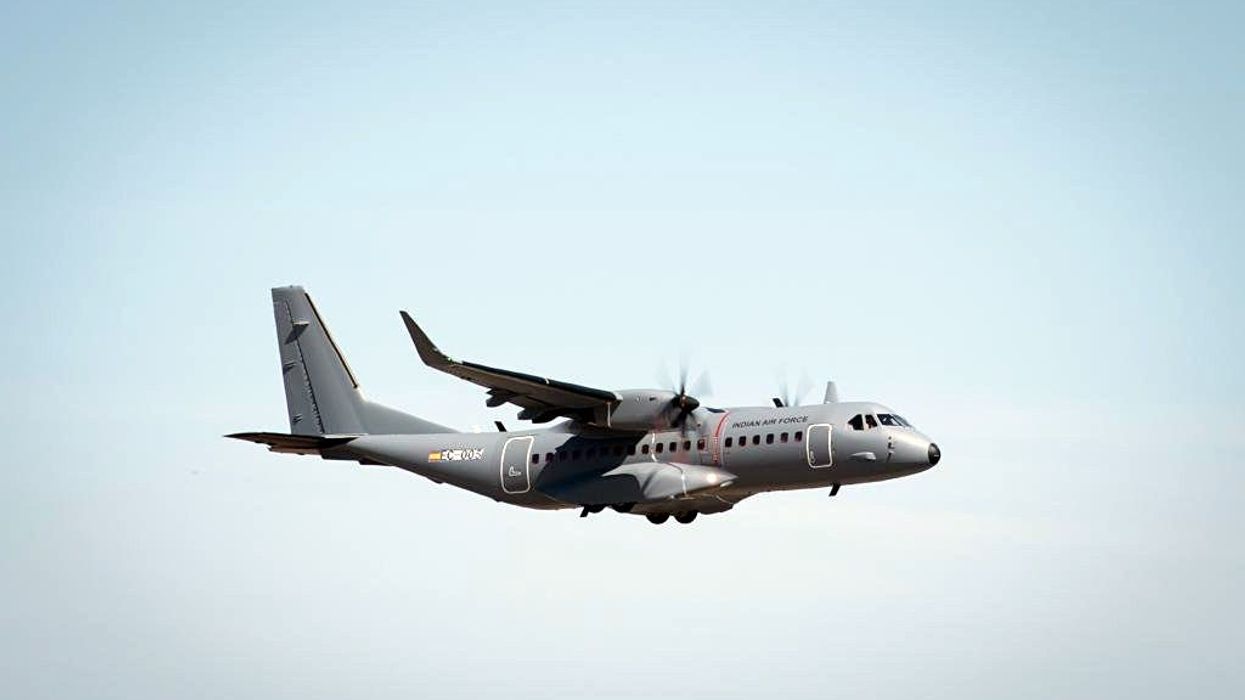
The first Airbus C295 aircraft built for India has successfully completed its maiden flight in Spanish city of Seville, in a significant milestone towards its delivery by the second half of this year.
In September 2021, India sealed a nearly Rs 210 billion (£2.03 bn) deal with Airbus Defence and Space to procure 56 C-295 transport aircraft to replace the ageing Avro-748 planes of the Indian Air Force (IAF).
Under the agreement, Airbus will deliver the first 16 aircraft in "fly-away" condition from its final assembly line in Seville by 2025 and the subsequent 40 aircraft will be manufactured and assembled by Tata Advanced Systems (TASL) in India as part of an industrial partnership between the two companies.
"This first flight represents a significant accomplishment for the first Make in India aerospace programme. With the Indian Air Force set to become the largest operator of the C295 in the world, this programme exemplifies our commitment to improve the Indian Air Force (IAF) operational capabilities," Jean-Brice Dumont, Head of Military Air Systems at Airbus Defence and Space said on Monday (8).
In October last year, Prime Minister Narendra Modi laid the foundation stone for the manufacturing facility for C295 planes in Vadodara.
Airbus said the C295 final assembly line being built in Gujarat is the first concrete, large-scale Make-in-India defence programme in the private sector that will unlock the industrial value chain of design, manufacturing, assembly, testing, delivery and maintenance of the complete lifecycle of the aircraft.
"This programme will significantly contribute towards developing the indigenous capabilities of Indian companies for an 'Atmanirbhar Bharat’ (self-reliant India)," it said in a statement.
The global C295 programme comprises 280 orders from 39 operators, the plane maker said.
The C295 is known to be a superior aircraft used for tactical transport of up to 71 troops, and for logistic operations to locations that are not accessible to current heavier aircraft.
The aircraft can airdrop paratroops and loads, and also be used for casualty or medical evacuation.
The aircraft is capable of performing special missions as well as disaster response and maritime patrol duties.
After the mega deal was finalised last year, Airbus said the C295 programme will see the company bring its complete bouquet of world-class aircraft manufacturing and servicing to India in collaboration with its industrial partners.
(PTI)
Airbus C295 built for India completes maiden flight in Spain
In 2021, India sealed a £2.03 bn deal with Airbus Defence and Space to procure 56 C-295 transport aircraft to replace the ageing Avro-748 planes of the Indian Air Force